
This article, prepared by Bush AgriBusiness and StoneX, explores the increasing volatility of beef prices, the effect this is having on industry profitability, what is causing the increased volatility and what producers can do to manage it….
Part 1: The Volatility Trend
Tom Copley & Ian McLean, Bush AgriBusiness
The recently released 2026 Australian Beef Report has identified that the volatility of beef prices is increasing over time and that this is causing increasingly volatile industry profitability.
While producers accept variability as part and parcel of beef production (and agriculture generally), readers and producers will have felt the effects of price volatility in recent years. The all-time, extremely high prices in 2022 were followed by a colossal slump to 20-year lows, which was then immediately followed by a return to above-average prices in subsequent years. Figure 1 (adjusted for inflation) graphs operating profit (earnings before interest and tax) per Animal Equivalent (left hand vertical axis) for the Top 25% Northern & Southern Producers against beef cattle prices (inflation adjusted EYCI on right hand vertical axis).
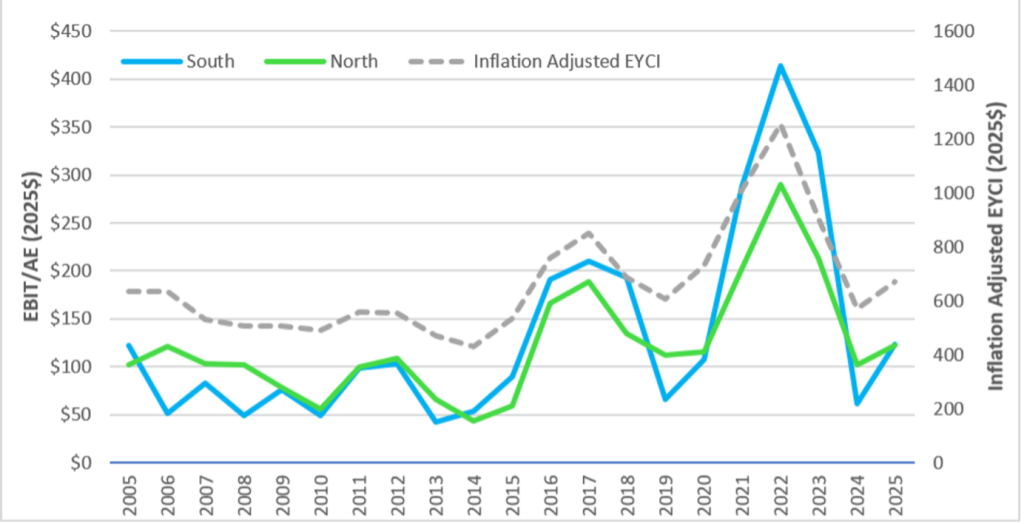
Figure 1. Source: Bush Agribusiness
Three trends can be seen clearly from the available data and this graph:
- volatility of beef prices is increasing over time;
- volatility of profits is also increasing over time; and
- there is a direct correlation between beef prices and the profit per animal unit. Over the 21 years of data considered in the 2026 Report, this correlation is over 0.9.
Empirical market forecasting data gathered from the Bush AgriBusiness Crystal Ball (generated by a mix of star signs, BoM forecasts and magic eightballs) suggested that what comes next in the market remains anyone’s guess.
However, this doesn’t mean the risks associated with this apparent volatility trend should be blindly accepted, and managers of profitable beef businesses will need to consider their options closely if it continues.
Operationally, this means increasing financial reserves, disciplined forage budgeting and management of stocking rates, all of which will support greater management flexibility. Of equal importance, as highlighted in greater detail in the previous article on the Australian Beef Report, is maintaining a low cost of production with expenditure targeted at creating more kilograms of beef.
It’s not flashy, and doesn’t win ribbons, but a consistently low cost of production (which avoids following a fluctuating market cycle) provides a stable platform for businesses to maintain and improve profitability despite market trends.
Part 2: What is behind the volatility trend?
By Ripley Atkinson, Australian Meats & Livestock Manager, StoneX
Cattle prices and industry financial performance, driven by price volatility, has shifted substantially in the past six years. As price volatility becomes a structural feature of the cattle market, there is potential for this challenge to continue. Figure 1 above depicts this very clearly.
The immediate reaction gives rise to two questions. Firstly, why are cattle prices becoming more volatile and subsequently influencing producer’s profitability? What can be done about this? Bush Agribusiness have pointed out cost of production and herd performance at an operational level as fundamental foundations to managing volatility, but today, I’ll look to address the two questions from a lens outside of operations and elaborate on some potential tools producers may wish to consider assisting in managing price volatility and risk.
In response to the first question, there is not one singular driver of why volatility in cattle prices has increased, but a combination of drivers, working in tandem across different market cycles to create the volatile moves in prices the market is experiencing.
Isolating time periods helps clarify and explain the drivers of this volatility. In January 2020 – January 2022, prices rallied at their strongest levels since the last upcycle of 2014-2016. The factors which drove this rally were a combination of:
- Record low interest rates;
- The drought breaking, which turned into successive strong seasons from 2020 – 2022;
- Low cattle supply, due to the herd’s liquidation during 2017-2019; and
- Record producer demand for cattle to rebuild herds.
Now consider the February 2022 – October 2023 period. Prices declined from earlier January 2022 peak to hit 20-year lows (after adjusting for inflation) in October 2023, creating the worst price crash in percentage terms since the beef crash in the 1970s. The factors which drove this included:
- The market “moderating” from its record highs;
- Drying seasonal conditions (particularly in 2023) for a short window in the middle of the year;
- Emotive reactions to weather forecasts across the beef supply chain, particularly at the producer level;
- Intense hype, scrutiny and fear mongering on social media channels around El Nino conditions; and
- Culminating in all of this was plummeting producer confidence, ripping a demand lever completely from the market which encouraged further downside pressure.
The two market cycles above are the clearest examples of the fact that there is not one singular driver which determines price volatility. Rather, it is a multitude of forces at play, working in tandem at the same time, to create the conditions for prices to be so volatile.
Managing price volatility
What other potential solutions are there to managing price volatility? For producers, outside of operational management (which Bush Agribusiness has identified), there are tools available within industry to assist in potentially managing price volatility, which ultimately means greater stability in terms of profitability of a business. These tools may be used by individual beef businesses as risk management or risk mitigation tools to potentially assist in managing exposure to price volatility at a market level.
StoneX, via its Feeder Cattle Forward contract, is endeavouring to provide a potential solution to help mitigate price volatility, which is available to the market all year round, even when direct forward contracts from buyers are inaccessible.
The physically deliverable forward contract, which targets feeder cattle of all categories and locations, underpinned by an independent index (reported by Argus Media) ensures that producers have access to forward contracts monthly, up to seven months in advance, all year round.
The intention of these contracts is to provide beef producers with a potential tool to assist in stabilising income throughout the year, mitigating exposure to volatility in the cattle market, which may adversely affect income generated from sales.
The forward contract tool StoneX is providing to the market is intended to be used as a hedging tool, providing protection and risk mitigation in the same structure, under a physically deliverable forward contract. By forward contracting at fixed prices on a portion of total turnoff, these types of tools can assist beef producers in protecting and stabilising their income against volatility in cattle market prices which ultimately influences their business financial performance.
Another option is to engage with purchasers of cattle and explore their willingness to offer forward contracts at fixed prices, and increasingly, at different stages of the cattle cycle, buyers are willing to offer these contracts to producers.
How a fixed forward contract can benefit, goes to the heart of stabilising income of the beef business, potentially mitigating some of the risks associated with volatile prices.
Risk mitigation at a price level is critical to supporting the on-farm, operational decisions and management producers are employing to further protect themselves against price moves which can damage profitability.
Views expressed are for informational purposes only, and not intended to be used for specific investment decisions. Past performance is not indicative of future results. StoneX Financial Pty Ltd (“SFA”) (ACN: 141 774 727) holds an Australian Financial Service License and is regulated by the Australian Securities and Investments Commission (AFSL: 345646)
HAVE YOUR SAY