

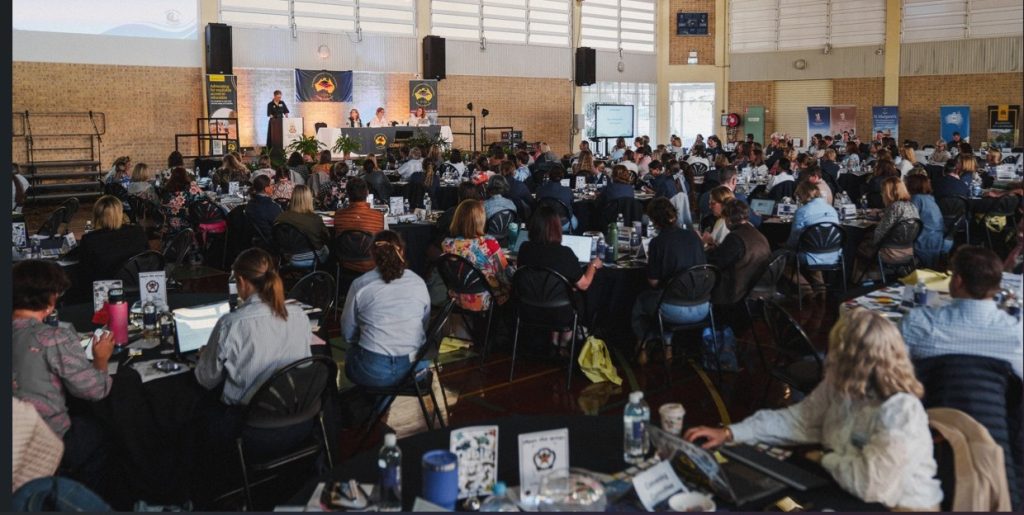
Delegates voting on resolutions at ICPA’s conference yesterday
THE growing inequity facing remote families forced to send their children away to school was a key topic discussed during the opening stages of the Isolated Children’s Parents’ Association Federal Conference on the Gold Coast yesterday.
More than 210 delegates from across regional and rural Australia came together for the conference, where the first day saw discussion focus on issues affecting the education of geographically isolated students. Many of the 100 motions were passed, including a number on this topic.
Delegates are calling for funding that better reflects the true cost of distance, with one Broken Hill family travelling more than 1100km to boarding school but receiving the same government support as families living just 56km away.
Proudly hosted by the ICPA Queensland State Council, this week’s conference celebrates the achievements and successes of the previous 12 months in advocacy, support and awareness for geographically isolated rural and remote students.
ICPA Federal President Louise Martin acknowledged the strong and powerful collective voice of over 210 attendees and delegates representing every State and Territory.
Conference motions and speakers on the first day covered wide-ranging topics across boarding and rural school access, communications and curriculum throughout distance education, specific education needs, student travel, tertiary education and training.
Specific topics included the importance and formal recognition and remuneration for Isolated Classroom Supervisors (RICS), as well as addressing educational disadvantage and ensuring fairness for isolated communities.
“You can see the common themes across the motions, we are a united voice,” Ms Martin said.
Delegates were also welcomed via a video presentation from the Regional Education Commissioner, the Honourable Fiona Nash, who highlighted the importance of the ICPA and it’s achievements.
Ms Nash noted since the 2025 Conference, through the motion and outcomes of the ICPA, that policy change happens, including changes in the recognition of Tertiary Access Payment (TAP) allowing isolated students who take gap years after completing their secondary studies before going on to university.
“That is a real win, and that has happened because of the advocacy from ICPA, for making that happen and getting the decision makers to recognise that there was a better way than what they had in place,” Ms Nash said.
“Ensuring that the views and issues are recognised. I commend the role of the ICPA in keeping myself and the Federal Government abreast of the challenges facing isolated students and it’s communications are by far some of the best that I receive.”
Conference delegate, Rebecca Pearce from Broken Hill, spoke of the inspirational sentiment in the room. With children attending boarding school in Tamworth as well as a son attending University in Gatton, Mrs Pearce acknowledged the inequality of support for GI students and would like to see a distance based loading added to the Assistance isolated Children Payment.
 “We receive the same funding support as someone who currently resides 50km from the boarding school. Yet we are more than 1100km from our boarding school. Whilst the system is currently equal, it is not equitable” she noted.
A delegate from Broken Hill branch, Mrs Pearce has a background as a qualified teacher herself, and will present a Motion today for a tier-based funding support system.
Federal council member and Queensland vice president Nikki Mahony presented the Partnership Report and Rural Schools Portfolio Report, recognising the valuable contribution of ICPA’s strategic and funding partners.
Her report highlighted the importance of these collaborative relationships in supporting the Association’s advocacy efforts, strengthening its capacity to deliver meaningful outcomes, and ensuring the ongoing advancement of educational opportunities for rural, remote and geographically isolated students and their families.
Early childhood
Members from the Bourke Branch of the ICPA raised an approved motion for improved access and utilisation of early childhood early intervention funding, currently managed through the NDIS scheme.
The South Australia State Council motioned to advocate the Federal Government, for increased training opportunities and rural placements and incentives for teachers and allied health professionals in order to improve access to specialist support for students with learning difficulties, who are not eligible for the NDIS in rural and remote areas. The motion was passed unopposed.
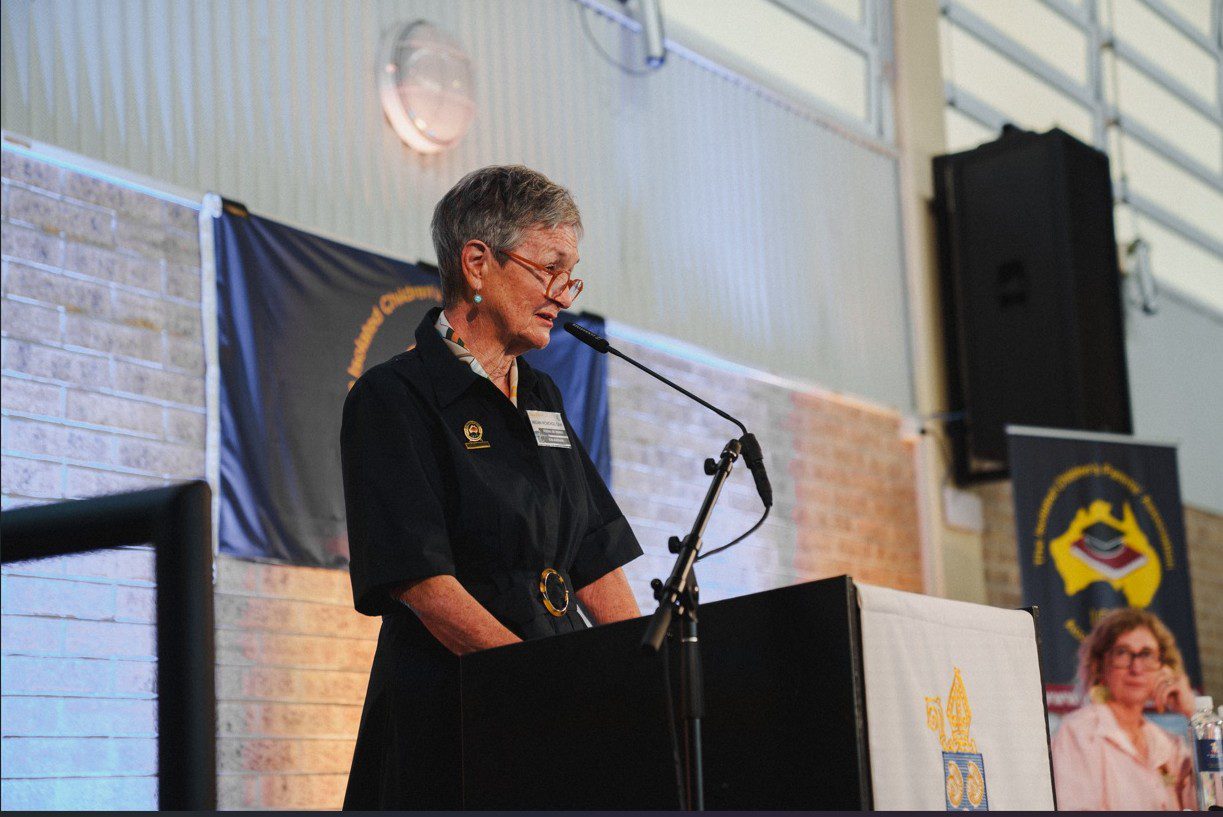
Queensland’s Megan McNicholl addresses the conference
National telecommunications provider and ICPA strategic partner Telstra led the afternoon session with a panel covering digital access, web safety, online literacy and resources and tools to support online learning.
Conference motions also covered isolated student travel accessibility issues such as long travel times and high flight costs for geographically isolated students. The ICPA confirmed motions that will see the ICPA continue to lobby airlines and key stakeholders including Qantas and REX Airways to implement student discount considerations for students travelling to school and compulsory face to face learning sessions from their rural and remote communities.
- The new ICPA Federal Council will be announced later today.
- A total of 100 motions will be voted on by ICPA delegates across the two days, with each motion carried then binding the ICPA to advocate for the carried issues.
There is an alternative to working on a farm and also to sending a child to boarding school. It comes down to an interwoven series of choices, wants and needs – including family, employment, education, opportunities and so on.
None of the choices are easy and they all involve a compromise – but it is not reasonable to expect that the government pick up the tab for what is fundamentally a private decision.
For a lesser outlay to get between home and school, move house, change schools, or both. There is no equity for the taxpayers who are asked to fund the gap.
Rural and remote communities made up of people of all ages are essential for the good functioning of the country, but it’s not fair to say the cost of travelling from them to school is unfair. The distance from the big smoke is a huge part of what makes bush living so good.
Your comment raises the old question of how much value the government places in having viable populations away from the concentrated coastal fringe, Angus. Cost of living in remote areas is exponentially higher than living in the cities. Apart from mining, the red meat industry (bush based) is one of the nation’s largest export dollar earners. Beef alone generates $20 billion in value annually, 70pc of which is export. Few other sectors come close. Drop decent levels of support for people living in remote areas, and the national economy is seriously compromised. Editor
Wow Angus North – just wow. Can you not see how that attitude is destroying regional and remote Australia? Families asking for equity in access to education for all geographically isolated families in order for this country to support the billions of dollars that primary production contributes to the national economy is not unreasonable. You also have the choice to really educate yourself on the subject before commenting. The ‘taxpayers that fund the gap’ are also the beef producers, the farmers, the truck drivers, the mustering pilots, the freight companies, the remote teachers and police, the nurses, the shopkeepers, the wildlife officers, the biosecurity officers… all these people rely on a healthy pastoral industry, and its not healthy if families cannot afford to educate their children. Do you REALLY want regional and remote Australia to be FIFO? Literally millions of dollars are pumped into remote and rural education strategies – asking for a small portion of that to be equitably directed to families trying to educate their children while they do the heavy lifting is NOT too much to ask.
Thanks Kerrie, I am well educated. I am also not ignorant to rural and remote life or living. And as a parent myself I understand that I must make choices not just for myself but for others.
Editor, I accept your point that beef exports are valuable and that they represent the end point of a value chain which starts in the bush. But just because one family leaves a farm to pursue education doesn’t mean farming stops – someone else will resume the farming. Turnover happens when other opportunities are chased down – the new people aren’t the old people but they’re usually still willing participants in their new society.
You will see from my final paragraph that I recognise that people are what makes communities; it is communities that keep the country ticking. I agree with you both, and with myself, that it is in Australia’s interests the rural and remote communities continue. However, I would prefer to see an expansion of services away from the coastal fringe and posit that, paradoxically, subsidising access to the coastal fringe’s services has the opposite effect.