
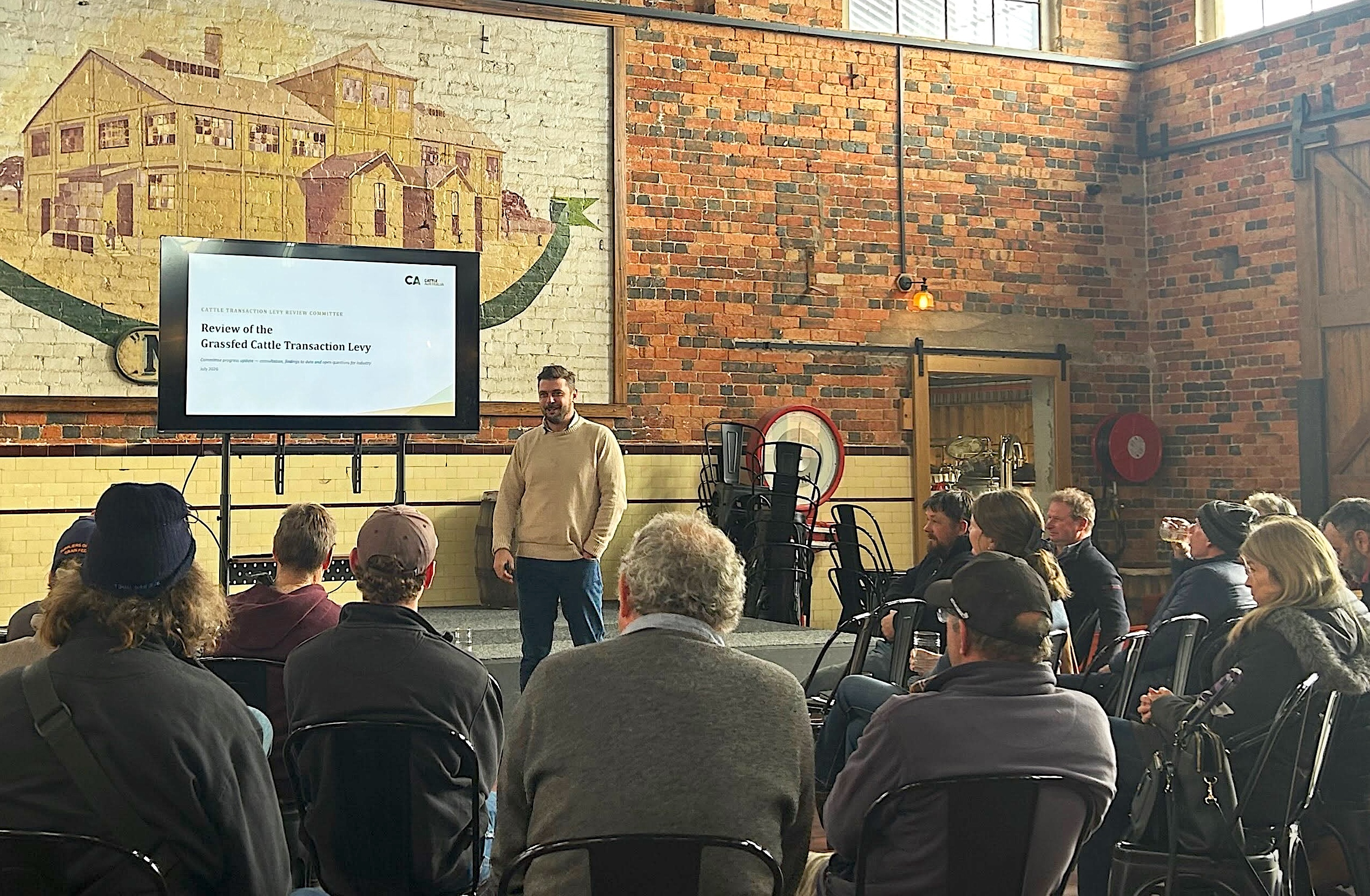
Cattle Australia CEO Will Evans addressing producers at Sale in Victoria during the levy review consultation phase of meetings.
AUSTRALIA’S $5-a-head grassfed cattle transaction levy has delivered value to producers over the past 20 years, but several current programs need stronger justification, the Cattle Transaction Levy Review Committee has concluded.
Its final report identifies market access, integrity systems and research funding leverage as the clearest areas in which levy investment has helped the industry.
The findings follow extensive consultation that gathered the views of more than 1000 grassfed levy payers across 34 regional meetings, a national online survey and additional company and group consultations.
“This analysis of past investments, grounded in consultation with levy payers revealed that, while there have been areas of frustration in some marquee investment areas, overall the levy has delivered value for levy payers,” the report states.
However, the committee’s analysis also concluded that not every program delivers equally strong benefits and current expenditure for several programs still require stronger substantiation.
In recommending that the $5/head be increased to $6/head from July 2028, the committee wants levy recipient bodies to demonstrate the value of their programs and increased transparency accountability to levy payers before the proposed $1/head increase takes effect.
Benefits created
The report noted that the industry is stronger now than it was when the $5/head levy was introduced 20 years ago.
Since 2009 the gross value of cattle production had more than doubled from $7.5 billion to $17.7 billion, beef exports had reached record volumes at 1.4 million tonnes, 13 trade agreements now covered 83 percent of red meat exports, and Australian beef now commands a premium of around $1.20 per kilogram over competitors, deemed to be worth about $2 billion a year across industry.
MSA, the eating quality grading system, has been estimated to return in excess of $320 million to Australian beef producers.
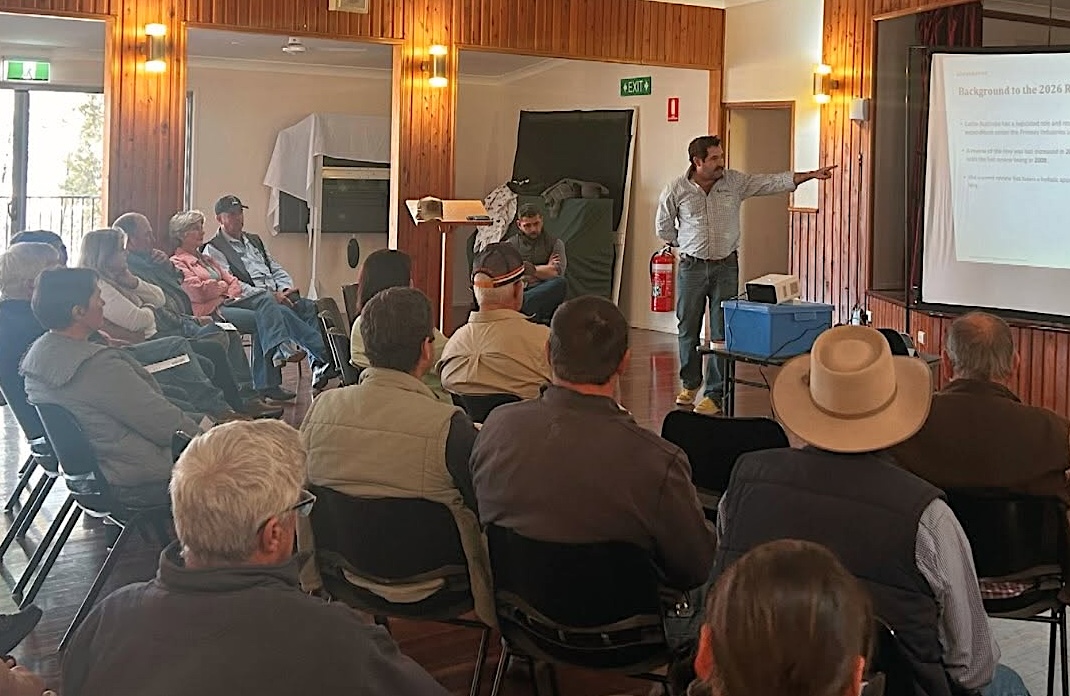
Cattle Transaction Levy Review committee chair Bryce Camm addressing producers at Bauhina in Central Queensland in July.
The work by the MLA Donor Company to leverage funding through Commonwealth matching contributions had significantly expanded funds available for industry research beyond producers’ levy payments. More than $400 million in commercial or external funds has been invested through the donor company facility since FY2012, alongside $548 million in research levy expenditure across the broader red meat sector.
Other benefits include integrity systems underpinning Australia beef’s global reputation and market access, biosecurity arrangements and protections, national residue testing, producer extension and adoption programs, genetic advancements and national market reporting and market information services.
These were shared assets that individual producers could not build alone.
However the report also cautions that not all gains identified could be attributed specifically to the levy alone, with factors such as seasons, exchange rates, trade agreements, global demand and private investment also shaping industry performance.
The report said the committee assessed the effectiveness of levy expenditure through a range of ways including historical benefit-cost evaluations, direct feedback from producer consultation and a comparison of industry performance in 2009 with today.
“It is the view of the Committee that at least some of this improvement has been assisted by investments made through the grassfed levy, most clearly in market access, integrity systems and the leverage of research funding.”
Marketing has delivered historical value but questions over future spend remain
International marketing had historically offered among the best returns from levy investment, and that historical investments have delivered significant advantages according to the report.
However, exporters now had a stronger presence and invested in their own brands in established markets, which made it harder to separate the contribution of collective levy spending from commercial investment.
The committee said the review supported the case for continuing collective investment in international marketing, but also raised questions about whether historical levy spending had now addressed some of the gaps it was originally intended to fill, and whether the same funding levels were still appropriate in mature markets.
This remained “a substantive issue for the industry to resolve”, the report said.
On domestic beef marketing, the review found that producers support its continuation, but the committee said clear benefits had been difficult to discern, while benefit-cost rankings had also been consistently low relative to other marketing investments.
As a result, the committee found there is not a business case to increase funding for traditional marketing activities.
“It is the Committee’s view that the case for increasing expenditure in International Marketing and Domestic Marketing today has not been made,” the review report concludes.
“While relative program spend has declined, this does not appear to have diminished Australia’s trade competitiveness nor had a negative effect on grassfed levy payers.
“The inverse of this is also true, in that a clear benefit of what an increased allocation would provide in returns to grassfed levy payers is not available within the current data.”
Beef Central understands the committee has not ruled out more investment in the future, with a key message being that the case for more funding could be made, but would need clearer evidence of what that investment actually delivers.
The committee is therefore recommending that each levy recipient body assess all programs, justify their current value and publicly report the results before approval of FY2027/28 budgets and the proposed $1/head levy increase from July 2028.
Proposed new method to evaluate levy investment decisions
It also recommends the introduction of a new system of evaluating future levy investment decisions which would compare what is intended to occur with what would occur without the expenditure.
Or, put another way, it would estimate “the demand position with and without the funded program, rather than crediting the program with everything that happens while it runs”.
Despite recommending against an increase in funding for traditional marketing activities, the committee has still recommended increasing the marketing levy allocation from $3.66 to $4.35 per transaction.
Why? The report states the additional funding would support communications, capability building and integrity systems increasingly draw on those funds.
“Today, $0.87 in each $5.00 transaction is diverted away from what are the commonly perceived purposes of the levy,” the report said.
“These are program areas that have evidenced successive and consistent demand over time, providing support for the likelihood that they are unlikely to decline in significance into the future.
“Additionally, there are many activities that MLA is assumed to undertake that fall broadly under the category of industry representation, that are simply not occurring or being resourced at this time.
“These essential activities give a clear demonstration of ‘market failure’ and require prioritisation under the levy system.”
Research value and challenges
On the question of research investment, the review found that levy expenditure had delivered value to the cattle industry, particularly by attracting additional commercial and government investment.
However, it also found that research projects did not always reflect producers core needs, with concerns that priorities can be influenced too heavily by existing organisational structures rather than broader producer requirements.
Producer engagement and adoption also remained below desired levels, while the report also highlighted issues around every-increasing delivery costs and commercialisation challenges.
The report acknowledged that low uptake is also at least partly due producers’ capacity to implement change rather than a lack of merit in the research, and that benefits across different production systems can be difficult to definitively measure.
It also emphasised a need for more effective priority setting and improved producer engagement and processors to translate investment into more concrete benefits on-farm.
The review concluded that additional investment was justified and recommended increasing the minimum R&D allocation to $1.12 per cattle transaction.
The overall finding from the report was that the levy has delivered benefits, but stronger accountability and clearer evidence of actual returns are needed to guide where investment expenditure is directed next, before the planned $1/head increase by July 2028 is introduced.
To view the full report – 2026 Cattle Transaction Levy Review Final Report and Recommendations – click here
HAVE YOUR SAY