FROM the outside, Darren and Len Henschell’s cattle operation in Southern Queensland seems pretty modest. The father and son own 100 cows and have spent most of their lives working on the killfloor at the Oakey meatworks.
But to look at the leaderboard of the Wagyu section at last week’s Paddock to Palate competition, the cattle bred by the Henschells are anything but modest. Their pen of seven fullblood Wagyu were clear winners, with Gina Rinehart’s Hancock Agriculture coming second and third.
The family, whose property is at Moola in Southern Queensland, have been entering the competition for eight years now. However, the limitations with their herd size means they can only enter the competition every second year.
Big Wagyu cattle are now marbling
One interesting part of the Henschell’s Wagyu win was the fact that they managed to rate highly in the carcase and eating quality parts of the competition, while also posting the highest average daily weight gain.
“You heard Joe Grose (3D Genetics) just talk about how Wagyu genetics have changed. Years ago, big cattle did not marble but big cattle are marbling these days with better genetics,” said Darren Henschell.
“Normally we win a few prizes on the carcases but not the weight gain, but everyone now knows that Wagyu can grow as well as marble.”
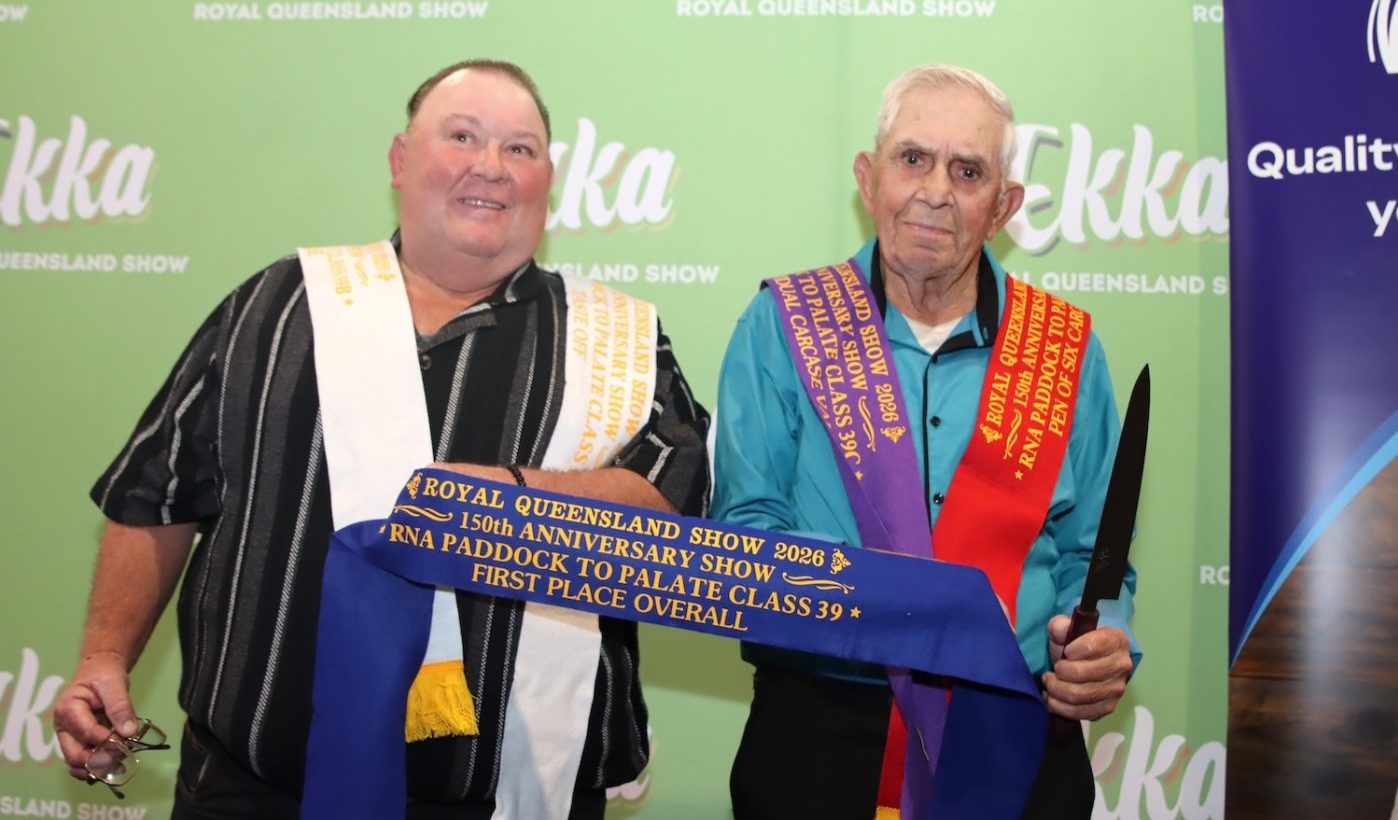 LA&DL Henschell winning pen of seven class 39 Wagyu
The Henschell’s received ribbons in just about every part of the class. They came third in the carcase section (behind the two Hancock entries) with a score of 585.575. They came second in the carcase value competition (behind Hancock) with a score of 106. They won the individual carcase value competition with a score of 20. They came third in the taste off competition with a score of 93, a section Hancock did not feature in. And they won the weight gain, for which Hancock also did not feature.
Looking at averages across the Henschell’s pen of seven, hot standard carcase weight was 458.86kg, P8 fat depth was 22.3, a camera marble score was 10.6, marbling percentage was 36.1, camera EMA was 139.65 and fineness of marbling was 5.64. The average carcase value was $7624.
Seeing Wagyu cattle on the chain
This year was the first time the Paddock to Palate competition made a Japanese carving knife, worth about $500, part of the prize. While it was a novelty for the competition, it made the Henschells a fitting winner – with both Darren and Len having spent a lot of their working lives at NH Foods Oakey meat works.
Len has been working there for 55 years and has the scars on the hand to prove it. Although the below injury was not sustained at the meat works.

Len Henschell.
He says he first picked up the idea of breeding Wagyu while watching them go past him while he was operating the scales. He then decided to purchase a bull from Wagyu pioneer Dr Simon Coates – who passed away in 2020.
“He bought four or five Wagyu full blood cows, the rest were just Angus cows, and we just kept building them up and building them up. We started flushing some cows and putting the embryos in the Angus cows,” Darren said.
While building up the Wagyu herd, Len would work the morning shift at the meatworks and Darren would work the afternoon shift – both using their spare time to work on the farm. They moved onto the farm full-time about 10-years-ago.
Darren said Wagyu genetics specialist Alan Hoey has been one of their main advisors, especially helping them identify which bulls to buy.
“The main thing we have learnt is that you need to cows that milk, because they have to produce a calf.
“Little Wagyu cows don’t have a lot of milk, but your growth cows have milk, so you have your growth cows around your progeny and your marble bull over top of them.”
Choosing the animals on genetics
Darren said the entry into this year’s paddock to palate competition was selected on proven genetics the family had bought in.
“Three of them were by an Arubial United bull, another one was by Wyndford Itoguni 308 and the seventh steer was by our own bull,” he said.
“I kept all the females out of the same lot. The quickest way to find out if they are worth keeping is to put their brothers in the feedlot and if they don’t marble than there is no point keeping the heifers.”
Staying on merry-go-round
All the Henschells cattle are sold directly to Lillyvale Feedlot, owned by current chair of the Australian Wagyu Association Laird Morgan.
Len says the marketing strategy is simple.
“Laird just says to send the bastards in.”
One of the main attractions in trying to hit the top specifications with fullblood Wagyu was to get a consistent premium on the cattle. Darren said the main advice they consistently receive is to stay on the merry-go-round of Wagyu.
“F1 Wagyu goes up and down like a yoyo, but full bloods often stay in a standard range.”
Feeding them on good country
Darren said another key to the family’s success is having the ability to graze cattle on high-quality brigalow-belah country.
“We are not supplementing our cows and calves, we are not creep feeding or feeding them on bunks, but we are still getting good results,” he said.
“I think that is because we are on good cattle country. All our cattle are fed on cultivation and not pasture – it is always forage oats or forage sorghum. Every mouthful they get is quality.
“Brigalow is a natural legume and the cattle do really well. Even in some of our paddocks where there is not much feed, the cattle look prime.
“If you take them and put them on ironbark country and try do the same thing, you just can’t because the goodness is in the ground.”
HAVE YOUR SAY