
ANALYSIS of ten years of commercial cattle business benchmarking data suggests that moving from the existing flat $5-a-head transaction levy to a percentage-of-sales levy would shift more of the levy burden towards cattle-growing and trading enterprises.
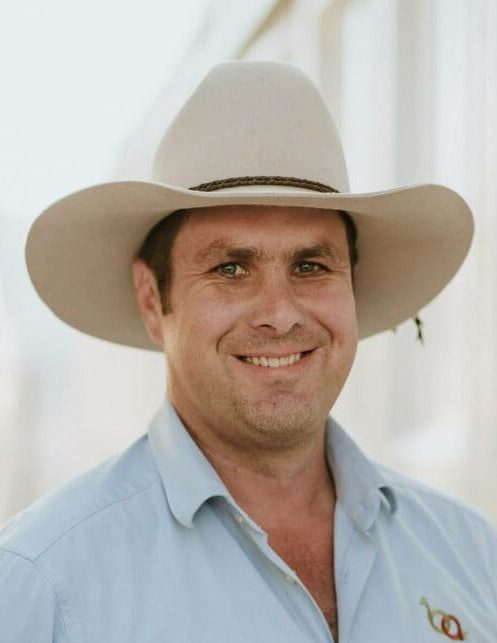
Ian McLean, Bush Agribusiness Managing Director
As part of its review of the Cattle Transaction Levy, Cattle Australia is asking producers to consider whether the collection mechanism should remain a flat, fixed-rate levy per head, as it currently is at $5/head, or change to a levy calculated as a percentage of an animal’s value.
On behalf of Beef Central, Bush Agribusiness director Ian McLean used ten years of anonymised financial data from more than 100 commercial cattle breeding and trading enterprises to compare what their payments would have been under the existing $5/levy versus what they would have been under a percentage-based levy.
The analysis covered an average of about 130 commercial cattle enterprises each year from Bush Agribusiness’ commercial producer client base.
Just under two-thirds were self-replacing breeding businesses, while the remainder were growing or trading enterprises that bought cattle and added value through weight gain.
Any client with mixed breeding and growing businesses and seedstock operations was excluded from the analysis.
Mr McLean said that under the existing $5-a-head levy, payments averaged 0.54 percent of cattle sales revenue for breeding enterprises and 0.41 percent for growing/trading enterprises.
Why was the proportion higher for breeding enterprises?
Mr McLean believed that was reflective of the lower average value of the cattle they sold.
“This is a function of breeding herds selling, on average, lower value animals than the growing businesses,” he said.
Because the same $5 levy applied regardless of an animal’s sale price, it accounted for a larger share of the value of lower-priced cattle.
However, the result is reversed when the levy is measured against the number of cattle carried or kilograms of beef produced.
“By their nature, the growing enterprises turn over more cattle each year than breeding enterprises.
“The number of head sold each year as a percentage of average head carried averaged 111 percent for the growing enterprises compared to 45 percent for the breeding enterprises.
“Therefore, growing enterprises paid a higher total levy than breeding enterprises, averaging $5.54 per average head carried each year compared to $2.24 respectively.”
“Looking at it another way, the levy added $0.02 in costs per kg produced for breeding enterprises and $0.04 for growing enterprises.”
The analysis also modelled a levy set at 0.5pc of sales revenue, broadly reflecting the average proportion of revenue absorbed by the existing levy across the 10-year period.
the flat rate levy: it’s not perfect but it’s simple, it’s easy to budget, and much fairer than any of the alternatives.
– Rolleston, Qld, producer Ian McCamley (more comments below)
Under that model, the annual levy paid per average head carried by growing enterprises would rise from $5.54 to $6.84 – an increase of about 23pc.
For breeding enterprises, it would fall from $2.24 to $2.07, a reduction of about 8pc.
For growing enterprises, the cost per kilogram produced would increase from $0.04 to $0.05.
It would remain at approximately $0.02/kg for breeding enterprises.
Ultimately the modelling highlights that the question of which levy structure is more equitable could change depending on the measure used.
For example, this analysis suggests a percentage-based levy would mean all businesses paid the same levy rate on the value of the cattle they sold.
However, it would widen the difference between breeding and growing enterprises when measured against average cattle-carried or kilograms- produced.
The existing flat levy places a higher proportional charge on the sales of breeding businesses which on average are selling lower-value cattle. But growing enterprises under a flat rate levy pay more relative to their operating scale because they turn over more cattle.
Discussion paper raises questions about levy collection mechanism
A discussion paper released by Cattle Australia as part of the levy review consultation process raised the levy collection mechanism issue and the question of whether the industry should consider switching from a flat-rate levy to an “ad valorem” or percentage-based levy.
“(This) could offer greater equity to industry members, especially during times of drought,” the paper stated.
“This could also be considered a more modernised approach to levy collection, given the separation of the value of certain production system units becoming far more distinct and the industry less homogenous than 20 years ago.”
“There are arguments in favour and against this model, with careful analysis of how to position this percentage value to ensure usability, equity in creating top and bottom price limits and other considerations needing to be made prior to this concept being fully presented to industry. However, feedback is being requested from industry members around preliminary responses.”
CQ producer has serious concerns about equity under percentage-based levy
One producer who has raised serious concern about a switch to a percentage-based levy is Ian McCamley from Rolleston.
Mr McCamley, who runs a growing and trading business, says his own analysis suggests a percentage-based levy would advantage cattle breeders to an even greater extent than he believes the existing flat rate levy already does.
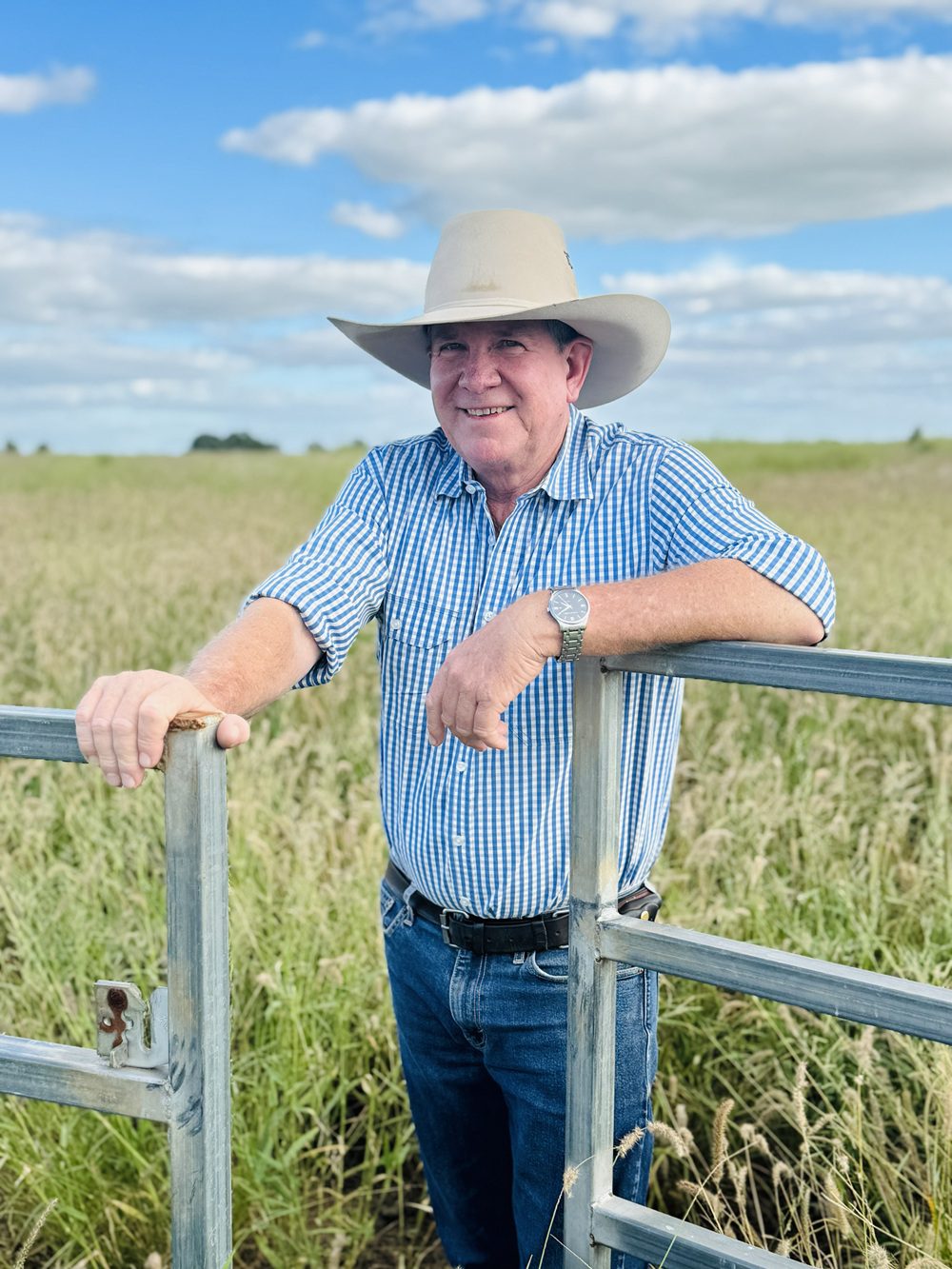
Ian McCamley. Picture: AgForce
He provided the following explanation to support his view:
“Under the current flat rate levy system, a bred animal sells for $1000 and a $5 levy is paid out of that $1000. A backgrounder buys the animal for $1000, grows the animal and sells it for $2000. A further $5 levy is paid by the backgrounder out of the $1000 gain. A finisher buys the animal for $2000, and finally sells the finished animal for $3000. The finisher pays the final $5 out of the $1000 gain. $5 paid for each $1000 in gain seems very fair and is very fair. A total of $15 in levies paid on a total of $6000 of sale value of the animal being sold three times at $1000, $2000, and $3000. To get that $15 from a percentage-based levy it would need to be set at 0.25pc as 0.25pc of $6000 is $15. So, the breeder breeds the same animal to again sell for $1000 and now pays only $2.50 for creating $1000 in value. The backgrounder buys the animal for $1000 and sells it for $2000 after adding $1000 in value. They pay $5 for adding their $1000 increase in value. The finisher buys the animal for $2000 and sells it for $3000 after adding $1000 in value. They now pay $7.50 for adding that $1000 in value.
“This I believe is why the industry has the flat rate levy, it’s not perfect but it’s simple, it’s easy to budget, and much fairer than any of the alternatives.”
Mr McCamley also points to a further reason that he believes exacerbates the disparity –
the compounding effect of higher turnover as one moves from breeding to backgrounding and finishing.
“The backgrounders and especially the finishers (Feedlots and Oats fatteners etc) would not only pay a higher amount per head, this higher amount would be compounded by their higher turnover.
“It’s been 31 years since the industry moved from a slaughter levy to a transaction levy. The transaction levy has always been set at a flat rate. This is not because no one has ever considered and debated any other method. I would argue that three decades ago the industry was more engaged, informed, and had much more robust debate than it does today.
“Back then the cattle industry participants got their information from a limited number of rural newspapers, the ABC radio, and regular well attended meetings.
“Today we see fragmentation and a top-down policy push occasionally sugar coated with information sessions, rather than structured bottom-up policy development.”
Percentage based levies are not new, this principle has been used for sheep and lambs as far back as 2008. If levies were based on a percentage of the gross value of a beast with a ceiling of $5.00 a smaller producer with less than 250 head would pay a 0.5% levy on a $1000.00 young beast and would attract 1 vote for Cattle Australia voting, if a larger producer with 10,000 head or more were to sell a $3,000.00 beast he would pay approx. 0.16% levy and would attract 12 votes for Cattle Australia voting, so we have a levy payer paying the largest levy getting the least votes, hardly fair. We need to correct the imbalance where every levy payer is paying the same percentage and has the option to become a member of Cattle Australia for one year and receives one vote. MLA has less than 5% of compulsory levy payers voting at AGMs etc. I believe Cattle Australia have less than 2% of levy payers as members. There are about 55,000 grass fed levy payers and if we don’t attract them with a fairer system we will get more of the same old, same old problems!!! For the industry to have any chance of being successful there are 5 clear points.
– Necessity forges unity.
– To achieve unity, you must have consensus.
– To achieve consensus, you must have participation.
– To achieve participation, you must have democracy.
– To achieve democracy, participants must have an equal vote.
Our profitability is underpinned by productivity which depends on good R&D
Unfortunately R&D is expensive but various studies indicate extremely good returns to R&D investment
Are we distracted by the small things rather than seeing the big picture?
The GRDC grain levy is 1.02 % which is double what we are taking about giving GRDC a big war chest to invest in productivity
We also ignore the study of agricultural policy when policy uncertainty ( governments implementing and changing policy with little if any consultation with producer stakeholders ) is one of our biggest risks and will continue to be so ( eg EPBC Act)
KISS – keep flat rate!
the $5 amount is not our biggest threat. the gaping hole we have as opposed to an American cattle association is we’ve got no bite. there are too many organisations which is what they want so when an issue arises where our position should be no or yes. we are comprised by the fact of division and secondly our mla is paid off by tye government of the day. we are where we are on alot of regulatory issues because our groups are conflicted. when has the mla or bodies under stepped up and pushed back or caught to remove regulation burden. cheers Matthew Della Gola
I could not agree more on the informed producer comment.
ABC rural today is a very pale shadow of 20 yrs ago
Industry leaders have taken too many policy development short cuts so small and medium producers feel very marginalized They are then feel there is no point travelling to a meeting when “they have already made the decision”.
Industry leaders
Many enterprises in the bigger western holdings not only breed, but grow out bought stock as well to iron out fluctuating numbers related to different seasonal conditions. It is only a minor issue in terms of other costs, especially transport. I wouldn’t get too worried about it.
I am out of the industry now so my opinion should have no bearing.The third best rate is flat rate;second best rate is flat rate;perhaps we need AI to tell us the best rate.