
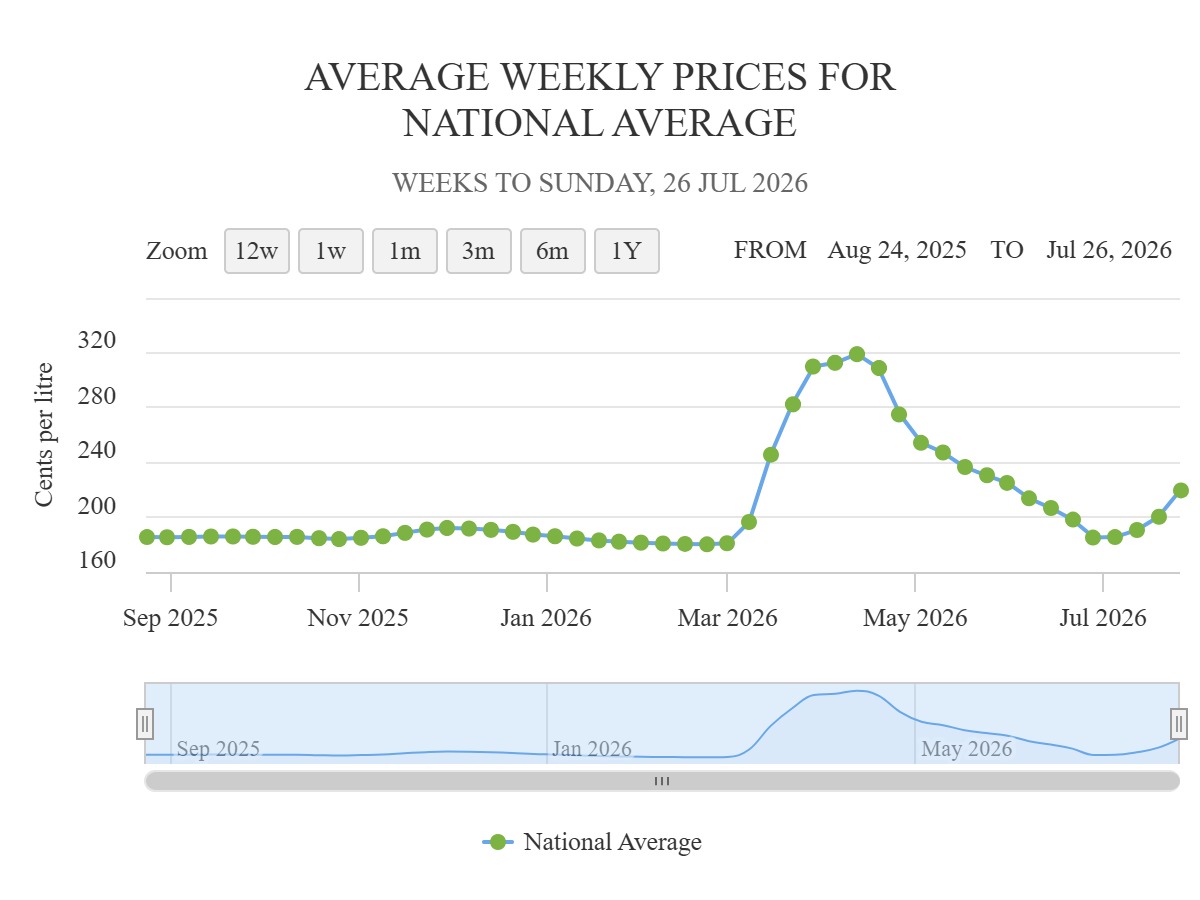
Australian Institute of Petroleum average week diesel prices for the past year.
AS fuel prices increase in again in Australia and war rages on in the Middle East, getting a good picture of what is happening has been tough.
If recent conversations at industry events are anything to go by, the fuel market has moved too quickly for many to keep with.
With Beef Central being in the same boat, recently caught up with RaboResearch Australia/New Zealand general manager Stefan Vogel who gave a brief overview of how global conflicts are still putting pressure on oil markets.
Why have prices again increased in Australia?
 According to the Australian Institute of Petroleum, average pump prices for diesel jumped 63c in Australia between the start of July and the start of August – far more than the 16c increase in the fuel excise that came online at the same time.
Asked why the increase went so much further than the increase in taxes, Mr Vogel said the tax coming back online collided with tensions flaring in the Middle East and the Strait of Hormuz again being shut.
“Markets are not trading what we have on the ground. Markets are trading the expectation of what is the supply for the next couple of months,” he said.
“The expectations of likely harder to get volumes in the future makes local inventories already more valuable.”
World depending on China
Mr Vogel said moves from China to limit its imports of oil have played a huge role in stabilising the market.
“China is the largest crude oil importer in the world and they suddenly imported 40-50pc less than normal, which is ginormous and people have no idea how they did it,” he said.
“There are people who try to explain it with electric vehicles, but for me that isn’t an explanation because then it would be a gradual decline. It wouldn’t just drop like a rock.
“The assumption is that China has massive reserves of crude oil in the country. They are taking their local reserves and the question is just how long they can keep on doing what they are doing. Basically, how long can they save the world’s economy?”
Mr Vogel said he believed China has made such drastic moves because they are the world’s biggest exporting country and they wanted to make sure their markets remained strong.
What is happening with the Strait of Hormuz?
When the US and Iran signed a Memorandum of Understanding in the middle of June, the Strait of Hormuz re-opened and the ships waiting to cross it were able to pass through.
However, that MOU collapsed about a month later and the strait was closed again. Although US president Donald Trump says it is open, barely any traffic has been passing through there.
Mr Vogel said insurance cost has also limited ships moving through the Strait.
“Even in that time when we have seen ships coming out, not a lot of ships happily went back in,” he said.
“This insurance is very expensive, so not a lot of shipping companies would have moved ships back into that Strait of Hormuz area.”
Mr Vogel said markets were starting get a bit more confident in the Strait of Hormuz before the war flared up again.
“The market was a little bit lacklustre, thinking ‘we’ll get volumes out of the Strait of Hormuz again because Mr Trump and the Iranians had signed a deal’, so the crude oil price dropped to 80 cents and the diesel price was low,” he said.
“But then very quickly we actually moved the other way around.”
Why did the fuel market calm down so quickly?
Fuel prices spiked quickly when the war started in March, before the market started to steadily drop in April. One part of that was the Federal Government suspending the fuel excise, another big part was international oil markets heading in the same direction.
Mr Vogel said many of Australia’s big suppliers of fuel in Korea, Singapore and Malaysia have surprisingly been able to access oil.
“About a quarter of what didn’t get through the Strait of Hormuz actually somehow made it out of that area,” he said.
“There are some pipelines that can bypass the Strait of Hormuz. That was about a quarter. Another quarter was all the strategic reserves that were released by multiple countries, the International Energy Agency released quite a bit of that. But the real surprise in the world market was China.”
Australia feeling it more than most
Mr Vogel said while the Government has demonstrated that it can get access to fuel, Australia is more exposed to the fluctuations in fuel prices than most other countries due to our low stockpiles of fuel.
“Be it the US, Brazil or Europe, everybody had better fuel security than we did,” he said.
“We have paid substantially higher prices, or at least the difference from pre-war levels to the top and then back down, was much stronger in Australia than in pretty much any of the big other grain and beef producing nations in the world.”
Clearly it is a good time, the right time to buy an electric vehicle.
They are far cheaper to service and run than ICE vehicles.
Many EV options are available for the same price as an ICE vehicle.