
By splitting international beef production into two groups market analyst Simon Quilty has identified a widening gap in global beef supply – one that has also prompted a clear prediction on where he thinks Australia’s feedlot expansion will eventually come to a halt.
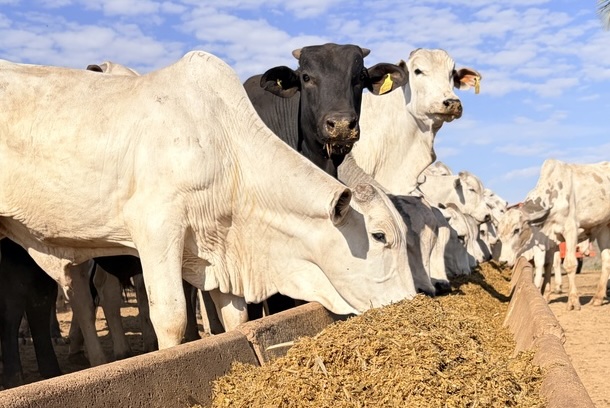
Beef cattle feedlot intensive production system, high technology in animal nutrition, modern livestock farming
TRYING to get a sense of the global beef cattle supply and demand situation and what the future holds?
Here’s a different way to look at it, offering a deeper picture than national cattle numbers alone.
Market analyst Simon Quilty
Recently, while preparing an extensive analysis report for a large Australian beef supply chain, the Global Agri-trends market analysis team of Simon Quilty and Brett Stuart tried a different approach.
They divided the world’s beef production into two populations broadly along quality lines – those with largely Bos taurus production and those with Bos indicus-dominated production.
This is not a definitive census of cattle production in each country, but was chosen for simplicity to highlight the general position each country occupies on the global quality versus commodity beef spectrum.
On one side, they grouped countries with significant levels of Bos taurus cattle production, including Australia, Argentina, USA, Europe, Mexico and Canada.
On the other side, they included those with large Bos indicus-dominated populations, including Brazil and India.
Bos indicus surpasses Bos taurus in global herd
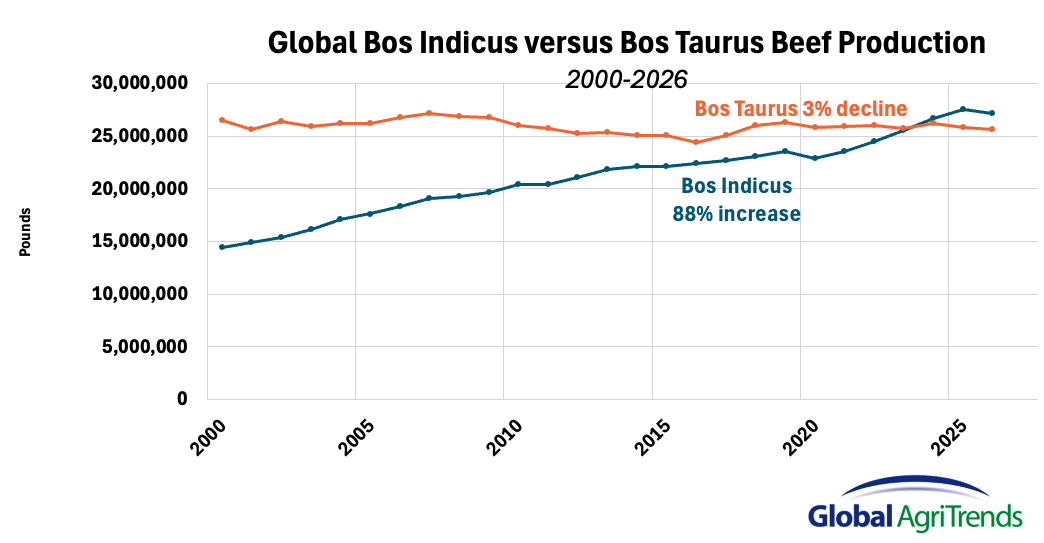
The analysis revealed a significant trend – it showed a long-term, gradual decline in Bos taurus beef production on the quality side globally, and strong growth on the commodity side.
“Bos indicus two years ago surpassed Bos taurus globally, meaning there is more commodity meat in the world than ever before,” Mr Quilty told a gathering of northern producers hosted by AgForce and Cattle Australia in Cloncurry last week.
Source: Simon Quilty, Global AgriTrends
Bos indicus dominant nations such as Brazil and India were truly “dominating the world” in production of commodity beef he said, with the Indian buffalo-dominated herd up by 210 percent over the past over the past 25 years, Brazil up by 90 percent and China up by 48pc.
But on the Bos taurus side production was on a long-term declining trend, driven by competiing land uses such as cropping, carbon farming and urbanisation.
“Bos taurus is in high rainfall areas, cropping truly has taken a toll, whereas Bos indicus is often in very marginal areas across India and in Brazil, they keep mining the Amazon,” Mr Quilty said.
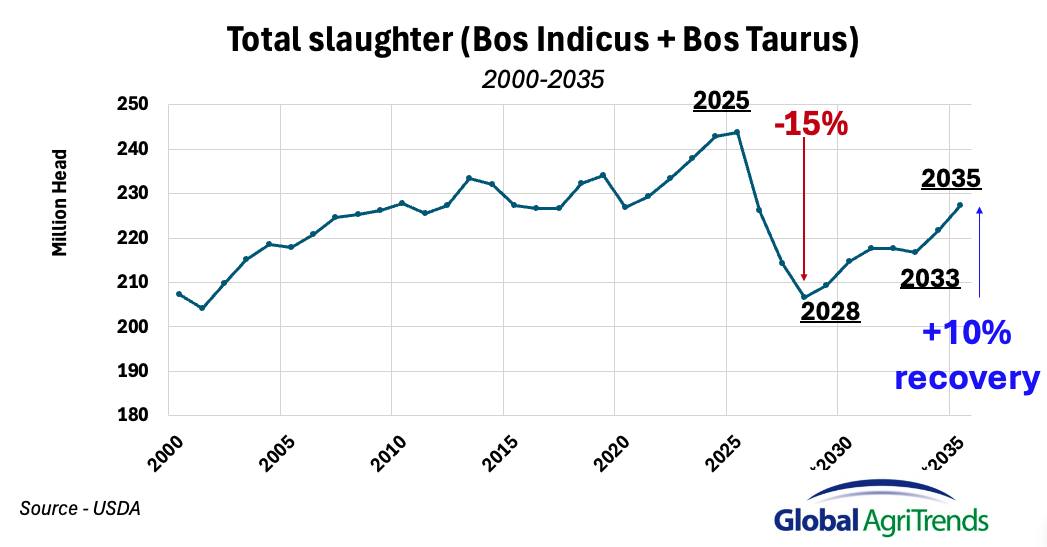
He expects the long term trend of declining Bos taurus production versus rising Bos indicus production but also noted that at this moment rates of slaughter of both are falling due to a rebuild cycle that is happening simultaneously across most of the world.
Source: Simon Quilty, Global AgriTrends
“It’s the first time I can ever remember where I can point to nine countries that are all moving into rebuild,” he told Beef Central this week.
“And so globally that when you put Bos indicus and Bos taurus together all those countries will see female retention and a lowering of slaughterings over the next two years until 2028, and then you will start to see the numbers start to pick up again after that.”
Overall he said Global Agri-Trends is expecting a 15 percent fall in global slaughter rates over the next three years as this widescale rebuild takes place.
“That means not just higher prices for Australia, but globally higher prices,” he said.
But despite the rebuild he emphasised that overall, “that long term trend of Bos taurus does not change”.
“Bos taurus will get back on track, but that long-term three percent decline continues, and it basically means the price spread between quality versus commodity gets greater,” he said.
Australia has responded
Australia has been one of the few countries that has responded to this shift, he said, reflected by the recent expansion of its feedlot sector, and the increasing production of Angus, Wagyu, composite and flatback cattle in northern Australia.
“It’s a beautiful example of filling that niche globally as numbers have declined,” he said.
“In the overall scheme of things, our numbers in the north are relatively small compared to the global trend, but nonetheless, we have adapted and tried to meet that declining quality availability globally.”
The overall trend “flies in the face” of the general belief that the middle class will keep growing and quality beef production maintain pace no matter what, he said.
“I’m saying actually quality beef because carcase weights have increased has actually remained incredibly steady for 26 years.
“And if carcase weights had not have increased, actual numbers have been on the decline, but it’s the bos indicus the commodity that truly increased both in carcase weight and in numbers that have met that growing protein demand globally.”
Source: Simon Quilty, Global AgriTrends
Where Australia’s latest wave of feedlot expansions are likely to stop
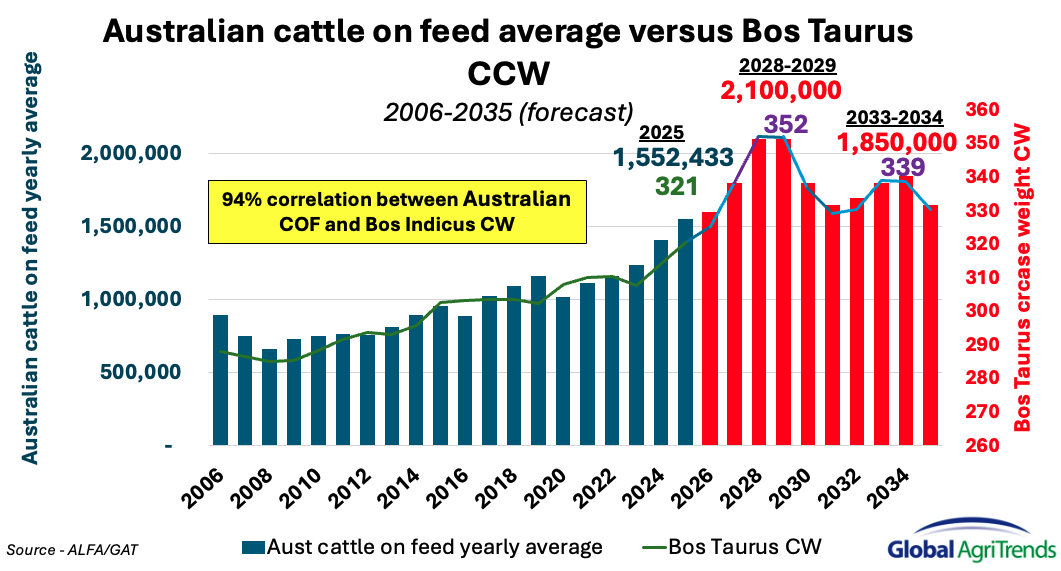
He also believes the same trend will see Australia’s feedlot industry continue to expand for the next three years – but then level off rather than continue on unchecked.
“Then if I’m right about rebuilds and about the long-term Bos taurus decline, we think that we’ve got three really solid years of growth in the feedlot industry in Australia.
“And we go from today, 1.6 million up to 2.1 million.
“But I think then we cap out after that and so that’s a 30pc increase.
“We hold at 2.1 million and then we come slightly back as those rebuilds I spoke of globally happen.”
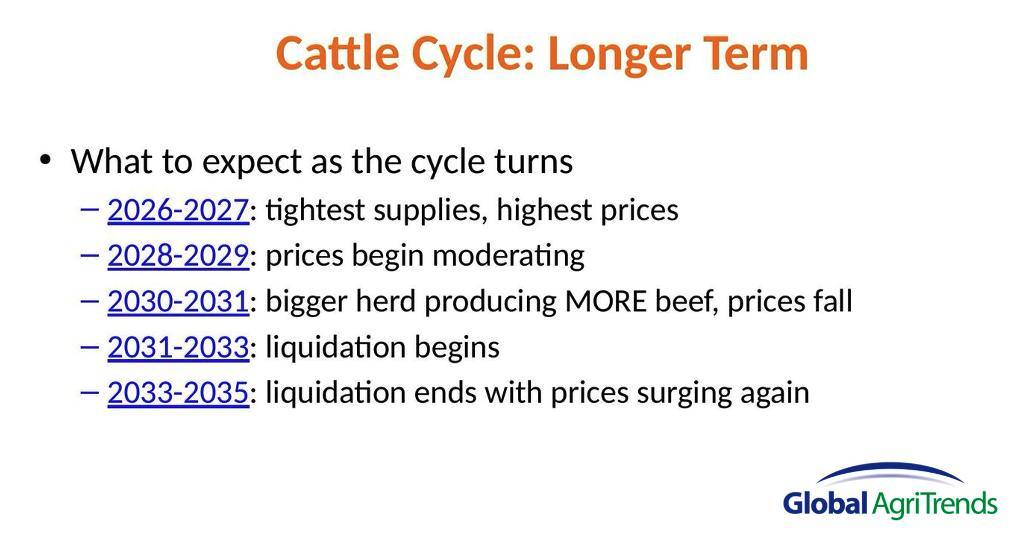
Looking ahead for the next 10 years Mr Quilty said expects the cycle to be as follows:
Source: Simon Quilty, Global AgriTrends
The net effect would be the industry settling at a level of around 1.85 million head on feed.
“I don’t believe this belief that we go forever with a bigger and bigger feedlot sector,” he said.
“I think why and how it’s growing today has been in response to global demand and I see global demand over in 2028-2029, peaking and then holding relatively steady as rebuilds occur across the world.
“So, I’ve actually got hard numbers around why I believe Australia’s feedlot sector has got upside, but it’s limited to 2.1 million head.
“This is an actual on-feed number; capacity does exceed this normally and could be at 2.3 to 2.4 million
head.”
“Either way, over the next 10 years, globally available quality cattle become tighter, and commodity cattle are more plentiful, resulting in quality cattle becoming more valuable, and the spread between the two widening.
“Australia’s northern herd has done an amazing job responding to this global trend.”
HAVE YOUR SAY