THE power and value of relationships was a central theme behind an inspiring Rural Press Club address delivered in Brisbane this morning by much-respected Queensland beef processor and cattle industry identity Terry Nolan.
Terry delivered the annual Malcolm McCosker Memorial address to a Press Club audience of more than 800.
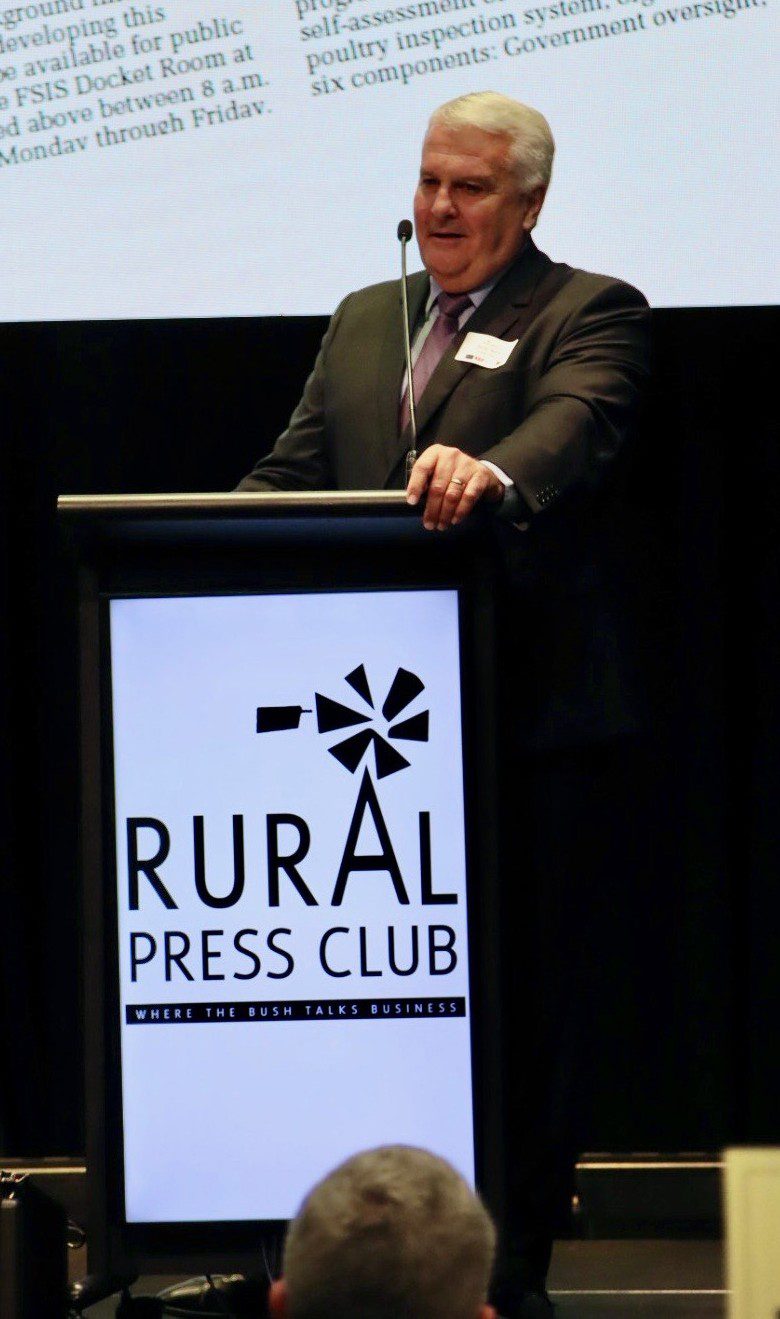
The annual breakfast held during the opening stages of Brisbane’s Ekka traditionally includes a landmark address from a respected beef industry stakeholder, and Terry Nolan’s address this morning did not disappoint.
The timing carried a sense of symmetry, as the Nolan family is poised to complete the sale of its Nolan Meats processing and lotfeeding business to Hewitt Foods. At the same time, Terry has participated in virtually every Ekka since 1979 – the past 47 years – either as a led steer or stud beef judge, carcase competition competitor, cattle buyer, or simply lending enthusiastic support at the Cattlemen’s Bar. Often all four at once.
This morning’s address was punctuated with dozens of ‘life lessons’ he has picked up over the decades from others – mostly older folk with vast layers of experience. These lessons have helped shape his attitude and approach to business, and dealings with people. An extensive list appears at the bottom of this article.
Terry and his brothers Michael, and the recently-passed Tony, forged their family processing business, Nolan Meats, into a regional beef processing powerhouse, having had the humblest of origins as a small retail butcher shop in Gympie launched by their father Pat, 80 years ago.
Nobody has contributed more than Terry to beef industry affairs over the past 30 years, with countless appointments to industry boards, steering committees, peak councils and other bodies. Much of it unseen and little-unacknowledged, he leaves an industry legacy that will live on in the red meat supply chain for decades to come.
Curiosity led to lotfeeding
One of the 12 life lessons he highlighted this morning was the ‘value of being curious.’
“Ask yourself: What great problem have you solved, ever, where you knew all the information in advance? No problem worth solving is like that. We all need to be curious to be better,” he told the gathering.
Curiosity was one factor that led Terry into the field of lotfeeding in the early 1980s. He befriended Don Bridgeford, one of the Australian feedlot industry’s true pioneers, who was grainfeeding cattle near Warra on the Darling Downs. Terry struck a deal to feed five head of cattle a week for a butchery Don Bridgeford owned in Gladstone – learning along the way, mixing rations by hand using a formula Don provided. The business venture lasted until 1985, when the shop was sold.
“Business to me is simply providing solutions for people with a problem. Don had a problem, and was just a great guy to work with. We helped him; he helped me, and I learned along the way,” Terry said.
“With a little of Don’s advice, I decided to start feeding a few cattle myself. Opportunities lie in the most unlikely places, and often stemming from simple, good relationships,” he said.
Big on dreams and short on cash, 12 head was all Terry could afford to buy out of the local saleyards at the time. He had to pay his father Pat for the grain, but got free use of Pat’s piggery feed mill.
By 2015 Nolan Meats had more than 30,000 head on feed, turning off well over 100,000 yearling cattle a year.
“It really was like the old Kevin Costner movie, “Build it and they will come,” he said. “For all those people that compete against us in the market, blame Don Bridgeford and (schoolmate and well known stock agent) Mark Simpson for our start,” he said.
The value of industry representation
Terry broke his teeth in industry representation via the QLD Country Meat Processors Association and the old Meat & Allied Trades Federation (later to become the National Meat Association – one of the forerunners of today’s Australian Meat Industry Council).
“It was a tangible way of giving back to industry,” he said with some modesty.
“If you think about it, the professionals you have the most in common with in your industry, may be your competition,” Terry said. “They wrestle with similar problems and have similar goals. And you can offer value by sharing what you’ve learned and what you know – and that value will often be reciprocated.”
“Joining MATFA, it was the first time I really believed that one could benefit from talking to fellow competitors. Previously, we had always wanted to row our own boat.”
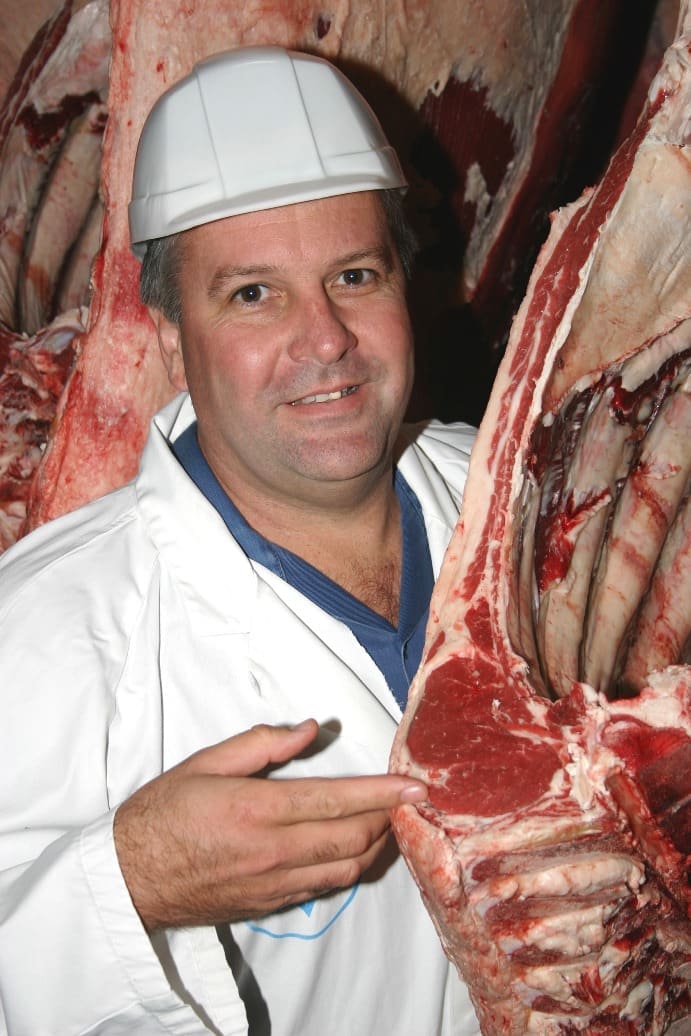
Terry Nolan
Terry used an analogy on this topic around NRL coaches, “who you would think of as quite competitive.”
“But they often talk to one another about personnel, policies, and rules to improve the overall game. The competition isn’t the competition. The powerful monopoly is the competition. Loneliness is the competition.”
“It might be that your industry doesn’t already have a vibrant association of peers. If it doesn’t, start one. If it does, you should be a contributor to it. There has never been more upside for doing so. We really do need to help fashion Government policy.”
Terry said he remained an absolute advocate for industry organisations, provided they can focus on two key questions, Who’s it for? and What’s it for?
“If you can answer those honestly, knowing that it is part of growing a bigger, better, more profitable and more sustainable industry without adding bureaucracy, you should be ‘all in’. As they say: ‘If you want to go quickly, go alone. To go far, go together’.”
Export accreditation breakthrough
Among a bunch of prominent industry stakeholders he identified during his presentation, Terry paid credit to former Teys Australia chairman Allan Teys, for providing the strategic guidance and moral support to deliver Tier One export accreditation to the industry.
“In my opinion Allan was the last great statesman of our meat industry. While (Victorian processors) Gary Hardwick and Frank Herd assisted us in piloting Tier 1 exports into overseas markets and were always supportive, it was Allan Teys who took a strategic position and threw his moral support behind our company as we tried to resurrect the failed Export Project 2, which became the Meat Safety Enhancement Program,” he said.
Nolan Meats undertook MSEP into the USA in 2006 to 2008.
“Enter the second person, Dr John Langbridge, then with AQIS, who championed from within. We couldn’t have been successful without Dr John’s efforts. Likewise, nor could we have got it off the launch pad without Allan Teys’ vision and political nous.”
Many readers may not be familiar with what Terry was talking about. In its simplest form, that successful trial work from 2007 was the foundation of today’s Australian Export Meat Inspection System (AEMIS), which now operates in every export meat plant in Australia.
“As the driver, John Langbridge was 20 years ahead of his time. Nolan Meats was just the vehicle,” Terry said.
Meat Standards Australia
As the strongest early supporter of a struggling Meat Standards Australia program in the late 1990s, Terry also singled out David Crombie’s and former MLA marketing head, the late David Thomason’s industry contribution for praise.
 “David was another visionary and I still use a quote he said to me once when we were working together on the MSA Steering Committee. He quoted the famous Canadian Ice Hockey player Wayne Gretzky, who when speaking about the art of winning, said, ‘I skate to where the puck is going to be’.”
“Our industry owes a lot to David Crombie for the way he led MSA and other industry-changing initiatives. Not just that, but he is one of those people you would class as just an all-round good bloke.”
“I was fortunate enough to work with David when I chaired the MLA Domestic Marketing Committee from 1999 to 2011. Once we got over the backlash of the Bruce Ruxton ad, offending all and sundry with the Lamb Chop bouncing along to “Advance Australia Lamb”, David’s genius really kicked in with many more campaigns including the ‘Dancing Butchers’, ‘Red Meat Feel Good’ with Sam Neil and Sam Kekovich’s Australia Day Lamb ads.
“David Thomason, David Crombie, Don McDonald, myself and a small working group were tasked in 2003 with lifting the MLA Levy by $1.50 to $5. That campaign was also successfully implemented in 2006, and it is still at that same level 20 years later. Again, David Thomason did much of the behind-the-scenes leg work.”
“David Thomason taught me to see optimism not as a prediction; but as a choice.”
Among a host of others connected with the MSA development era, Terry referenced former AA Co visionary John Griffith, “who was part of a wonderful era of MSA development and helped support Rod Polkinghorne’s ‘zealot-like’, dogged determination to make a difference in meat grading.”
“And he did. It was just a wonderful time and it was an honour for me to be at the table with all those wonderful and passionate minds, united for the betterment of our industry.”
‘Drunks under the scoreboard’
Terry had a clear, pull-no-punches message for all the ‘drunks under the scoreboard’ who sit back and criticise industry bodies about any blue-sky initiative, an ad that may not work, or a program that stumbled and failed to deliver.
“Please spare a thought for the people that have given, in most cases, freely of their time, to provide guidance through our industry bodies to result in some of the best meat industry systems in the world,” he told the audience. “Instead of complaining, I say pull on the jersey, lace up the boots and run on the field. Please don’t paralyse our industry with pessimism.”
Aligning values, thoughts, feelings and actions – and the dangers of ‘group-think’
Terry recounted an episode during an MLA AGM in Toowoomba in 2001, when there was a groundswell of support for ABA, and processors were campaigning to oust MLA.
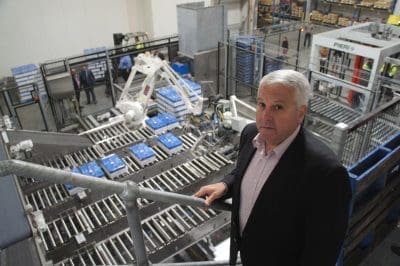
Director Terry Nolan above the robotic pallet stacking area in the Nolan Meats plant, which can build a full pallet of cartons every 60 seconds
“I was in attendance, listened to all speakers, heard the full debate. It came time to vote and ABA lost narrowly – even though many processors had pledged their support to them. I volunteered that I didn’t give my 80,000 votes to ABA, and copped probably the biggest serve of my life from another processor who was crunching the numbers.
“The message is, while it is nice to be compliant and popular, that should never be your sole aim.”
“That barrage of abuse only made me so much more determined to ensure I always align my values, thoughts, feelings and actions and be true to myself. It probably had the opposite effect to what the deliverer intended. It helped me become more focused and strengthened my character for future competition and confrontation.”
“Group think can be really dangerous. It is OK to be different.”
Animal welfare foresight
Terry found time to weave in a story on the industry’s strategic approach to addressing animal welfare challenges.
“In 2004 I remember dining with Peter Holmes a Court and Don Mackay (another couple of great blokes, part of AA Co at the time). Peter brought an almost prophetic approach to industry. Like it was yesterday, I can hear Peter saying, ‘Animal welfare will bring this beef industry to its knees within ten years’.”
“He was 100pc correct: It took just seven years and the ABC “Bloody Business” story to do that. Public expectations were changing. Sadly, people affected are still waiting for compensation on that issue. Awareness may have been their best protection and prevention.”
 “I am pleased to say that the Australian Meat Industry Council (Terry sat on the board, and acted as chairman for decades) championed that lead, through then Executive Tom Maguire, to draft industry’s first Animal Welfare Standard for the Processing sector in 2005. It was published, enacted on a voluntary basis by AMIC, and reviewed for the second edition in 2009 – all before the Four Corners story broke a year later in 2010.
“Peter’s experience interacting with the public, running London theatres, triggered his awareness. That in turn ignited my passion and support for such an ambitious Animal Welfare Standard. It fitted with my personal values and passion for horses, dogs and cattle. More importantly, it taught me to be aware of trends and always maintain a view for the future.”
12 Life lessons
Terry ended his presentation by offering a dozen key life lessons he had learned along the way.
“The future is not something that happens to us. It’s something we can make, together, on purpose, or not at all. A potential promise, or a series of promises, that enable a better future. It is done via healthy relationships,” he said.
1: Begin. Begin before you’re ready, because you will never be fully ready.
2: Speed of delivery is important. Think and be aware; Four billion people got the phone before they got the library or the bank. The phone became both.
3: Under-promise and over-deliver. Get it there on time. Basic service will always be respected over glossy brochures.
4: Be curious. We really have a surplus of information and we have to filter it. Or, we don’t have sufficient information right now and we have to find some. Read, listen, observe, ask.
5: Teach what little you know; even before you are ready. Share the knowledge. Only generosity can make the world kinder and wiser.
6: Be creative, take the road less travelled, you can’t use up creativity. The more you use, the more you have.
7: Be brave in making real choices. Understand the paradox of choice. ‘Is less more’ or ‘Is more less”? Are we maximising or satisfying? Focus on what truly adds value.
8: Take the long view on the purpose and the short view on the action. As they say, think global, act local.
9: No half measures – You have to be ‘all in’ to have a chance of success. The three Nolan brothers have been moderately successful by that principle. You don’t have to agree with each other’s views, but you need to respect their views and explore their perspective. When it gets heated – as it often did/does – heed our mother’s advice and “Never let the sun set on your anger.”
10: Mistakes happen. Learn from the past and press on. Guilt, self-pity, revenge are not principled strategies. Experience, repair, and commitment to the future are.
11: Build relationships. Through relationships there is real hope for everyone.
12: Finally: Have faith. ‘Bear’ Grylls quoted on his training as an SAS Soldier: “One of my superiors gave me a piece of advice that has stuck with me ever since. He said, “To survive, you need three faiths:
- Faith in yourself. Your skills, your training, your ability to endure.
- Faith in each other. The person to your left and your right. Knowing they have your back, no matter what.
- Faith in the Almighty. A belief in something bigger than you, that can carry you when the first two fail.
“In business, in family, and in life, it’s the same. You need all three. The self-belief to start, the team to keep you going, and the faith to endure when it all feels impossible,” Terry said.
“The future is not a place we’re going. It’s a thing we’re making. Every day, with every choice, whether we admit it or not. Artificial intelligence alone won’t get us there in a fulfilling way. Fostering healthy relationships will.”
On behalf of the Australian beef industry, Terry, we thank you and the Nolan family for your indelible contribution, and the legacy you have left for others – Beef Central.
- Stand by for a Weekly Grill podcast episode featuring Terry and host, Kerry Lonergan
Terry, congratulations and thank you.
Jon, thanks for the coverage, wish I could have been there to see the address.
Terry Nolan was one of the smartest and most knowledgeable people the Beef Industry could have ever engaged to help navigate it through the difficult times over the last 40 years. His practical knowledge and experience of the industry is unsurpassed and will be a great loss to the Industry. I wish him well in a very well deserved retirement and thank him for everything he has helped to achieve for cattlemen.
I am a retired cattleman and have known Terry for 40yrs.