
AUSTRALIAN beef has been excluded, while lamb and goatmeat are included in the latest round of punitive tariffs on imported products announced by US President Donald Trump overnight.
Effective today, the Trump administration has imposed a permanent 12.5 percent tariff on a wide range of Australian goods after accusing the Australian Government of failing to adequately police forced labour in its supply chains (ie products imported to Australia from China).
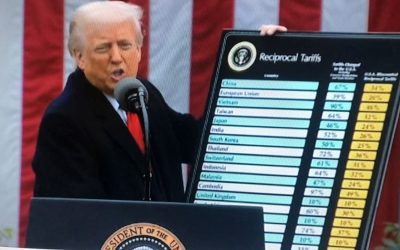 However exemptions on major Australian export items like beef, copper, gold and pharmaceuticals, covering 70pc of total exports to the US, will moderate the impact.
Both Australia and Brazil have been given exemptions on beef imports, as the US domestic beef industry struggles with production volume blighted by a cattle herd at 70-year lows after drought, and showing little sign of recovery. Retail and wholesale beef prices in the US are at all-time record highs.
However Australian lamb and goatmeat are subjected to the new tariff, effectively lifting the protein’s tariff rate into the US from 10pc to 12.5pc. The US recently launched a controversial global safeguard investigation into lamb imports, at a time when US lamb producers are themselves receiving record high returns, https://www.sheepcentral.com/australia-confident-facts-support-mutual-benefit-of-us-lamb-imports/
For the fiscal year ended 30 June, the US was Australia’s largest beef export market (493,000t), largest lamb market (85,200t) and largest goatmeat market (30,776t).
Australia’s beef export rival Brazil will also escape the new tariff on its beef exports to the US, however the existing 24.5pc out-of-quota tariff remains.
 Some other countries, including the UK, will only be subject to a smaller 10pc tariff under Trump’s measures announced overnight. The US says those nations are taking stronger action against forced labour – a claim Australia disputes (see below).
Today’s new levy will replace a temporary 10pc tariff applied earlier this year that was set to expire at the same time. Australian beef has not been exposed to that 10pc tariff since early in the year.
A total of 60 countries will be hit with the new US import tariffs from today, including Japan, the European Union and the United Kingdom, after a protracted US investigation concluded they had failed to prevent items made with forced labour from entering their production processes.
The modern slavery investigations were launched in March after the US Supreme Court struck down Trump’s so-called “liberation day” tariffs, prompting the administration to pursue an alternative legal pathway to reinstate the levies.
A statement issued by the office of US Trade Representative Jamieson Greer alleged that Australia had “inadequately enforced bans on goods produced by forced labour.”
Universal condemnation
Australian industry and government sources have universally condemned the tariff imposts as unfair and unjustified.
Federal Trade Minister Don Farrell said the tariff was “unjustified, and inconsistent with Australia’s free trade agreement with the US.”
“Australia is a country that deals with the issue of modern slavery seriously,” he said.
Deputy prime minister Richard Marles said the decision “made no sense”, and the Australian government “was arguing forcefully against it.”
AMIC response
The Australian Meat Industry Council said it strongly objected to the US Government’s decision to impose additional tariffs on Australian sheepmeat and goatmeat exports, suggesting the measure was unjustified, inconsistent with the Australia-US Free Trade Agreement and fundamentally failing to recognise Australia’s world-leading record on labour standards and worker protections.
“The decision follows investigations, public consultations and hearings conducted throughout 2026 and which ignored the strong and robust case put forward by Australia in defence of our labour policies, which the US government has itself rated as world-leading,” AMIC said.
“Australia has a robust, world-leading regulatory framework to address modern slavery and forced labour across supply chains. The Australian meat industry operates under stringent workplace and compliance requirements, providing confidence in the integrity of our production systems.
“Ultimately, the ongoing and increased tariff on protein imports will increase costs for American importers, retailers and consumers while also undermining a long-standing and mutually beneficial trading relationship between Australia and the United States.”
NFF: Ag sector deeply disappointed
The National Farmers Federation said it was deeply disappointed in the decision.
“The new, increased tariff represents a further and unnecessary trade barrier between two trusted allies with a long-standing agricultural and economic partnership underpinned by the Australia-US Free Trade Agreement, which provides for zero tariffs on two-way trade,” it said.
NFF chief executive officer Michael Guerin said the decision was a step in the wrong direction.
“Australian agriculture is profoundly disappointed by this announcement,” Mr Guerin said.
“Rather than moving back towards the free and fair trading arrangements that have served both our countries well for two decades, the US has chosen to further increase barriers to trade, despite Australia’s longstanding record of high standards and responsible trade.
“The increase adds further challenges for Australian exports, particularly given a number of other economies received a lesser tariff of 10pc.
“The NFF has long championed free and fair trade, not just for agriculture but all industries, recognising its role in global economic growth, stability and food security. Australian agriculture is unwavering in its commitment to this.”
Mr Guerin said Australian agriculture remained committed to a considered and measured approach.
“Australia’s interests are best served by pursuing open markets, maintaining our reputation as a trusted and responsible trading partner, and continuing to strengthen our trading relationships around the world.
“While some major agricultural exports appear to remain exempt, including Australian beef, today’s decision is nevertheless a disappointing setback for Australian exporters.
“Australian farmers are among the least subsidised in the world and have built a global reputation for producing high-quality, sustainable and reliable food and fibre. We will continue working with Government and industry to ensure Australia’s trade interests are protected and to expand opportunities in markets that value the quality and integrity of Australian agricultural products.”
Tariffs on Australian businesses both disappointing and meritless
The Australian Industry Group said the new tariff measures were both disappointing and meritless.
“Unfortunately, a tariff regime now appears to be the new normal when dealing with the US and signals a further blow for Australian aspirations for a free and open global trading system,” AIG’s chief executive Innes Willox said.
“The justification for the imposition of a 12.5 per cent tariff that Australia is not tough enough on forced labour ignores the reality that we already have one of the strongest legislative regimes in the world as the result of legislation introduced in 2018,” he said.
“The threat by the Federal Government to further penalise businesses in an attempt to mollify the American administration would only serve to increase compliance costs and reduce the incentives for them to seek to access global markets.
“Economies around the globe are understandably trying to address the scourge of forced labour, but without coordination on definitions or solutions, companies are left caught in the middle, navigating inconsistent and occasionally competing cross jurisdictional rules and reporting obligations.
“Australia has to date had one of the strongest Modern Slavery Acts that has assisted Australian companies to interrogate their supply chains. Today’s assessment by the US demonstrates the risks they face in unilateral determinations of how best to address forced labour in global supply chains, and the ever-present need for World Trade Organisation coordination on these matters.
“Australian Industry Group will continue to support the Government’s efforts to overturn these tariffs which run contrary to the intent and spirit of Australia’s Free Trade Agreement with the United States, which has been in place since 2004,” Mr Willox said.
- The USTR Docket Notice regarding the 12.5pc tariff, and exemptions, can be read here.
HAVE YOUR SAY