
COMMENTS and graphs published by ABARES earlier this week have left a false impression that the United States has already started shipping fresh (chilled or frozen) beef to Australia, following recent trade access changes.
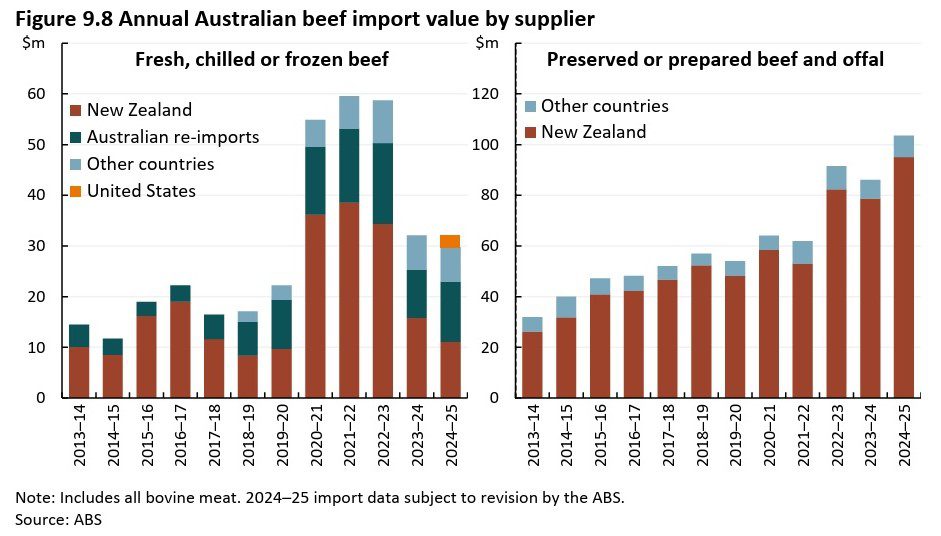
In its September Ag Commodities report, ABARES published the graph (below), clearly suggesting that “Fresh, chilled or frozen beef” imports to Australia from the United States (orange bar in the graph) have started, during the 2024-25 year.
Click on image for a larger view
The graph appears within a section in the ABARES report’s Beef and Cattle chapter appearing on page 64 titled, “Beef imports to remain minimal and dominated by New Zealand.”
The suggestion that US fresh beef imports have started is false.
Adding to the confusion, the report also states:
In 2024–25, Australia imported $2.5 million (269 tonnes shipped weight) of beef from the US – the first imports since 2004–05. Prior to the implementation of food safety and biosecurity restrictions limiting imports of beef from the US in 2005, imports were minimal and accounted for a small fraction of total imports and a negligible share of total Australian beef supply. Due to Australia’s high domestic supply, consumer preferences and long freight distance from the United States, imports of US beef are not expected to be significant in 2025–26. In addition, US beef exports are forecast to decline by the USDA in both 2025 and 2026 due to a fall in cattle slaughter.”
To be absolutely clear, US fresh (either chilled or frozen) beef imports from the US have not yet entered Australia.
ABARES has evidently extracted incorrect data from ABS import statistical records, Beef Central was told, but failed to pick up the mistake in the compilation of its September report.
Based on the evidence included in the ABARES report, Beef Central received media inquiries yesterday from Sky News and others claiming US beef imports had started. We had to assure them that they were incorrect.
 Beef Central has sought clarification from industry and government sources about the mistake, and has confirmed that US product has not yet arrived in Australia under the new protocol.
The best explanation for the mistake that MLA or AMIC could provide was that it represented an incorrect import data entry by ABS, which ABARES then failed to pick up for its September report.
Another theory is that the 269 tonnes of beef referenced in the ABS import trade report may have in fact been Australian in origin, originally destined for the US market, only to be rejected and returned for some reason. That beef ‘arrival’ may have then been be mis-directed into the wrong import activity column when data was collected.
Inevitably, when the first US beef DOES hit Australian shelves following the recent protocol changes, it will attract widespread metro media headlines – regardless of the volumes involved. But as Beef Central pointed out in this earlier article, any US trade into this country will be fundamentally for ‘symbolic’ or ‘novelty value’ reasons.
As discussed in this earlier report, US beef under current trading terms will be completely uncompetitive in the Australian market in financial terms, in any reasonable ‘like-for-like’ quality comparison.
ABARES has since provided a response to Beef Central, removing its claims about US beef imports. Click here to read in a separate story published 5 September.
In the meantime we’ll keep readers posted when the first real importation of US beef does take place.
Click here to view the original September ABARES Outlook report.
Click here to view the revised version issued 5 September.