
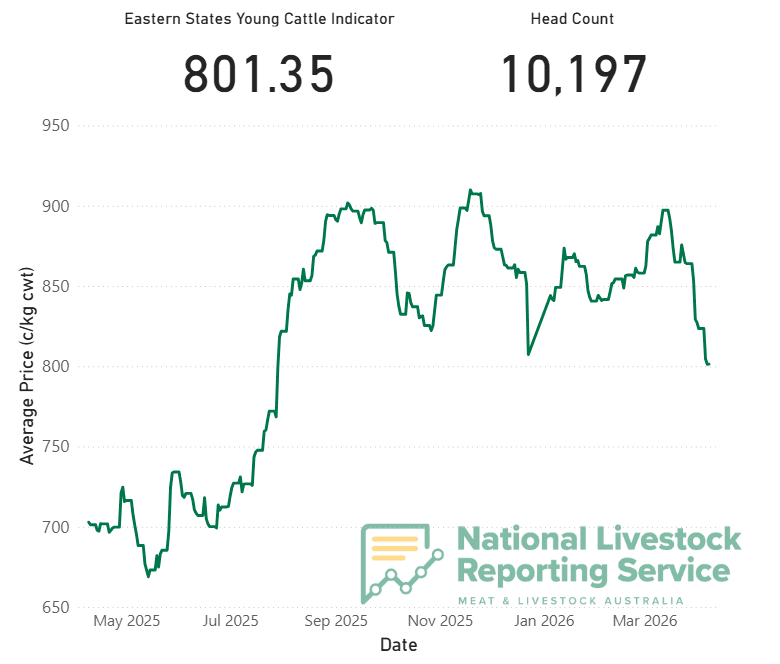
Meat & Livestock Australia’s Eastern Young Cattle Indicator.
SALEYARD prices have dropped significantly in the past month, with the benchmark Eastern Young Cattle Indicator going down ten percent since the middle of March.
While several factors are playing into the softening of the young cattle market, the uncertainty created by the surge in fuel prices has largely been attributed to the drop off. It must be said those prices are coming down from historically high levels.
The EYCI opened today at 801c/kg carcase weight, a 28c/kg drop on the past week and an 81c/kg drop on the past month. The indicator fell briefly into the 700s mid-morning, before recovering a little as today’s later sale results were added. All other liveweight indicators have been tracking in the same direction, with cows being the segment of the market dropping the most –the processor cow is now 50c/kg less than a month ago, at 328c/kg.
Some typically big contributors to the EYCI have not been operating in the past week due to public holidays. Wagga, Tamworth, Dubbo, Forbes and some other smaller yards have not held sales.
Southern processors try shopping close to home
Beef Central was told that there has been a decrease in numbers of cows heading from Queensland down to southern processing plants in recent weeks – with one processor saying the freight bill from Roma to Eastern South Australia adds about 70c/kg to the price.
Perhaps demonstrating southern processors’ intentions of shopping closer to home has been the dairy cow indicator increasing by 11c this week, making it the only cattle indicator to increase.
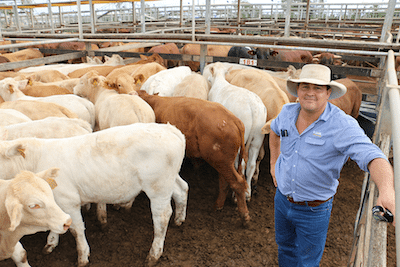
Grant, Daniel & Long Roma selling agent, Geoff Maslen
Cows are making a lot more money in the south, with the Leongatha contribution to the processor cow indicator being the highest average price of the past seven days at 396c/kg, almost 100c more than yesterday’s Roma sale at 306c/kg.
As is usually the case, numbers going through southern saleyards are a lot less than Northern New South Wales and Queensland and GDL Roma branch manager Geoff Maslen said a southern processor had been active at Roma in the past two weeks.
“That took us up to these short weeks, but in another fortnight’s time we expect another one-to-two southern processors to start chipping away,” he said.
“Whether they are going to make as much an impact as they did last year, because that is going to be fuel-related to cart those cattle back. But they are telling us they are coming up to buy cattle because they are going to run out of weighted cattle.”
Market still looks bright
Mr Maslen said buyers from Western and Central Qld, where the season has been good, have recently come into the market – including cattle he recently purchased for a producer at Camerons Corner, along with Winton and Longreach.
He said while prices have dropped in the past month, they are strong compared to the past year.
“A month ago, 600c was pretty common for a good, crossbred weaner steer through the Roma saleyards and it is now more like 500c,” he said.
“This time last year we were buying weaner steers for 350-400c and heifers for a lot less than that, so we are a long way better than we were last year.”
Mr Maslen said cattle are getting to feeder weight quickly in some areas where there has been a good season, which may also be putting some downward pressure on the market.
“Most of the feedlots now are every bit of four weeks out, so we are seeing anyone who has steers 500kg getting their prices reduced down to like 450c/kg.”
Sheep market stays resilient
Interestingly, most sheep markets have been increasing in price over the past month with almost indicators steadily rising.
The sheep industry is said to be one of the most exposed sectors to the conflict, with the Middle East being one of its biggest markets.
It was suggested to Beef Central that a lack of supply may be driving the price increases.