

Richard Koch, Elders
Richard Koch is an economist working with Elders. His regional cattle markets wrap follows a weekly hook-up with Elders livestock managers across the country.
LOCAL cattle markets have eased recently in line with a softening in export markets as the impact of triggering safeguard quotas in China and Korea reduce export demand for Australian beef.
Looking forward to when we might see export markets start to recover, a couple of exporters have advised they are going to start freezing-down product for China in November with the aim to get it into the market very early in 2027, to avoid the tariff.
Next year, the China quota is not expected to last past May, whereby the Korea quota will be quickly filled.
Earlier this year, some exporters had anticipated that the UK may change its HGP-free regulations to an open-herd approach, moving away from the more restrictive EUCAS model. If that had happened, they would have redirected more medium-fed HGP-free beef into the UK, but that won’t be possible with the UK rejecting our HGP certification system in favour of sticking with EUCAS.
The distortions caused by North Asian safeguard restrictions are likely to get worse each year, and concentrate peak demand for HGP-free grainfed Angus cattle in a period from November through to about April.
This in turn may distort the market for suitable feeders. If we say peak China demand period is November-April then peak feeder demand to service this market would be 5 months prior, so June-October.
As feedlots turn off November to April, they might consider a domestic 60-day heifer or 120 day shortfed steer program prior to going again for China in June-October.
Something to consider if you are targeting this market with HGP-free Angus feeders.
Cold weather slowing cattle performance in the north
Even though the NT and northern QLD had one of the biggest wets on record last summer, growing a lot of feed, the feed value has been knocked around by the recent spate of cold weather with cattle performance absolutely stalling.
Northern clients with cattle now are at the crossroads, pondering whether to sell now or put another wet on them.
It’s not like they’re going to delay a month and bank some extra kilos, and if they don’t move now, they are going to be early next year for that class of cattle.
There is still strong demand on live exports, but expect a bit more activity going forward out of Townsville in the next four to six weeks.
Good quality Brahman numbers are drying up out of the NT.
Charters Towers sale last week was solid, the best quality cattle stood up okay, but the ordinary cattle are getting harshly dealt with. For vendors needing to put a season-and-a-half on cattle, there’s not a lot of demand for those.
It’s the cattle that have got an immediate bang for buck that seem to be attracting the attention.
Will CQ run out of feeders?
Our team in QLD reporting a hell of a lot of feeders have gone to feedlots early and at lower weights that they normally would – at 420kg instead of 460-480kg to take advantage of the higher prices, and there may be a shortage of feeders coming out of winter, particularly with feedlots increasing capacity across QLD.
Cattle on feed numbers are being driven by expansion in QLD and NSW feedlots
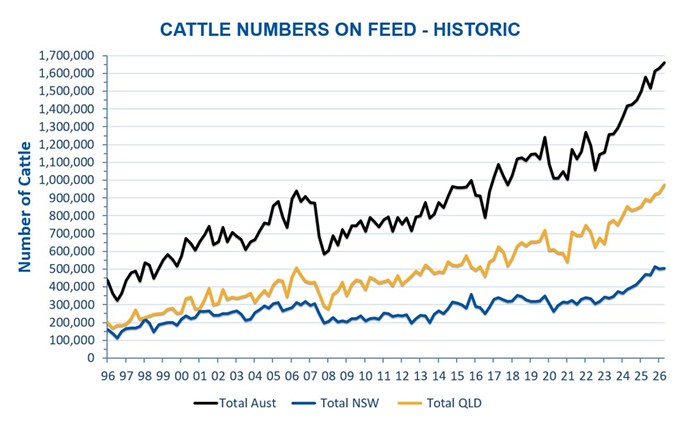
Source: ALFA
A major exporter remains very active across Queensland on store cattle and in booking custom feeding pen space, particularly in CQ where they haven’t previously played much before.
This could be a strategy to allow them greater flexibility on buying (ie. when the market gets too high they can pull back and use company-owned cattle) or it could be part of a wider strategy to shift processing capacity from North America to southern hemisphere where cattle are cheaper.
Readers may have seen the move by US beef processing giant, Tyson, to abruptly shut a 3000 head per day beef processing plant in Illinois and a boning facility in Utah and sell a plant in Washington as part of a restructuring of its north American business. That comes in response to chronic shortages of cattle and ongoing losses (it recently reported US$600m in annual losses across its beef packing operation).
Tyson expects to maintain similar cattle throughput levels across a smaller, more efficient, more highly utilised processing network.
This won’t be the last restructure we see in North America cattle processing industry this year.
Numbers ease at Southern Qld saleyards
Roma yarded about 5800 yesterday (down 2000 from last week and well back from the peak of 11,000 in July), following on from last week, where there was a decline in yardings with a similar story playing out at Dalby.
Most export cattle categories were about the same as the week before with a few ups and downs, mainly quality driven. Southern processors buying is starting to become a little more selective with one buyer purchasing 50 cows last week out of 2000 cows last week.
The best of your crossbred feeders are holding at around $5.10 with Angus feeders $5.60-5.80. Some feedlots are not offering quotes till the middle of September as they’ve enough cattle backgrounded to supply their own job.
The store market clawed back half of last week’s losses on the back of lack of numbers and a few people seeing a bit of an opportunity to put a bit more weight into them and trade them to a feedlot in the summer.
There has been little to no rain in southern Queensland and August/September are the two driest months, so the outlook isn’t great. In the southwest, south of St George it is very, very dry – probably a month away from cattle getting a bit tricky to truck. They’re good and strong, but they’re not far off not being able to transport.
SA/VIC/Riverina
Livestock markets across the south are still very quiet. Most areas had good rain last week anywhere from 40-100mm which will keep the season ticking along. Most that I have spoken to are in awe of crops from Forbes in NSW right across to the west coast of SA.
There have been a few warmer days of late and there are patches of pasture growth, so the end of winter is in sight.
My contacts in the Riverina suggest that they will have stock to sell a bit earlier than normal with the tops of the steers headed for a domestic grassfed supermarket contract at $9.70/kg dw in mid to late September and the bulk of the steers going into a feedlot at around $5.60 at 400-500kg at around the same time. This is about a month earlier than normal.
I read about a grazier around Broken Hill that has sold 200t of mixed livestock the past two weeks (about a third of his livestock) that were consuming around 6 tonne of feed per day, but he estimates his 30,000ha is currently growing about 60 tonnes of feed per day….suffice to say he will be restocking soon.
Expect volumes to start building through central and southern NSW in September and from October in markets further south, alleviating the current pinch in supplies that is sending southern processors north looking for stock.
Important developments in grain markets
The global wheat trade is undergoing a notable reshuffling as Black Sea shipping disruptions reduce export prospects for Ukraine and Russia.
Basically, persistent attacks have shut down exports out of the Black Sea with alternate paths to market costly and difficult (truck and rail freight to ports in northern and western Europe).
By the end of last week less than 10pc of grain export capacity remain operational in the Azov-Black Sea basin. Around one million tons of wheat has been exported from Russia so far in August after just 1.6mt in July.
In a normal season, Russia would be expected to export 4-5mt through the northern hemisphere late summer and autumn, before slowing in the winter months. This appears to be a bigger issue than what the market is recognising.
Tighter Black Sea supply is already being reflected in global prices (all prices quoted in $US). Compared with July, EU wheat export quotes jumped by $25/t to $262/t, while US prices rose by $26 to $321/t, Canadian prices by $20 to $292/t, Australian prices by $13 to $291/t and Argentine prices by $12 to $239/t.
Major grain importers in Asia have started shifting purchases away from the Black Sea region toward alternative suppliers. Indonesia has already purchased Australian wheat for September-October delivery, while other Southeast Asian countries have booked similar cargoes.
With ship owners increasingly reluctant to enter high-risk areas of the Black Sea, traders are offering Asian buyers’ grain from Romania and Bulgaria instead. Some contracts that do not allow a change of origin have had to be cancelled under force majeure.
I think the market is understating the risks of prolonged disruptions to Black Sea shipping and this on top of poor crops in western Europe and the US will increase export demand for Australian grain, which means that import parity (into the northern feeding region from central NSW) will increase.
The market hasn’t thought as far as dry northern hemisphere winter crop planting conditions or the difficulties that the Black Sea may have in financing planting if they can’t sell this year’s crop (its sitting everywhere in grain socks in paddocks).
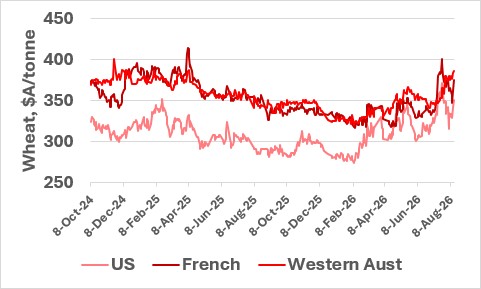
Source: LSEG Workstation | This chart shows US, French and Western Australian wheat prices
HAVE YOUR SAY