
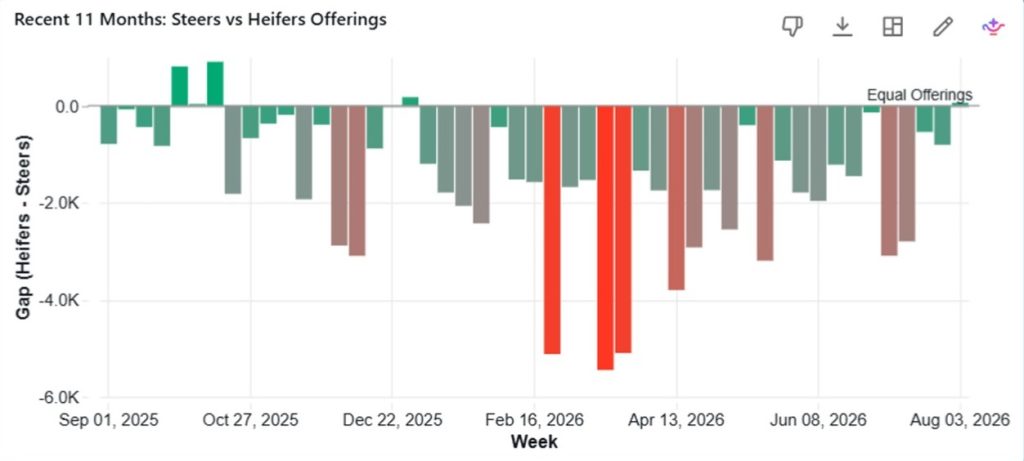
FRIDAY’S AuctionsPlus catalogue included some unusual statistics that reflect the current declining state of the cattle market, with beef producers keeping a close eye on the BOM forecast about prospects of a ‘Super El Nino’ becoming a key part of their thinking.
As can be seen in the graph above, it’s been 217 days (about 7 months) since AuctionsPlus last listed more heifers than steers in weekly sales. The previous occurrence was the week starting 29 December 2025, which was obviously holiday impacted, and showing a catalogue of only a handful of cattle.
Commercial cattle offerings online last week (Aug 3-7) saw heifers carry a small lead over steers (5910 head versus 5848 steers) – a rare event that happens less than 10pc of the time, historically.
Steers dominate the online market structurally. Over the past five years of trading (253 weeks from August 2021), AuctionsPlus offered a total of 1.43 million steers (58pc of the young cattle market), while heifers totalled 1.03 million head (42pc).
Statistically, that makes it harder for heifers to numerically outpace steers in any given week.
Heifers exceeded steer offerings in only 24 weeks over the past five years. The most recent meaningful heifer-lead period was late September through to mid-October 2025, when heifer numbers topped steers for three consecutive weeks from September 29 to October 13.
Before that, it’s been sporadic single-week occurrences only. The drought period 2019-20 also showed periods of high heifer disposal has herd liquidation kicked in.
AuctionsPlus general manager Network, Paul Holm, made the point that performance metrics also favoured steers over heifers, in terms of volume.
“Historically, steers achieve an 82pc clearance in online trading, versus 78pc for heifers,” he said.
“Over the long-term, steers typically command a price premium of $100-200 per head. Last week’s heifer lead is notable, but it still represents only a slim 1pc margin—well within normal weekly volatility,” Mr Holm said.
Drought shadow stretching north
More recently, drought or very dry conditions have extended north out of NSW into southern Queensland, with four large Queensland local council areas drought declared late last month. The local Government areas of Balonne, Goondiwindi, Southern Downs, and the southern part of Maranoa have been drought-declared following prolonged periods of below-average rainfall and pasture growth. That’s pushed some heifers to market, recently A+ listings indicate.
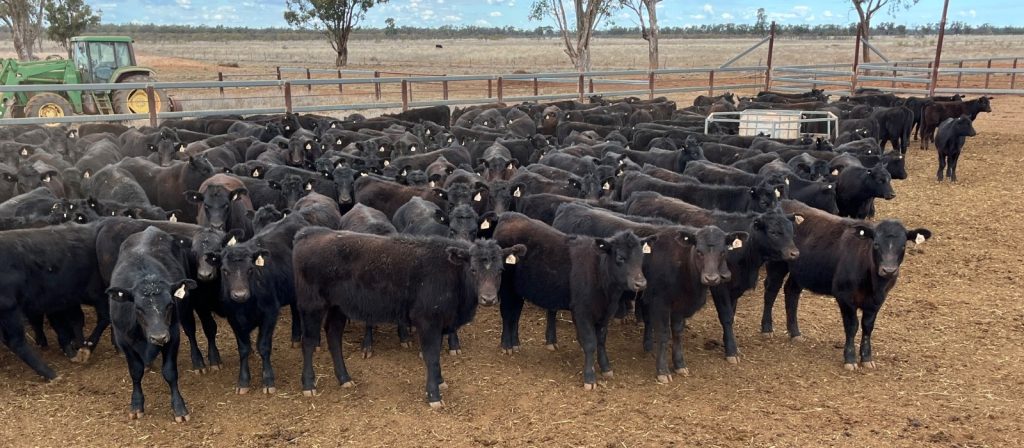
A good example of the impact of recent deteriorating conditions was a large listing of 296 6-8 month old Angus and Angus cross heifers from St George on Friday (pictured below), with the lighter end around 200kg making 480-485c, and the heavier end 219kg making 438c.
“These heifers are only getting sold due to failing seasonal conditions,” assessor Russell Jorgansen from GDL said in listing commentary.
“Southern Queensland buyer activity dropped off a cliff last week,” AuctionsPlus’s Paul Holm told Beef Central.
“Normally they would be buying 60pc of the listings around now, but last week was only 35pc.
Beef Central also asked about the unusual alignment (in c/kg terms) of the five steer weight categories in online selling last week. The spread from the lightest steer category (less than 200kg) to the heaviest (+400kg) was just 7c/kg.
“I think the (narrow spread in pricing) comes down to the point that lighter cattle are travelling further, while the heavy cattle are staying more local,” Mr Holm said.
As seen in the April Beef Producer Intentions Survey conducted by MLA, taken as northern regions of NSW were being severely buffeted by drought, 21pc of Australian beef producers surveyed said they intended to reduce their beef cattle herds over the next 12 months, with southern producers more likely (22pc) than northern producers (16pc).
The four factors contributing most to negative sentiment in the April survey included fuel price increases and/or shortage (36pc), Middle East war/global geopolitical instability (35pc), dry /drought conditions (current, actual -30pc); and cost of production / input costs (excluding or not mentioning fuel – 30pc).
HAVE YOUR SAY