
 Chris Howie is a regular Beef Central and Sheep Central livestock markets columnist.
I THINK it’s time to remember that not all advice is good advice.
Much of what I write is not because I woke up and thought “that’s a great idea”, it’s because many of us in the agency world lived and breathed the trade.
Celebrated with the client on the wins and worked to make it right when it didn’t go our way.
In 1991 I purchased 600, 65kg Merino wethers for $16 a head to do a quick trade onto the live export ship expecting to get $25. What I didn’t know was the trade out of Adelaide was about to stop and 110,000 sheep in the export yards had no home. The $16 wethers became $6 sheep overnight. Shortly after that we started the sheep disposal scheme. The idea was right, but influences outside of my control took over.
 My point is that we are in a time of high prices and our focus on small wins and cost control tends to disappear. Rain, Grass and high prices are the perfect environment for “instant marketing experts” with limited real-life experience to appear. Like politicians, many of these couldn’t make their own business work but they love to tell us how to do it. The size of the crowd in the hall doesn’t make the information correct.
So where is Chris going with this?
Looking to historical trends, market analytics, season and opportunities is how most of us form an opinion on what we should do when buying and selling. We can never have all the information, but a good “gut feel” with a bit of science and focus on animal health tends to be about 80pc right most of the time.
My concern is when marketing advice is provided that tells a producer to sell then sit back and wait it very quickly creates a re-entry exposure that has the potential to create a business failure. Managing positive weight gain by adjusting numbers with a sale program is far safer than a “preserve pasture for later” unload.
If we look back at 2021 and steers made $1600, I remember writing in Beef Central “they can’t get any dearer”, but the same calves next year made $2100, 2023 they were back to $1200. How is your buy-in going now?
My advice is stay in the game, but focus on feed, stocking rates, weight gain and animal health
My advice is stay in the game, but focus on feed, stocking rates, weight gain and animal health. Unless it’s a drought the unload mentality means you must jump back in the day it rains which is an old-fashioned punt, or the market will beat you every time.
Let’s use our scones and capture the best average, using what you have available not pie in the sky mathematics that will leave you high and dry.
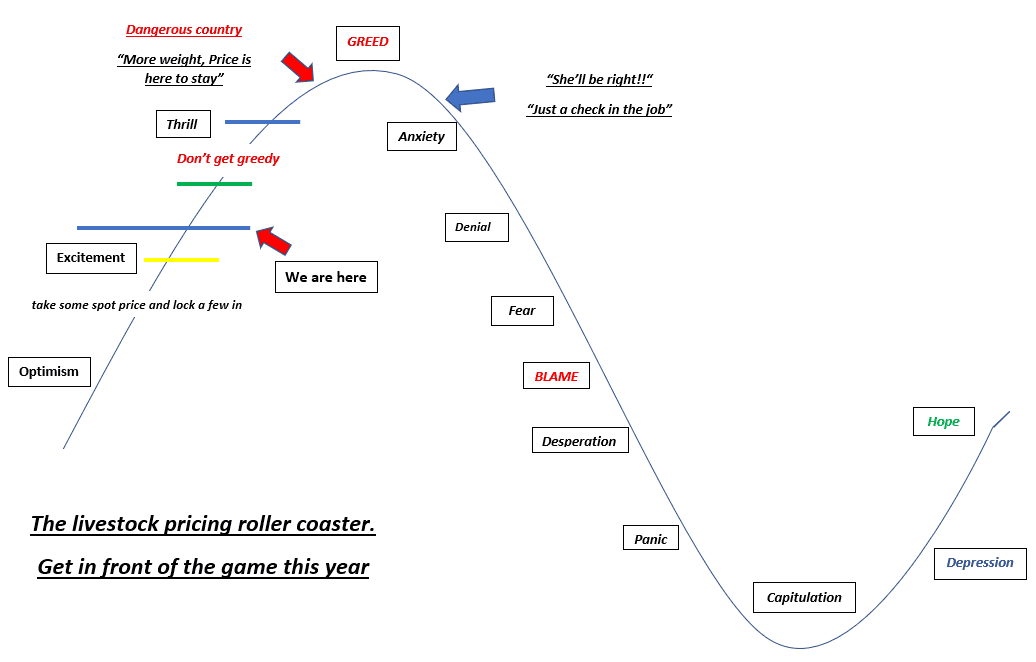
Time to reset what we are doing and how we are thinking
This diagram is so simple and hopefully gets you thinking about the coming spring supply and demand pressure on pricing vs weight gain change over. Take the time to think about what you need to do instead of “doom scrolling” on facebook at night.
Feedlot lambs/wet pens.
Speaking to one of the major lamb processors this week and he raised the issue of stock not being presented in a satisfactory state for slaughter. Every year I raise the need to prepare paddock sucker lambs by curfewing them before trucking. However, the increase in feedlot lambs and wet weather has created the issue of mud dags on the belly and crutch that make it impossible to process them. One works returned two loads to the vendor as unsuitable for processing which shows the seriousness of this considering the shortage of lambs.
We saw this introduced with cattle many years ago seeing a requirement for exit cattle during wet conditions to be washed to remove dags prior to delivery. The simple solution for mud dag lambs is a full belly and wide tail crutch before consignment to remove a contamination risk. Don’t do this on your normal paddock sheep though, just a simple pocket crutch to preserve your skin value. I agree with the return of dirty livestock as a processors export licence is way more important than 400 mud covered lambs.
Agistment needs to be front of mind as an income stream.
I took a run up to the Farina bakery last week at the bottom of the Birdsville track. From Orroroo north the feed situation got better and better. However after covering about 100 km it became evident the one thing missing was livestock. This feed was not fresh green but established cattle feed as far as could be seen, 100’s of thousands of acres. We don’t get years like this very often in the grazing country and before the rain in northern NSW we were desperate for agistment. It’s a pity that so much simple income has been missed with something as easy as offering agistment.
One funny story agistment story from 1989 when the season was like this. Bob Rowe and Chris Thomas in the old T&R days dropped a mob of cattle on the Willochra Plain north or Quorn in SA at this time of the year. When it came time to load out the marshmallow had grown and was 6 foot high with the cattle making tunnels though it and were impossible to muster for a period of time. The marshmallow have the same growth this year.
Lambs.
The tailing percentages for lambs being reported are exceptional. Maiden merino ewes at 110% is common and older ewes towards 150%. Many of the April / May drop lambs are very fresh with the lead of them heading towards slaughter weights.
July is the time for agricultural shearings to start and the first of the southern sucker lambs to appear. Speaking to an old client at Robertstown in SA he has drafted off his first run of XB suckers averaging 40 kilo and putting them on A+ as stores. I like this approach of taking the very good money available with the lead drafts. Drafting the top 15% of your drop early and cashing them in is good business when prices are high. A little bit of extra work for a great return.
Seed.
It will be a massive seed year come spring. Make sure all of your hard work on lambs is not wasted by letting them fill up with geranium, spear and barley grass seeds.
SIL ewes.
Plenty of this model now being purchased in the high $300 range. The math still works but we now need to be mindful of what is driving the price – Wool, SIL percentages and mutton price. If one of these corrects (mutton price) the lamb & wool value become very important. For those that jumped in at $180 – $220 I think your model is looking pretty good but don’t stop looking after the ewe and lamb just because you purchased well.
Alice Springs show sale.
Cattle presented very well with just under 4000 offered consisting of 3000 steers. Steve Gaff, Red Centre Rural quoted best 400–500kg feeders to $6.02 and averaging $5.45. Across all steer weight ranges the average was $5.33 / kg. I remember when $1 a kg was a good day. Well done to the Stations that support this sale. Like the Mountain calf sales, it is part of the Australian story and should be preserved.
Feeder prices holding
Andrew Hosken, Hosken Livestock, Tamworth has always kept a very close eye on cattle trends. Feeders are holding around $6 however we think the net is being cast wider for numbers, so the potential upside is being absorbed by the additional freight cost and a move towards on farm pricing weighed nearest weigh bridge. Smaller saleyard numbers are being offset by supply running from the north keeping abattoirs satisfied. Although we both feel this supply run maybe shorter than some pundits suggest.
Chinese tariff adjustments had already been factored earlier in the year by Australian processors however offshore demand has yet to strongly influence pricing. The Chinese tariff structure is different to the Brazilian supply into the US with a very small pre delivery window available prior to the next Chinese tariff free period commencing in January.
Longer term outlook remains positive with cows and calves or PTIC cows remaining very good buying compared to dry cattle. A splitter / fattening cow and calf from $1750-$2700 looks great value alongside 600c steers. Split the calves off asap & treat as 2 fatteners – weight gain on both equals dollars.
Stud sale season.
Bulls and rams are presenting exceptionally well and the selection available is outstanding. Again, I stress look at what the end user wants and what you can deliver from your property. Many of the good agents and elite studs will assist you with this discussion. Using the tools available such as the EBV / ASBV are extremely important.
Also consider the future marketing opportunities that you should breed towards e.g. IMF measurements in lambs aligned to the development of a premium lamb / sheep product offering similar to cattle. It is important to directly connect your sire purchase to your sale program, just dropping calves and lambs on the ground and hoping for the best leaves income the table.
Housekeeping for WA producers and Eastern state buyers.
It is a requirement in the east for livestock to be accompanied by a National Health Declaration. Even though it is not a requirement in WA this simple document allows Eastern buyers to operate on your livestock at auction. For the buyers it is important you establish which lots have it before bidding. Trying to secure these documents after the event is creating a real issue for the selling agent which a simple question could have fixed.
Touristy stuff.
Farina bakery on the Birdsville track was exceptional. Speaking to the baker he had baked 153 loaves of bread the previous day of all descriptions. I did laugh when told collecting wood is not allowed and they are reliant on old mulga fence posts. Bloody hell, after standing up for over 120 years these posts burnt hot, I suppose they trucked them in from somewhere else years ago? How times change. Completely volunteer run this operation has tourists from far and wide lined up. Only open for 8 weeks it has 1 week to run until next year. The win for me was the Vanilla slice as good as I have ever eaten.
The Birdsville, Oodnadatta and Strzelecki were all closed indicating the fantastic winter rains that continue. I know the scientists say Lake Eyre being full doesn’t make any difference, but I reckon that’s BS because the season is beyond good.
Simpson desert trip planned? Don’t!! Unless red mud and bogged to the mirrors is your fun pass time
Next article:
I will have finished my role as the RMA Network CEO. What a fantastic three years dealing with independent agents from all over Australia as well as many involved in the entire red meat and wool chain. Other than travel, I will continue to be involved with the RMA Network in helping maintain and developing contacts on an ad hoc basis.
Opportunities
- Take the win on the lead lambs
- Lock in some forward pricing on wool
- Cow and calf trades – weight gain x 2
- Correct presentation for processors
- Sire selection – work out why you need him first
- Have a look at central Australia before the heat appears – once in a lifetime.
 Chris Howie will sign-off with friends and colleagues as the retiring head of RMA at RMA’s annual member conference being held in Brisbane today and tomorrow. He plans to continue to write his popular Beef Central and Sheep Central monthly column. Reports from the conference in coming days.
Some valid thoughts.
6 mths vision is essential and. eware of stupid Gov interference, they don’t consult our rural industry leaders
Well done Chris
Always look forward to reading your articles
Full of useful advice