
WEATHER is the word this week as Australia’s benchmark saleyard indicator drops 40c and yardings start to increase.
Meat & Livestock Australia’s Eastern Young Cattle Indicator has closed this week at 955c/kg carcase weight, down 40c from the start of the week after it went above 1000c earlier this month.
Many of MLA’s saleyard reports, including Dubbo, Roma and Dalby, mentioned conditions drying out – which reduced prices in those markets. Both reports said southern restockers were still active in those markets, which put a floor in the price.
Heifers have copped the biggest hit, with MLA’s restocker heifer indicator dropping 30c to 437/kg, the feeder heifer indicator dropping 10c to 464c/kg and red ink over the heifer section of the big saleyard reports.
Numbers contributing to the EYCI have been increasing for the past month, with 22,000 going into this week’s indicator being a 7000 head increase from a month ago.
MLA’s Alex Fry said in his weekly market wrap that the national yarding increased 4 percent week-on-week to 72,529 head – with that increase entirely driven by some big yardings in Victoria (that do not contribute to the EYCI).
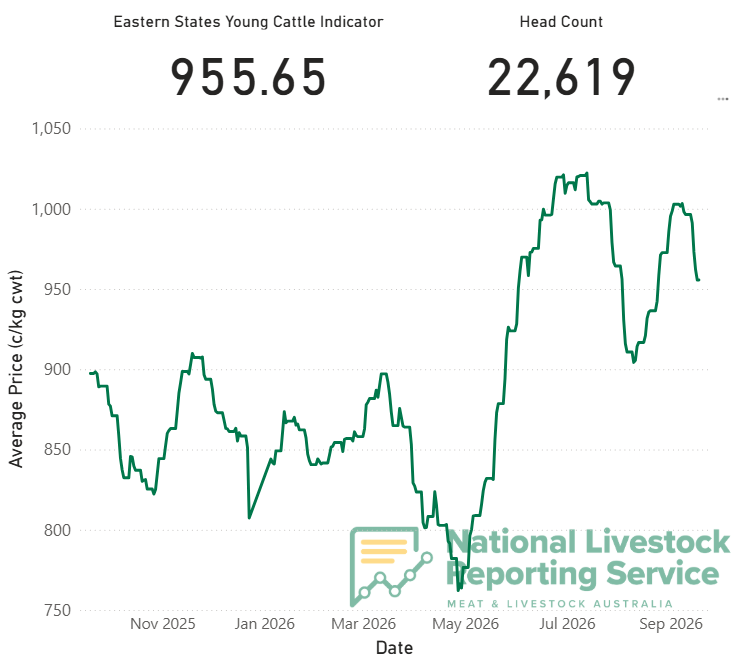
The Eastern Young Cattle Indicator September 18. Click to enlarge.
Leongatha yarded 5108 head and Mortlake yarded 6466. Bernie Grant from LMB Livestock and Land at Hamilton said a dry weather forecast and El Nino declaration was pushing many producers to make sure they have some cash in case the season deteriorates.
“Producers are just taking a bit of the action while there is good money around,” Mr Grant said.
Market still very strong
Mr Grant said the market was still very strong, with Angus feeder steers making between 530-550c/kg and heavier (350-400kg) weaners making between 580-620c/kg.
“Not many light cattle were there this month, because the season has been so good there wasn’t many of those 200-250kg steers – I think they have already gone,” he said.
“I don’t think we will see many light cattle from now on. Even in the weaner sales next year, I think the lightest cattle will be about 270kg.”
Most of the cattle were sold to buyers in Victoria, with Mr Grant saying most producers further north chasing some lighter cattle.
“Feedlots were still very strong on those 350-400kg weaner steers, they were pushing that job along very well – which they haven’t been doing in other sales,” he said.
Numbers to peak in November
StoneX Australia livestock manager Ripley Atkinson said there are more calves in Victoria than he originally thought. He said in his weekly email that he was expecting numbers to keep increasing before peaking in November.
“Seasonally at this time of year, cattle supply continues to grow before peaking in November – the onset of drier weather may pull this forward and naturally, we should expect to see larger volumes marketed from here on in,” he said.
With conditions drying out again in Northern NSW and Southern Qld, Mr Atkinson said demand for lighter cattle had dropped slightly.
“Restockers are losing some belief in the weather outlook and that’s being reflected in a pullback in rates for light cattle as demand wanes,” he said.
“Watch this though, because if widespread storms develop (which they will at some point, likely November) the market will sharply move the other way – meaning continued volatility in prices as demand swings into the end of 2026.”
HAVE YOUR SAY