
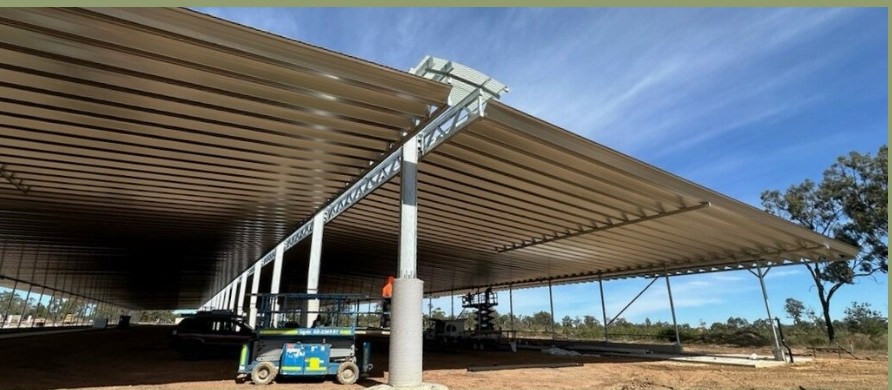
Permanent shed structures at Darren Hamblin’s Struggle Downs feedlot near Warwick
TAKE a look around the 100-odd commercial trade displays at the grainfed industry’s BeefEX conference held recently, and it was clearly evident that permanent shade structures are now big business across the feedlot sector.
At least five or six permanent shedding service providers mounted substantial displays or attendance during BeefEX, held on the Gold Coast – each with their own benefits and perhaps, drawbacks.
Australian Lot Feeders Association’s Jeff House estimates that somewhere around 50,000 Australian feedlot cattle are now housed under permanent roofing, rather than shadecloth.
Roll back 20 or 30 years, and there were only two or three Australian feedlots with permanent shed structures.
The first was the Tasmania feedlot built and operated by Japan’s Jusco/Aeon, where local weather conditions made weather-proof shelter an imperative for acceptable pen conditions. The second was the smaller Ashleigh Park Wagyu feedlot near Culcairn in southern NSW, originally built along Japanese housed feedlot lines.
Rangers Valley installed an early permanent shelter area some years later, but its been the last five to eight years that traction has really started in adding permanent shelter in some feedlots, as distinct from shadecloth.
Scroll forward to today, and somewhere between 20 and 30 large beef feedlots have invested in permanent shelter. Most are in addition to, rather than replacing shadecloth type shelter.
Most, but not all, are geared towards longfed Wagyu and Angus programs. One exception is a smaller yard on Queensland’s eastern Darling Downs, feeding predominantly Coles 70-90 day cattle, where a permanent shelter was retroactively built over an existing feedlot.
“Let’s not call it a shed”
During discussions at BeefEx on the topic, it became evident that some grainfed industry stakeholders prefer to avoid the use of the descriptive term, ‘shed’, which they say implies that each structure is “an enclosed box with roof, and four enclosed sides.”
They are wary that that carries with it some connotation of intensive livestock production, when in fact such roofed facilities have unimpeded airflow, abundant ventilation and light, and in some cases allow cattle to move out into open air sections of the pen.
Stocking density is evidently a balance in covered-yard pens. While traditional pen scraping and manure removal often becomes unnecessary under cover, too few cattle in the pen and conditions get dusty; too many and the conditions can turn boggy, one yard manager said. The secret is to manage numbers so that natural animal discharge keeps the pen surface moist, but not wet.
Simple logic might suggests that higher value animals (eg Wagyu) may offer greater value from the considerable investment in building permanent roofing – but it’s not necessarily the case.
Nathan Schwarz, principal of permanent shelter manufacturer, Earthscape Technologies told Beef Central that he typically receives four or five inquiries each week about potential permanent shelter installations in feedlots.
“But only about half of those are about Wagyu; the rest are for conventional cattle,” he said.
What was clearly evident in the BeefEX trade show roofing displays was that different roofing design system approaches have been adopted by lotfeeders.
Earthscape Technologies, based on the Darling Downs, developed a roofing profile steel forming, called VersaSpan used to roll roofing profiles on-site. The unique profile qualities of the ribbed (corrugated) roof material allow for spans of up to 20 metres without structural support, and overhangs of 3-5 metres. This helps reduce construction costs.
The technology slowly developed from its original application in quick and easy constructing of military shelters during times of conflict. Complexities in calculating structural strength, especially in curved roof profile situations, has limited its civilian and commercial use up to now.
Earthscape’s roofing profile forming equipment has recent been used in far-flung locations across Queensland, including a large shedded structure at Strathmore Station in Queensland’s Gulf country. In other applications it has been used for hay sheds, machinery sheds and even aircraft hangers.
Feedlot roofing structures have now been added to the list of applications, with the system featuring in Darren Hamblin’s expanding Struggle Downs feedlot near Warwick. The yard now has two covered areas, each 10,000sq m (200m x 50m) in size, accommodating 1000-1200 head under each. Roof height is about six metres, providing good ventilation, without obstructions.
One of the key features is that the ‘self-supporting’ roofing system can reduce construction costs by 30pc compared with some shed options, Mr Schwarz said, through reducing the total volume of steel support required.
A second installation is happening at a greenfield feedlot site near Bell, with up to six covered roofed areas planned.
Mr Schwarz said potential feedlot customers had a variety of reasons for considering roofed shed installation.
“In some cases, especially further north, it’s simply to keep cattle cooler, improving feedlot performance. In another example from a lotfeeder in South Australia, its all about managing high rainfall and avoiding wet/boggy pen conditions over the winter months.”
“When we talk to the average customer, they see a lot of benefits. For many the main goal is avoiding climate issues and taking more control of the environment and optimising feeding performance; but there’s also the opportunity to feed more cattle on a given footprint, compared with open pens, under regulatory considerations.”
For others, another factor was the opportunity to harvest the runoff water from the roof. At the Struggle Downs yard and the new facility near Bell, roof runoff (20,000sq m in total at Struggle Downs) is directed into a dam, and pumped into tanks for stock water.
“In the case of the new Bell feedlot, its been calculated that the rainwater off the roof could account for 30pc of livestock requirements, in an average year,” he said.
Multiple reasons for investment
While the reasons for investment in sheds are many and varied, here are some of the main roles they are playing in feedlots, based on industry feedback:
- Controlling climate issues – the shedding helps reduce heat load in warmer areas and keeps cattle out of wet and cold conditions, improving pen surface conditions.
- Reducing dag loads – many shedded pens are used for the last phase of a feeding program where the dry bedding and pen surface eliminates dags on coats.
- Increasing cattle numbers – regulations allow for higher densities of cattle under sheds, meaning lotfeeders can increase numbers without increasing geographical footprint.
- Adding water – shed roofs can capture large amounts of water that can supply drinking water for cattle for about a third of a year. Cooler conditions under cover also reduce overall water consumption.
Victorian-based shed manufacturer Entegra has taken a lead role in the development of feedlot sheds, with its Ridgeback barns accounting for an estimated 80pc of the country’s shedded feedlot pens.
Entegra has been behind some of the more well-known shed developments in the country, including Teys’ at its Jindalee Feedlot, Rangers Valley at Glen Innes, the Shaw family’s Canning Downs feedlot at Warwick and the live export yards at Berrimah next to the Port of Darwin – which is not technically a feedlot but uses the Ridgeback design.

An Entegra shed at Teys Jindalee feedlot.
The company says it has about 50 projects in the pipeline, including a large development at Tess and Andrew Herbert’s Gundamain feedlot near Eugowra in Southern NSW.

AgDSA’s Matt Norton listens on as Entegra’s Greg McCalman addresses the recent Toowoomba protein conference.
Director Greg McCalman said there are many and varied reasons operators are investing in sheds.
“You have your very traditional feedlot space, which is mostly within a three-hour radius of Toowoomba, there has always been interest there,” Mr McCalman said.
“There is also quite a bit of interest down south and now even from the United States. We have done some installations in New Zealand but that is mainly for dairy. We have quite a few in the tropics and we are very interested in looking at Asia over the coming years.”
Mr McCalman said it was hard to distil down the main reasons lotfeeders are making the big investments into sheds, as the reasons varied from region to region.
“You can have anything from dag loading, heat loading, getting them out of the cold and wet if they are down south. You have commercial reasons like average daily gain increases and health reasons like lower mortality and morbidity,” he said.
“Water is becoming a bigger part of the conversation because you are reducing your consumption of water by having them in a controlled environment and you are able to capture clean rainwater.
“Instead of the rain being a double negative like it is in traditional pens, where you are losing the water and creating odour, effluent and everything else, you are now turning the negative into a positive.”
Tips for building a shed
Asked what he would tell someone looking to build a shed, Mr McCalman offered a few simple tips:
- Keep it simple – adding ongoing cost like fans and electricity are a balance sheet cost and the project will not stack up as well financially.
- Think about bedding – he said bedding could be an article on its own. It was important to know what type of pack you are after and have the materials like wood shavings, straw or other things already accounted for.
- Sheds are designed for greenfield sites – while retrofitting to existing pens is doable, it is a challenge and Mr McCalman says you can end up paying for things twice.
- Look at a clean water pond – Mr McCalman said he had not seen the water from a shed fit into tanks, putting in proper drainage rather than letting it flow into a swale drain means the water will be clean for consumption.
Another consideration with sheds was whether to make the pen area completely covered or partially covered.
“There is two sides two that point. If it is partially covered, you still have to do all your effluent management, you still have all your falls and earthworks to suit that,” Mr McCalman said.
“But the upside of partially covering a pen is that you can reduce your square meterage of roof.”
HAVE YOUR SAY