
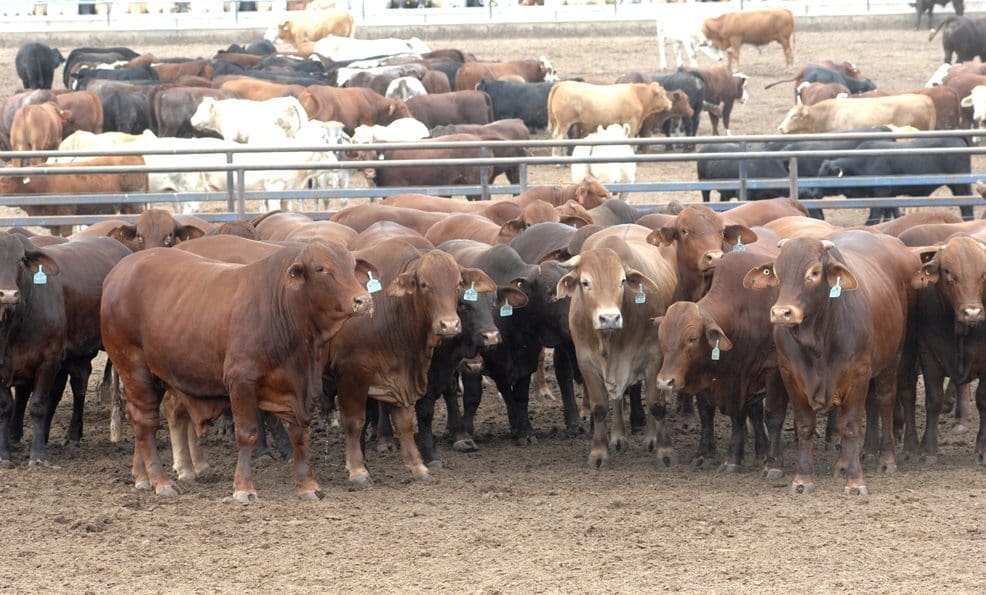
THERE’S an old saying that for lotfeeders to make a profit, they need two of the three key variables – feeder steer price, ration price and finished grainfed slaughter cattle price – to be working in their favour.
Unfortunately in Beef Central’s latest 100-day grainfed trading budget calculated on Friday, all three appear to be working somewhat against them.
In the leadup to this week’s BeefEx feedlot conference on the Gold Coast starting on Tuesday afternoon, we’ve applied our standard set of variables (see full description at base of page) to forecast profitability in a typical 100-day program on the Darling Downs.
The projection is based on a 450kg feeder steer purchased on Friday going on feed in a Darling Downs custom feedyard this week, and closing out after 105 days on 4 January next year. Beef Central has published the trading budget occasionally over the past 15 years.
Our latest calculation on Friday forecasts a trading loss of $170 on a typical animal entering feeding pens this week. That loss is exceeded only by a figure of -$236 recorded in a similar calculation this time last year (details below).
Worth noting however, the current trading loss figure of $170 is based on our standard animal producing an average daily gain of 2kg/day. For better feedlot performers gaining at 2.2kg/day (10pc improvement), the loss softens considerably, to $72 a head.
Feeder price
For today’s trading budget we have priced a typical flatback feeder ex Downs at 520c/kg. That’s down from a peak around 550c/kg seen about a month or six weeks ago, but much higher than the 480c/kg quoted around this time last year.
As noted earlier, feeder steer prices have not yet declined significantly in line with the deteriorating season and tough export meat trading environment.
AuctionsPlus quoted +400kg feeders from 482c-601c/kg on Friday, averaging 555c, but the overwhelming majority of those sales were located in southern Australia, and were Angus-based, attracting a considerable margin. Paddock quotes on Angus feeders remain anywhere from 560-600c/kg in some areas.
Ration price
Ration prices being charged by typical Downs custom feedyards are currently around $540/tonne, close to all-time highs seen in the past 15 years. Some yards claiming higher performance are charging higher than that, around $560-$570/t, Beef Central was told this morning.
Grain positions obviously vary from yard to yard, which may impact that figure, but grain prices generally have risen $20-$30/t in the last three weeks.
For comparison, our trading budget calculated in September last year (Sept 3), quoted a finished ration price of $450/t – $90/t lower than where it sits today, worth around $140/head over the 105-day feeding period.
This week’s ration price is based on a Downs wheat price last week at $430-$440/t and barley $410-$420/t. That’s partly due to the outlook for new-season local grain, with dry weather having a significant impact. Southern grain in now being shipped north to Downs lotfeeders in volume, and that partly accounts for the current Downs feedgrain price. While the prospects for new season grain in the south are much better, that harvest is still some way off.
Other factors affecting current ration prices being prepared on the Downs are sharply rising diesel prices pushing freight rates for southern-grown grain higher, as well as its looming impact on harvest costs; and the rising value of other ration ingredients. Cotton seed, for example, is currently trading on the Downs north of $600/t, and hay is close to record highs, as many producers buckle-down for a dry run ahead.
Based on this week’s feedlot ration cost of $540/t, we calculate current total feeding cost in 100-day programs at $846/head ($705 this time last year), and total production cost (including feeder purchase) of $3117 (versus $2912 a year ago).
Cost of gain
Cost of gain on current variables is around 400-420c/kg, which, when compared with a 520c/kg feeder buy price makes feeding cattle for longer periods look attractive.
Is it happening yet? A couple of large Downs feedlots offered the following comments:
- Any extension of days-on-feed using lighter cattle to exploit cost-of-gain advantage comes with a penalty – lower stock turnover. Some yards currently operating at sub-optimal capacity might consider it, but for yards where pens are full (Queensland yards said to be at an unbelievable 98.4pc utilisation in the June quarter survey), it is less attractive
- As conditions continue to dry out, average feeder cattle intake weights in many Downs feedyards are declining anyway – regardless of any decision-making around COG.
All the above variables deliver a breakeven figure of 926c/kg, carcase weight in our latest budget.
Forward contract finished cattle prices
Against that, forward contract export processor grainfed quotes for 100-day cattle for early January delivery next year are at 875c/kg, reflecting the current tough meat trading environment. Forward contracts got to a high-point around 900c/kg earlier this year, before moderating somewhat. Tariff impacts in China and the US, plus a build-up of stock, have moderated the market outlook for Australian export beef, heading into the new year.
On the basis of a typical 356kg dressed weight carcase, the difference between the breakeven figure and forward contract price represents a loss of $170 a head.
Keep in mind the close-out figure for today’s budget is beyond the export processors’ Christmas close-down cycle, which should (in theory) increase their appetite for grain finished cattle intake. On top of that, the industry will be at the start of the ‘re-set’ for quotas and tariffs into key grainfed markets like China and South Korea.
For better feedlot performers gaining at 2.2kg/day (10pc improvement), this week’s loss moderates considerably, back to $72 a head. Worth noting, however, those better performers over the years in our trading budgets have more typically been in the black, rather than the red.
If it’s any comfort, the $170 a head loss figure quoted above is not record high. Our previous trading budget this time last year (click here to access) using the same variables forecast a $236 a head loss, the largest ever seen in this series stretching back 15 years. That loss was based on a breakeven of 838c/kg, and a forward contract for delivery late December worth only 770c/kg at the time.
So on the basis of the projected losses above, are fewer cattle now going onto feed?
Clear signals are not due until the next September quarter feedlot survey, results from which are not due until the middle of November.
“While anecdotally, at least, Downs numbers on feed are not yet in decline, there is certainly resistance being seen and heard among feeder buyers, based on current trading terms,” one regular Downs feedlot contact suggested.
“The advance of Wagyu feeding also clouds any trend in shortfeds a little,” he said.
“A lot of pen space that would once have been devoted to shortfed cattle is now taken up in those longfed programs, so the trend in numbers is de-sensitised somewhat. And Angus demand, if feeder price is any indication, remains relatively solid.”
About Beef Central’s 100-day grainfed trading budget
 Beef Central’s 100-day grainfed trading budget calculation is based on a standard set of representative production variables, ex Darling Downs. The calculation is built on a feeder steer 450kg liveweight, fed 105 days; 356kg dressed weight at slaughter; ADG of 2kg; consumption 15kg/day and a NFE ratio of 7.5:1 (as fed); $25 freight; typical implant program. Bank interest is included. The trading budget should not be interpreted as a comment on the viability of the lotfeeding sector – it is simply a gauge of the exercise of buying feeder steers, getting them custom-fed, and selling them under a forward contract to a grainfed processor. The opportunity costs of the exercise can easily be misunderstood, but the exercise is designed to provide a basic benchmark of profitability.
- Beef Central’s BeefEx conference coverage starts on Wednesday
Redo the math in USD per pound…
The Export of Beef is primary to USA who are underpaying Australian Farmers Lot Feeders and Exporters by over 50%
USA.pays Farmers $7.10 ($10 AUD) per Pound liveweight
This translates to around to $22 AUD per Kg
Australian Mining and Grain Companies don’t sell or export in AUD or sell to the USA for under 50 percent of value ask them to market Beef and get a fair share of the real value.
A $2000 AUD steer is $4400 AUD in the USA however you try to cut it Australian Beef Farmers are getting less than 50 percent of the real value of their Beef.
Imagine compounding that loss with a percentage based transaction levy rather than a flat rate levy!!