
IMAGINE a 200,000 head cattle feedyard processing more than 500,000 tonnes of corn each year for rations, where the heavily-automated feedmill is manned by just a single employee driving a front-end loader.
It sounds like a piece of fiction speculating about the grainfed industry’s distant future, but in reality its already exists, on the sweeping plains of Nebraska in the United States.
 Providing a deep dive into Blackshirt Feeders’ new greenfield feedlot project in the US Midwest during the opening stages of the feedlot industry’s BeefEx conference on the Gold Coast this week was founding partner Kee Jim.
His presentation covered design decisions, challenges, innovative solutions and commercial logic that’s been applied in the massive project.
By Christmas this year, the new Nebraska feedlot (not far from the town of Laird, just across the state border in Colorado) will be three-quarters complete, with capacity of 150,000 head. The final 200,000 head end-point will be completed next year.
That will make the Blackshirt feedyard the largest in the US, and second only in size – worldwide – to a yard or two in Mexico.
Unbelievably, the project has the capability, land, water access, license and milling infrastructure to expand even further, if the business decides to do so.
“I don’t believe there is really any reason to go to another site to expand further,” Dr Jim said. “The only real constraint to the size of the current feedlot is the ability to disperse nutrients. That would become the limiting step,” he said.
Most of the cattle on feed at the site are light feeders (just 300-400lb, or 150-185kg) mostly beef on dairy crosses.
In discussions with Beef Central after his presentation, Dr Jim shared that the cost of construction of the yard worked out at about US$1250/beast area, or about $1760/beast area in Aussie dollars. Given current construction costs in this country where some expansion projects are being valued at $3000-$3500/beast area and even higher, that figure looks highly competitive, despite the layers of innovation involved.
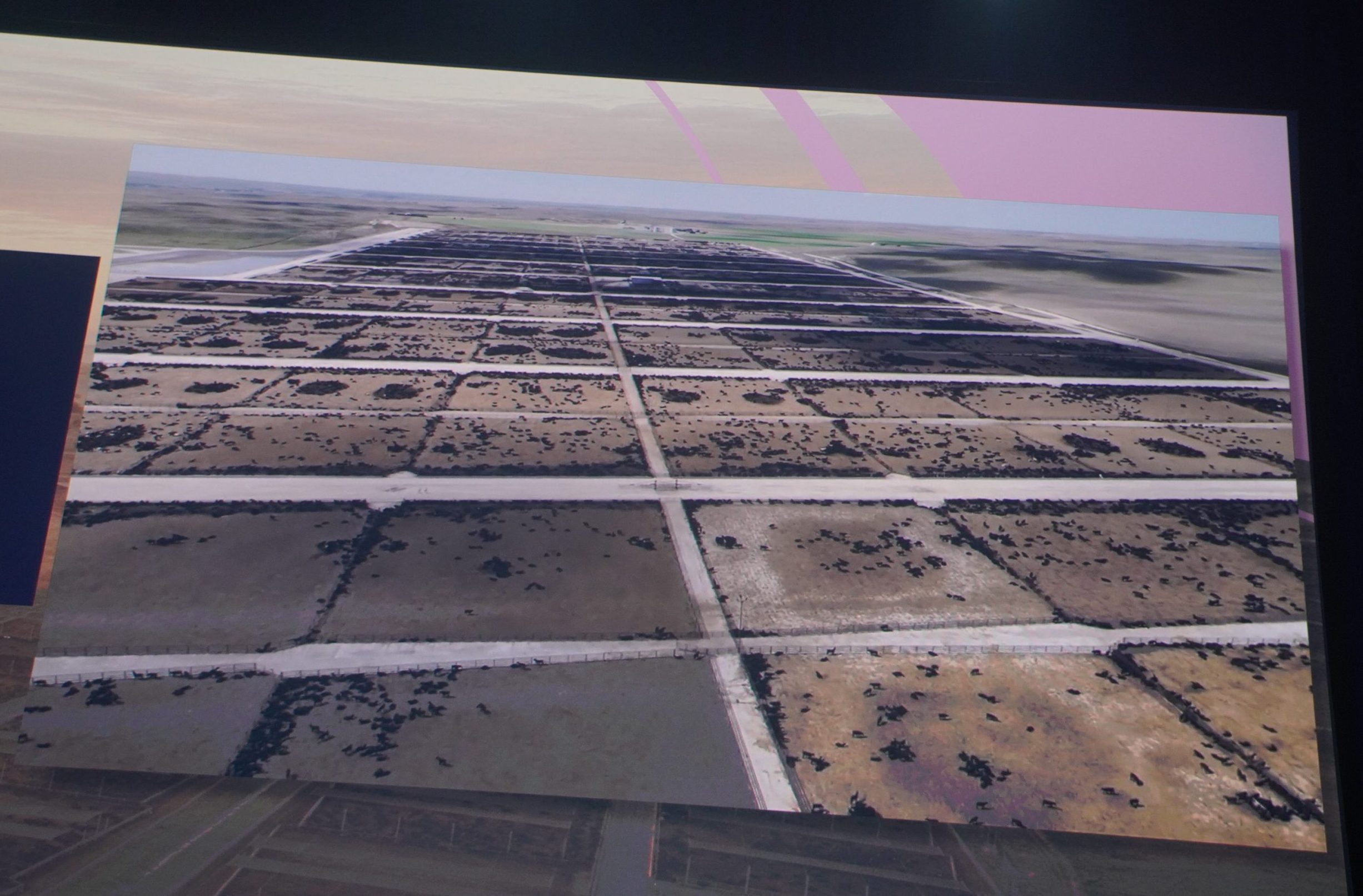
Cattle in pens at the Blackshirt Nebraska site
Greenfield site
Blackshirt Feeders/GK Jim Farms operates 16 yards across the US and western Canada, feeding around 750,000 head.
Building the new greenfield yard came about because Blackshirt felt it had “pretty much run out of US feedlots that it could acquire, that we felt were appropriately sized,” Dr Jim said.
For efficiency of operation reasons, the company “really did not like yards much under 100,000 head capacity,” he said, “but we just could not find any worth purchasing that were of that size.”
Blackshirt faced a problem familiar with many of Australia’s larger yards, that grew from modest proportions when first constructed decades ago, before drainage, environmental and other considerations came into play.
“For all the other 16 yards we run, we were quite critical, saying geez, I would never have done that, if I had been building those sites. In the past, people generally built feedlots where they lived – on ground that was not farmable – meaning they did not end up in very good places. There was little effort put in, from first principles, about where to site a feedlot, taking all things into account.”
But the biggest downside of a greenfield feedlot site was that whatever mistakes were made in layout and design, they could not be blamed on anybody else, Dr Jim said.
“The beauty is, knowing how big this thing was going to be, we were able to put things in the right spot – right from the beginning,” he said. “That doesn’t happen with a feedlot you buy and expand – it grows like a mushroom.”
RCC technology
One of the key innovations seen in the new Nebraska yard is the adoption of Roller-Compacted Concrete (RCC) as a pen floor base.
RCC was developed by the military for the rapid, cost-effective construction of runways and other purposes. The first application in a large scale feedlot in North America happened only in 2020.
RCC does not contain re-bar, and is compacted using vibratory forces. It is suitable for flat work only – not structural applications. It contains the same cement content as regular concrete, but different water and aggregate ratios, delivering the same breaking strength as regular concrete.
But in general, it is about one-third of the cost of regular concrete (in the Blackshirt application, about US$2.25/sq foot, or US$300/head space).
Blackshirt had applied it in smaller applications in some of its existing yards in Canada, answering some of the questions around durability and how cattle were likely to handle being on concrete.
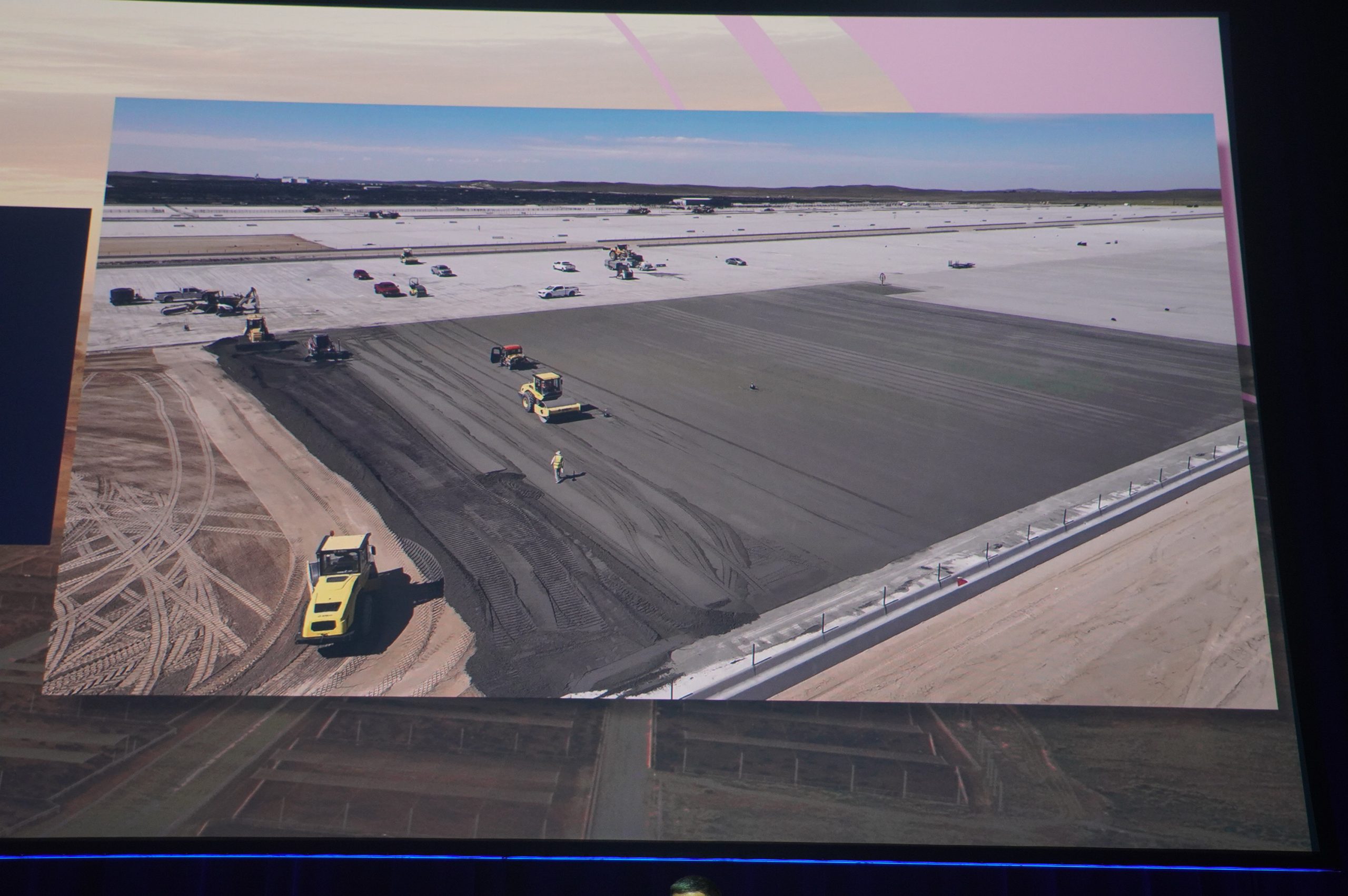
Plant levelling and compacting RCC to create some of the 300ha of pen surface at the feedlot site. Click on images for a larger view
More than one million tonnes of aggregate (roughly 44,000 truckloads) was required to batch and prepare RCC for the feedlot site, sufficient to surface an area of almost 300ha.
Pen slope was important when laying down RCC, with one degree the right answer, Dr Jim said. “You want the water to flow, but not fill up the collection ponds with manure,” he said. “It’s way less slope than what I thought was going to be required.”
In Blackshirt’s case, some five million cubic yards of soil was moved to create the ideal slope for drainage.
One of the huge advantages in the RCC-floored pens over dirt floors was zero pen maintenance, Dr Jim said.
The business had calculated that on the basis of conventional pen maintenance costs in the Nebraska area, RCC would pay for itself within five or six years. And that’s before the bio-digestion RNG benefits outlined below.
Ideal site
The site chosen for the project ticked a lot of regulatory, climate and environmental boxes – including the need for access to vast quantities of aggregate to produce the RCC floor-base, access to feeder cattle, water, feedgrain, packing plants and labour.
In order to secure enough water for the project, Blackshirt had to ‘dry-off’ (purchase) nearby irrigated farmland and associated water rights. It purchased 13 areas of farmland, removing the irrigation, backed by bores seven miles away in the world’s largest aquifer, piped to the site.
The surrounding Dundee County is the largest corn-producing county in America, with the aerial image below showing hundreds of green dots – each of which is a centre-pivot irrigation site watering around 130ac of corn, while the larger dots represent 550ac. Average irrigated corn yields in the area are 225 bushels/ac.
If we have our calculation right, that’s about 5.72 tonnes/ac, or 14.1t/ha.
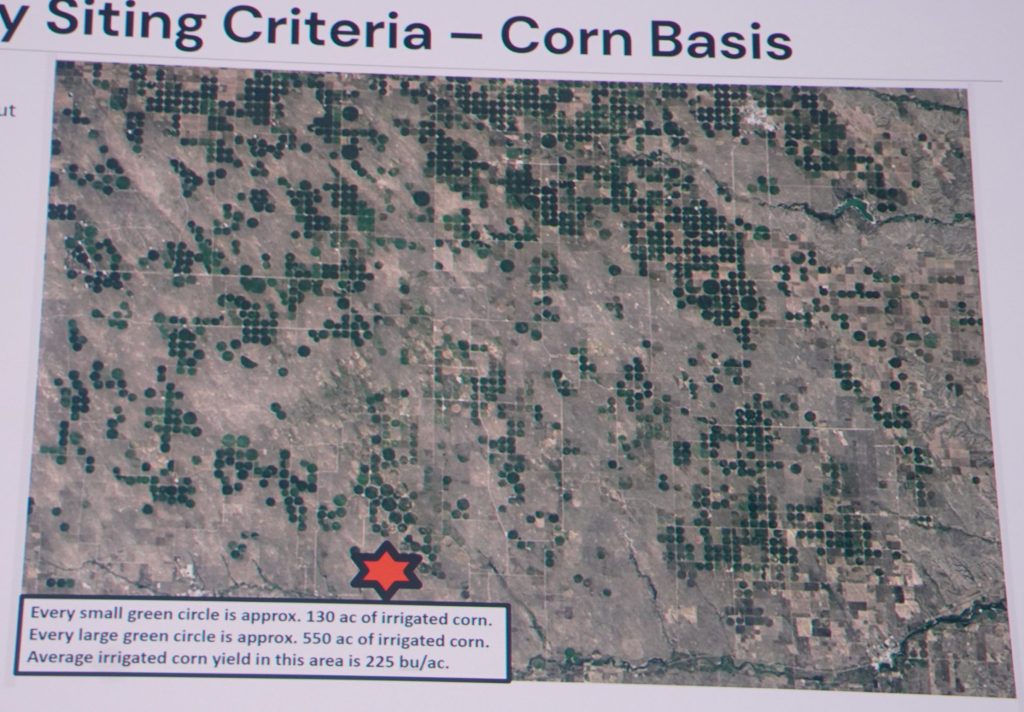
The farmer immediately adjacent to the feedlot controls some 18,000ha of irrigated cropping land.
That massive local production means the corn basis trades about US$20/bushel below the CME price. Contrast that with Blackshirt’s Texas yards, where the price is typically $101/bushel over the CME rate.
The difference in feed cost of production between the two areas was typically around US$150/head, Dr Jim said.
In sharp contrast with Australian conditions, there were 11 processing plants within a 320km distance (some of which were much closer), owned by JBS, Tyson, Cargill, National and others. Each one of those plants was processing more than 3000 head per day – roughly equivalent to Australia’s largest plant at Dinmore, near Brisbane.
Labour is another consideration in feedlot siting, and the new Blackshirt yard draws all its about from within a 45-minute driving radius. At full capacity at the end of next year, the site will employ roughly 100 staff.
Despite that, the company still had to build ‘Blackshirtville’, with up to 60 demountable accommodation buildings eventually likely to be placed on site.
Renewable Natural Gas project
At the same time, Blackshirt has an emerging anaerobic digestion business, using biodigestors fed with pen waste to generate Renewable Natural Gas (RNG) and creating carbon credits, currently worth around US$30/BTU.
With rising energy costs and via carbon markets, biodigestors are now economically feasible in large scale north American feedlots. One consideration, however, was access to an RNG pipeline to feed the production into.
“But in order for manure to stay clean enough to feed the biodigestors, our belief is that you do require a hard surface (RCC), and not traditional dirt floor pens,” Dr Jim said.
Feed milling automation
As highlighted in the intro to this article, Blackshirt has embedded high levels of computerisation, automation and infrastructure in its massive feed milling plant at the heart of the new feedlot.
“This is quite a bit different from our existing feedyards elsewhere,” Dr Jim said.
The highly automated batch mill takes less than three minutes to unload a full-sized grain truck, to supply the next year’s full built requirement of 20 million bushels of corn a year.
The two steamflake lines use massive 32×68 inch rollers, producing 40 tonnes of steamflaked corn/roll per hour. Each steam chest holds 1700 bushels, with a 35 minute retention time, delivering 60pc starch availability and 29 pounds of flake.
At the other end of the batch mill, it takes only three and a half minutes to manufacture a load (34,000lb), with a 75 second mix time.
The grand total number of human beings working in the mill is one: a single front-end loader operator, taking the components of the ration and loading them into the batch boxes for mixing, before tipping into the feed delivery trucks.
“To me, the ability to feed 200,000 cattle out of a centralised feed mill with just one physical employee is an amazing feature,” Dr Jim said. “That’s a big sea-change from our other sites. It’s an area that our team spent a lot of time looking at – evaluating all of the technology that they could find.”
He told Beef Central all the technology, sensors and other equipment used to deliver it was available on the market, bought and installed to work collectively.
“If you calculate the cost of feed milling infrastructure per head, and the cost of manufacturing, steamflaking and delivering the ration to pens – that is hugely different from our other feedlots.”
“It’s why we can run the system at 0.65 to 0.75 Full Time Equivalent employees, per 1000 head of cattle on feed – significantly more labour efficient than our other sites.”
In addition to the vast number of feeding pens, the new yard includes 300 research pens, each holding 10-15 animals, designed for trial work.
“Research is a critical part of our overall business model,” Dr Jim said. “We’re constantly looking at evaluating new technologies, feed additives, growth implants and other production tools.”
Horses were another integral part of the business, especially in pen riding, and the stable facilities at the site could be considered palatial, compared with most Australian feedlots.
“We believe that long term, nice facilities to saddle-up and work in is a good investment in attracting the best pen riders and cowboys to work with us,” he said.
Dr Jim said when completed next year, the project would come in with a budget variance of less than 4pc, and would be completed on time.
“We’re proud of the team that pulled it off,” he said.
- See today’s Weekly Grill podcast interview with Kee Jim.
The scale and efficiency of this feedlot is indeed impressive. It would be interesting to know what contingencies they have in the event of a breakdown at the feed-mill.
This is a wonderful article! Extremely educational….