
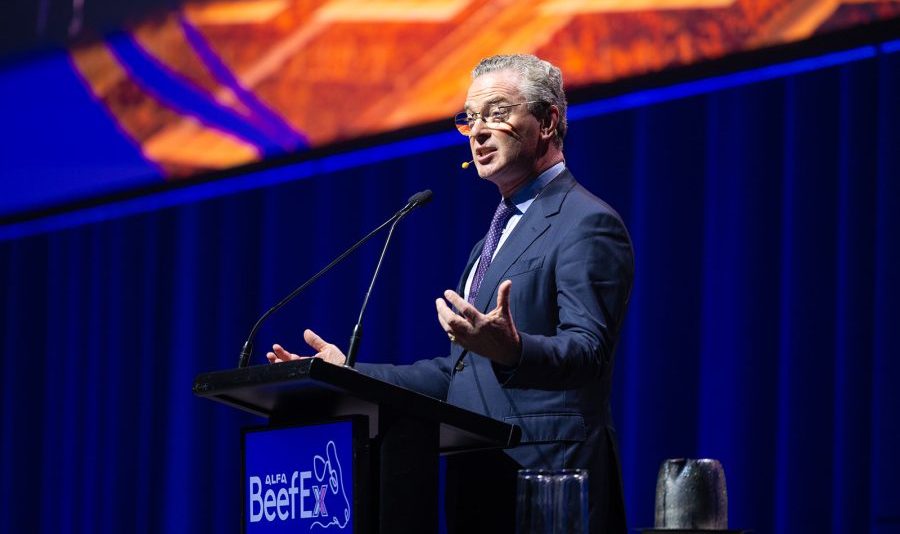
Former Federal Minister, Christopher Pyne delivers his address at BeefEx 2026. (Source: ALFA)
AFTER more than 25 years in Australian politics, Former Federal Minister Christopher Pyne knows what it takes to survive scrutiny, rebuild trust and keep communicating when the crowd gets noisy.
As one of the main speakers at the Australian Lot Feeders Association BeefEx conference this week, Mr Pyne shared what public life can teach any industry that knows what it’s like to be watched, questioned and misunderstood.
Mixed with stories from his two and a half decades as a politician, Mr Pyne detailed his crisis management strategies to the audience of more than 1200 lotfeeders, processors, exporters and service providers.
“I know that you feel you are under siege and that you’re threatened by social media or people from the cities who don’t know where their beef comes from, and sometimes we overemphasize their importance,” he said.
 “But the importance of the cattle industry is not to be underestimated, particularly in terms of the economic benefits.
“Agriculture really ranks with mining as the sector that has made Australia as wealthy as we are.
“Secondly, your sector creates tremendous social benefits. The communities of inland Australia are there because there’s economy and jobs there.
“So the cattle industry actually creates those communities. They wouldn’t be there without you, and that has a really important impact on the psychological health of the nation, but also our national security.
“We need people to be living all across our country – so people like you are part of our national security.”
The world looks to Australia for four things – Ag is one of them
One of the things that makes Australia influential in the world is our primary production sector, Mr Pyne told the audience.
He believed there are four sectors – mining, primary production, media (being home to News Corporation, the largest media company in the world) and sport where Australia impresses the globe.
“We are a dominant global player in things like beef, and one of the reasons the FTA with Europe is still not yet negotiated, is because we are a global behemoth in the agricultural sector, and they know that,” Mr Pyne said.
“Most Australians don’t realise that.”
Is social capital under threat? Yes.
Social capital is under threat and a lack of knowledge and education around where things, like food, come from, has put the beef industry under threat over the last 25 years, Mr Pyne explained.
However, he believed the beef industry had responded to that by continually improving and becoming world leaders in animal welfare, traceability, and environmental stewardship.
“You’ve kept investing in your social capital, and you need to keep doing so. Because politics and being in the public life has taught me, complacency is poison,” he said.
“If you think that everything’s fine and you don’t need to do anything new, that’s when the danger starts.
“That’s when the rot sets in, and this is particularly the case because of social media.
“Social media has changed politics, and it has put your industry under tremendous pressure.
“You are always a heartbeat away from a bad story being amplified by social media, which becomes an echo chamber, and it is very toxic.
“We think that the echo chamber is a reflection of what people are thinking, and it influences our decision making. But it’s not as important as you think it is.”
The danger of silence
So how does the beef industry maintain its social capital and public trust to survive judgment, when another crisis arises?
Mr Pyne explained his two ‘tried and true methods of surviving a crisis that could end your career or your industry’.
The first he called ‘leave no stone unturned’ and explained the importance of responding to every criticism.
“There is a tendency in Australia at a board level for people to ask their lawyer what they should say to the press and how they should respond to a crisis. I used to be a lawyer and lawyers are very cautious, so they almost always advise their clients to do nothing and say nothing,” Mr Pyne explained.
“In politics and in the industry you’re in, that is not possible. You have to leave no stone unturned. You need to answer every charge.
“One thing that Donald Trump has taught us is that you have to give your side of the story about absolutely everything to do with you.
“He has been accused and charged and found guilty of all sorts of terrible things and yet he’s won two elections to be the president of the United States. And everybody knows all those things about him and still voted for him.
“He answers every charge. He says, ‘I have to give my supporters my side of the story and let people make their own decisions’.
“So, he gets out there on the front foot and answers every single criticism.”
Mr Pyne shared early in his political career he was encouraged to share as much about himself as possible, ‘the good, bad and indifferent’, so that when there was a crisis people knew more about him than just that crisis.
“I was told it will help the public have a broader picture of me, so if something happened people would think ‘we know all these things about Christopher, and this latest thing wasn’t so good, but we like some other parts of him’. And that is Donald Trump’s method.
“That’s why in your industry, when you’re criticised, don’t go to the mattresses and hope that nobody will notice or that people won’t believe it. You have to answer every charge.”

The power of apologising – ‘doing a Peter Beattie’
The second of Mr Pyne’s tried and true method to surviving a crisis was – apologise.
“I call it doing a Peter Beattie,” he said.
“I was in my office one day, and I saw Peter Beattie doing a press conference announcing an election and his pitch was: the health system in Qld is completely broken and it’s all my government’s fault, and it wouldn’t be fair to give the opposition the job of fixing it. So, you need to re-elect me, so I can fix the problem that I created.
“I thought it was genius, sheer genius. He won that election very easily, actually.
“So, they are the two best ways to get out of a crisis – answer every charge and argue your case or apologise (when you’re in the wrong).”
‘You have a good story, get out there and sell it’
The best thing an industry can do is, obviously, not be in a crisis, but as the live export ban demonstrated external factors can cause the crisis. The next best thing you can do according to Mr Pyne is have a reputation you can lean on during the crisis.
“The mining industry uses advertising campaigns to remind people about the benefits of the mining sector, what it brings to communities, to national wealth, to global significance.
“We have the two biggest mining companies in the world in Australia and they invested in their reputation and they’re still doing it and I think the primary production sector can be doing the same.
“You can be investing in your reputation, so that when something goes wrong, because inevitably something always does go wrong, you have a strong foundation, a base where the Australian public think ‘we should give those people the benefit of the doubt because they are part of our national psyche, our national pride, and we want to support them’.”
He explained the industry will still need to respond and possibly change, but a strong reputation will allow the public to move on instead of trying to shut it down.
“I think staying below the radar and hoping that nobody notices the beef industry is not a great tactic,” Mr Pyne explained.
“I think continuing to build on your reputation is what I would be doing if I was advising your industry.
“When you think about the Royal Shows, everybody loves them. It’s the one time of the year that city people connect with agriculture and they love all the animals.
“So, there is a wellspring of support for the primary production sector amongst Australians, and I think you need to build on that.
“You have a good story, you should get out, and you should sell it.”
Excellent article. Awesome advice from Christopher Pyne. Peter Beattie was a master of managing media conferences. By admitting mistakes and taking personal ownership, and setting a plan to right them, he took the wind out of the sails of the journos time after time. Then he would do a ‘bump and run’ to change the narrative to positive stories to ‘feed the chooks’!