
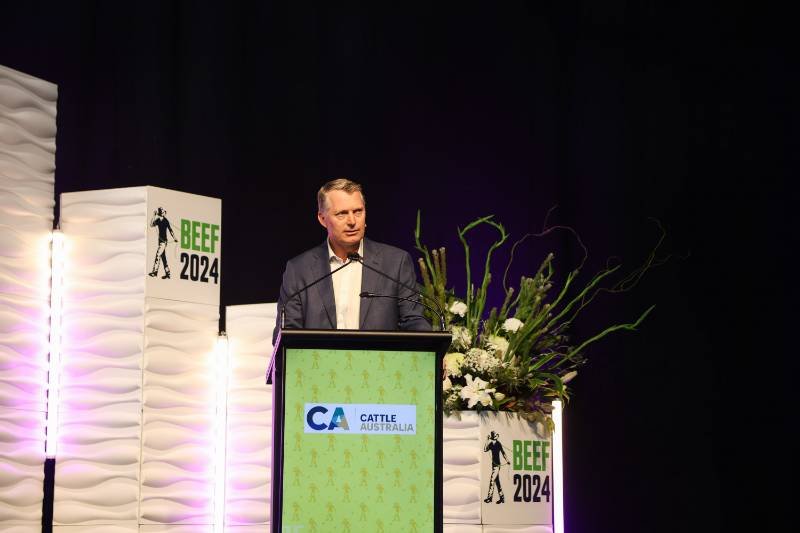
Rowan McMonnies addressing the Beef 2024 breakfast symposium. Picture: Beef Australia
One of the most engaging presentations delivered to a stadium filled with cattle industry stakeholders on the opening day Beef 2024 in Rockhampton two years ago came not from the beef sector but the egg industry.
As Australian Eggs managing director Rowan McMonnies told the opening Cattle Australia Breakfast Symposium that steak and eggs make a great marriage, but both also have common ground in the challenge they face to win and maintain community trust in their industries.
His candid and practical address in Rockhampton went to a question relevant to all sectors of animal agriculture – how should livestock industries respond when production practices are being scrutinised by an increasingly concerned public and at times hostile interest groups?
In answering that question he pointed out why the traditional industry instinct to launch into defence mode could some times make matters worse.
Mr McMonnies will return to the subject when he addresses the Australian Lot Feeders’ Association’s BeefEx 2026 conference on the Gold Coast from September 22–24.
“Constant rolling cannon fire”
At Beef 2024, Mr McMonnies recalled that by 2015 the egg industry was facing what he called “constant rolling cannon fire”.
 Controversy over cage production, the definition of free-range eggs, cholesterol and animal welfare was generating sustained negative coverage of the industry, he said, along with increased scrutiny from regulators and pressure from major retailers.
The industry’s response was to defend itself, seeking to counter emotional arguments with science-based information and responding to criticism “by shouting back with as much volume if not more”.
While that approach was strongly supported within the industry and gave producers some satisfaction, ultimately it did not help to achieve the larger objective of building the industry’s credibility or protecting its reputation.
What followed was a risk and an uncomfortable change in direction, he explained.
‘Radical transparency’
The industry committed to becoming “radically transparent”, which included going to the extent of commissioning an independent, nationally representative CSIRO survey of 5000 Australians and promising to publish the results for all to see unfiltered, even before industry leaders themselves had had a chance to see the results for themsleves.
From that starting point the industry then established an annual process of listening to community concerns, publicly reporting the findings, responding to the issues identified and outlining actions that could be taken on farms.
Mr McMonnies said the approach involved risk, and once the industry had promised to be radically transparent there was “absolutley no going back”.
“If we asked the Australian public to trust us, and we said we were going to be transparent and we didn’t meet that promise, ultimately we were going to make it worse.”
The results justified the risk. Measured community trust rose from 56 percent in the first survey to 60 percent and then 64 percent, while the balance of media coverage shifted from around 80pc negative to 80pc positive. Egg consumption also continued to grow, climbing to 263 eggs per person annually.
Mr McMonnies said he belived the success was not just due to the strategy but the culture change that underpinned it, reinforcing the message that “culture eats strategy for breakfast”.
“We can tell when people are not being straight with us, well guess what, the community can tell when you’re not being straight with them,” he said.
At BeefEx later this month Mr McMonnies’ presentation, titled Walking towards the fire, will offer lot feeders a practical guide to navigating community pressure surrounding intensive animal production, drawing on the egg industry’s experience.
For more information on the BeefEx program click here
reading this article reinforces to me another good reason to be largely chemical free and regenerative in nature