
152nd Edition: October 2026
Key Points:
- Australia’s live cattle exports are 23.5pc down year-on-year
- High Australian cattle prices and Indonesia’s domestic price caps are making trading conditions difficult
- Vietnam’s cattle herd is shrinking despite higher beef output
Regional Trends and Overview

Dr Michael Patching
China’s cattle prices are rising
China’s agriculture ministry reported live cattle at 30.58 yuan/kg, about A$6.55/kg liveweight, in the main producing provinces in the first week of October, up 12.8 per cent year-on-year. The national average beef price was 77.42 yuan/kg, about A$16.60/kg. National Bureau of Statistics figures put the cattle herd at 95.57 million in June, down 4.3 per cent on the year, with some analysts predicting substantial reductions to come. Discussion is increasingly focused on how China will respond to rising beef prices and tighter domestic supply over the coming years, including possible further changes to beef import quotas.
High Australian cattle prices squeeze trading partners
Australian live cattle prices have remained high for much of the past year, putting pressure on trading partners’ margins. Australian feeder steer prices are approaching local slaughter cattle prices in Indonesia and Vietnam, even before freight and other export costs are added. If those prices hold through 2027, live exports face further pressure.
Regional Price Graph
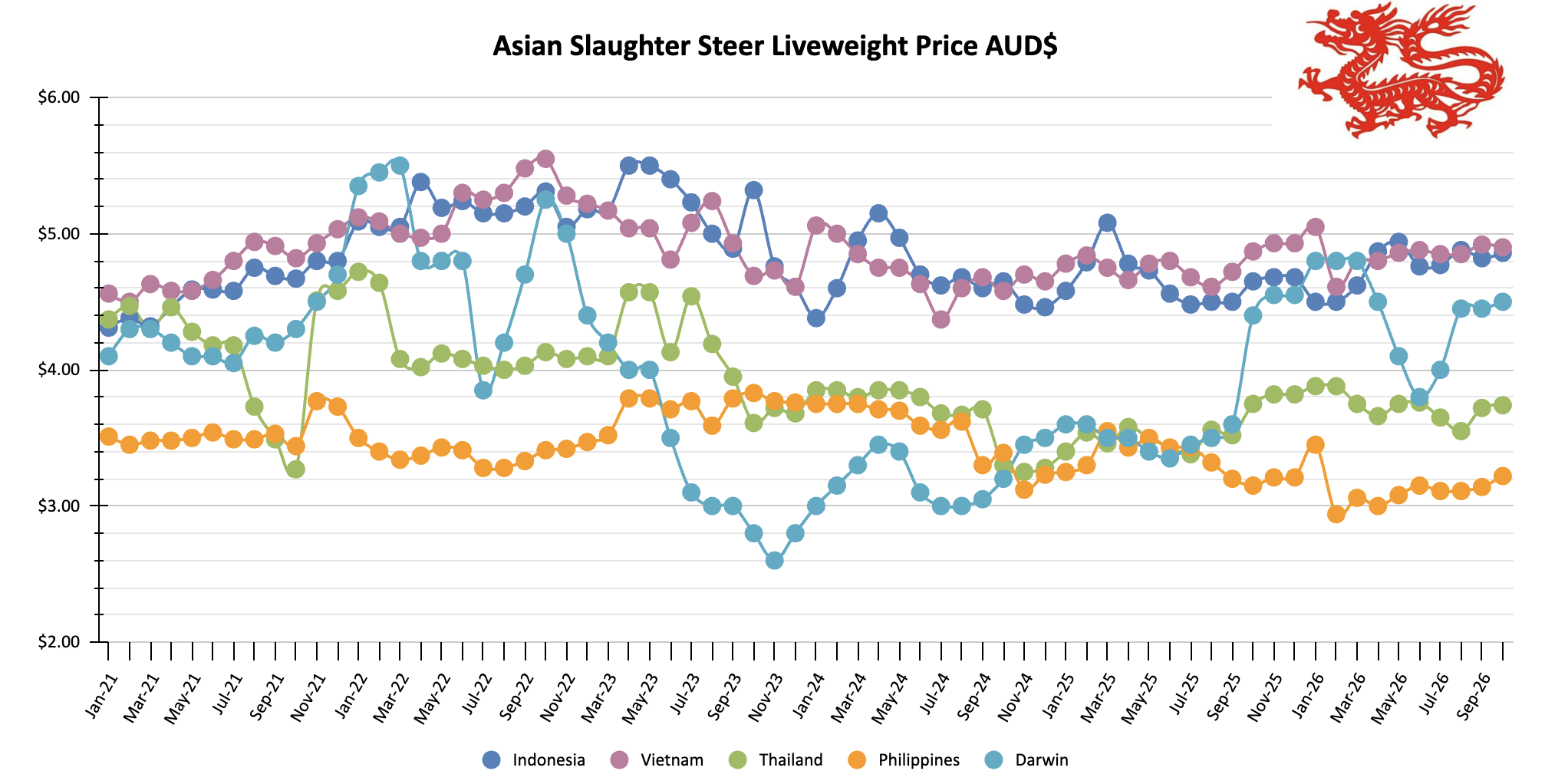
Indonesia: Slaughter Steers $4.86 AUD per kg live weight (IDR 12,556 = $1 AUD)
Berdikari and the growing role of state-owned enterprises(SOE)
PT Berdikari has received its first shipment of Australian water buffalo, which it is pursuing as a cheaper source of protein. Australia exported 7,384 buffalo in 2025, so repeat orders from the SOE could provide another outlet for the northern buffalo industry.
The wider issue is the growing role of state-owned enterprises in Indonesia’s food supply. State companies now import beef and buffalo meat to help stabilise prices. Berdikari has also been given a role in importing and distributing soybean meal for animal feed.
Prabowo’s government has moved to take greater control of commodity supply and pricing through import permissions, price controls and state purchasing. I expect SOEs to play a bigger role in food and feed markets in the years ahead. For Australian suppliers, knowing how to work with SOEs is likely to become increasingly important.
A dry season in Bali, a sign of regional conditions
In the parts of Bali I visited this month, cattle had virtually nothing left to graze. They stood on bare ground, tethered or penned, eating cut branches and browse while owners carried water in buckets. This reflects conditions across the rest of Indonesia where similar dry, hot weather is challenging livestock production across all species.
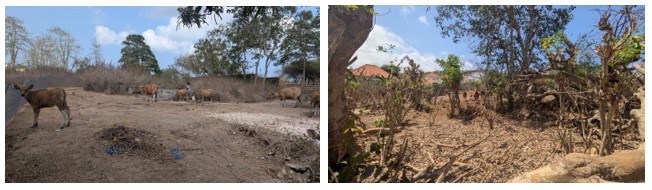
Bali, October 2026, cattle on bare ground.
Why Bali cattle are managed this way
Bali cattle descend from wild banteng, and the province protects the breed by restricting other cattle breeds, apart from small dairy herds. Smallholders commonly tether cattle on roadsides or vacant land and feed them cut grass. A cow can be a savings account, sold when school fees or ceremonies demand cash. Bali also limits cattle shipments to other Indonesian islands to protect its herd. Provincial agriculture figures put the herd at about 392,000 in 2025, compared with about 558,000 in 2021. Bali’s struggle to retain breeding stock reflects Indonesia’s wider problem of a declining herd.
Vietnam: Slaughter Steers $4.90 AUD per kg live weight (VND 18,086 = $1 AUD)
A smaller herd alongside higher beef output
 At the end of September, Vietnam’s cattle herd was down 1.6 per cent year-on-year and its buffalo herd down 6.4 per cent, yet nine-month beef output rose 1.3 per cent to 396,400 tonnes. The statistics office attributed the herd decline to mechanisation reducing demand for draught animals, shrinking grazing land, long production cycles and labour shortages. Those pressures suggest that rebuilding cattle numbers will be difficult. A smaller domestic herd could support demand for Australian cattle over time if the country prioritises and invests in local processing over imported beef, but the trade remains well below last year. September’s 5,213 head was our strongest month into Vietnam this year, lifting January to September exports to 12,721 head against 77,870 in the same period of 2025.
Competition from other proteins
The October slaughter-steer price in Vietnam is A$4.90/kg liveweight. Live pigs were around A$2.88/kg liveweight (52,100 dong/kg) on 14 October. The average imported buffalo meat price over the first seven months was about A$6.36/kg of meat (115,000 dong/kg). These prices reflect Vietnam’s longstanding structural challenge, with cheaper alternative proteins dominating the market and low-cost beef and buffalo meat still readily available.
Philippines
Taiwan gains access for breeding cattle
Taiwan has secured approval to export breeding cattle to the Philippines under agreed animal-health conditions. Two farms have been cleared, but no shipment was confirmed in the announcement. For Philippine buyers, the appeal is dairy cattle that can milk and breed in hot, humid conditions. Taiwan is promoting that suitability, but performance after arrival will be the test. The Taiwan Department of Agriculture’s 23 September circular also accredited Mexico and Ireland for live animals and genetic material showing a growing interest in diversifying their suppliers. Meanwhile, on 20 October, the Philippine Department of Agriculture announced the arrival of 1,419 pregnant Australian dairy cattle showing that Australia is still the trading partner actually delivering.
Malaysia
Sabah changes the rules for its breeder scheme
Sabah received 780 Brahman-cross cattle from Darwin this month, including 750 pregnant females. The state also purchased dairy cattle and Boer goats separately from the Darwin cattle shipment. Sabah’s herd has fallen over the past decade despite regular imports. Under the previous scheme, farmers repaid livestock assistance in calves. The new replacement scheme requires farmers who receive cattle to pay a bond of at least 10 per cent of the animals’ market value, refundable after three years if farmers meet conditions, including retaining and breeding the animals. The bond may be forfeited if cattle are sold or die through poor care. Sabah is trying to make that early sale less attractive, but I doubt a 10 per cent bond will change that behaviour. A farmer who sells an animal for $1,000 and forfeits $100 still has a strong financial incentive to sell when cash is tight.
Australia: Feeder Steers Darwin $4.50/kg liveweight
Price pressure limits the Ramadan outlook
DAFF figures show that Australia exported 46,765 cattle to all destinations in September, down from 71,711 in August. Indonesia took 34,085 of September’s cattle. January to September exports reached 447,101 head, 23.5 per cent below the same period of 2025. Indonesia accounted for 352,197 head, down 14.2 per cent, underlining the trade’s reliance on one market. Darwin feeders remained around A$4.50–A$4.60/kg liveweight in mid-October. At those prices, Australian cattle are very expensive for Indonesian buyers constrained by domestic price caps. Ramadan and the following Lebaran holiday would normally encourage restocking, but I expect any lift in buying to be limited.
Year 2026 cattle exports up to end of September – comparison across SE Asean markets
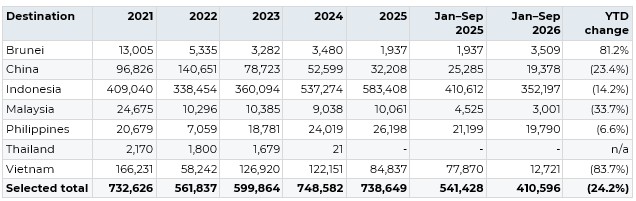
Table source: DAFF website
HAVE YOUR SAY