
150th Edition: August 2026
Key Points:
- First-half Australian cattle exports fell 29 per cent, and the squeeze is now biting downstream as Indonesian feedlots discount stock and ask for extended payment terms.
- Even as the live trade slows, regional players are planning to continue building domestic production.
- A strengthening El Nino and Thailand’s move to fund foot-and-mouth SAT-1 readiness are risks to watch into the dry-season peak.
- Vietnam took its first Australian cattle since January in July, an early flicker of life in a stalled market.
Regional Trends and Overview

Dr Michael Patching
Australian cattle exports fell 29 per cent in the first six months of the year, and the pressure behind that, dear cattle, a weak rupiah and Indonesia’s price cap, is now showing up downstream as Indonesian feedlot cash-flow stress. The contrast that strikes me is that while the live trade has slowed, the region is busy building its own capacity, from Jakarta’s city-owned cattle hub to Djarum’s dairy bet, Malaysia’s import-substitution plan and Hoa Phat’s 2030 target in Vietnam, all against a strengthening El Nino and a fresh foot-and-mouth scare.
Regional Price Graph
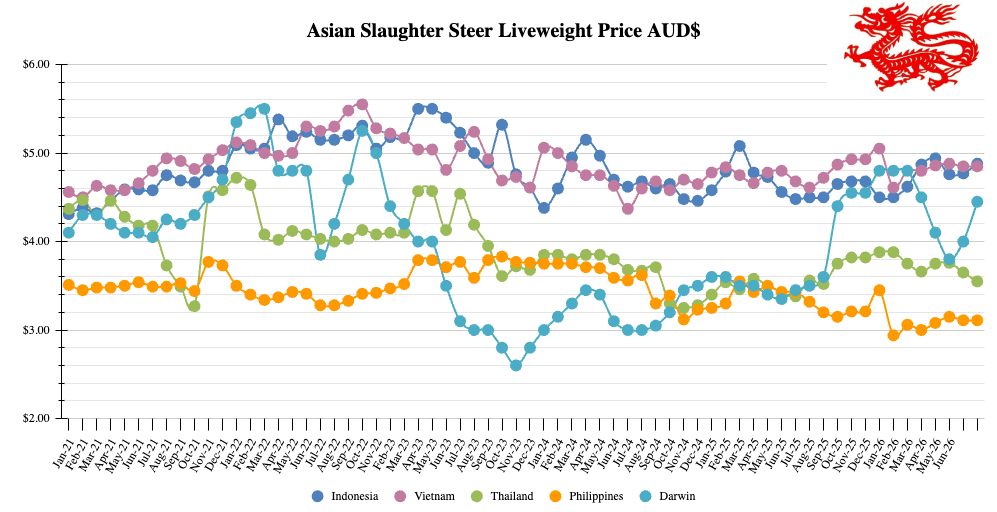
Indonesia: Slaughter Steers $4.88 AUD per kg live weight (IDR 12,500 = $1 AUD)
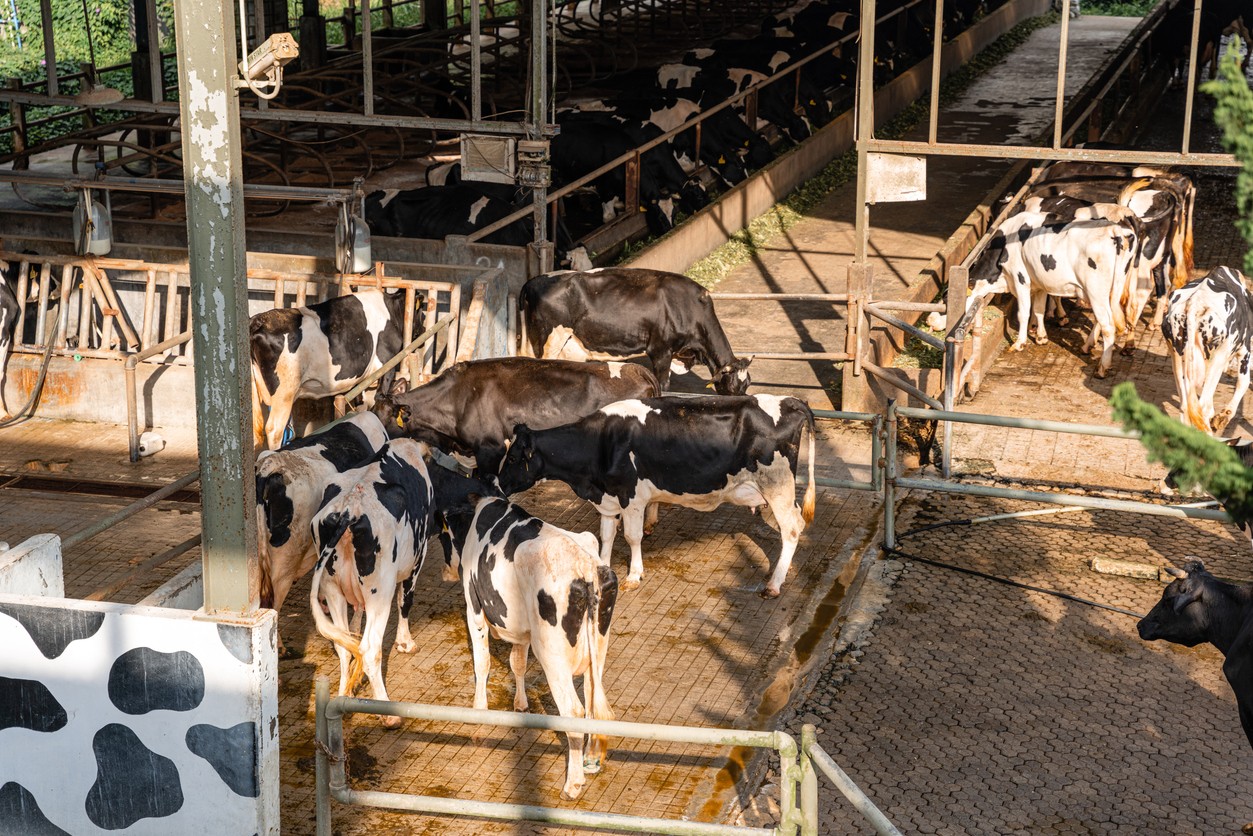
High demand and projected growth for dairy in Indonesia is attracting investement
Beef prices climb into the dry season
Retail beef is steady as the dry season sets in, averaging around Rp130,-140,000 a kilogram in our end-July wet market survey though we did hear prices substantially higher than that in some areas. Rising prices might sound like good news for the chain, but they are exactly what keeps Jakarta leaning on its feedlot price cap, the mechanism that throttles the feeder trade. The stronger beef gets at the counter, the tighter the bind on the importers who have to land and feed Australian cattle under that ceiling.
The feeder trade is running at a quarter of target
By late June, importers had brought in just 180,371 feeder cattle, only 25.8 per cent of this year’s 700,000-head national target, with an end-September deadline to catch up. What I find telling is the contradiction at the heart of it. Jakarta is publicly urging importers to accelerate shipments while its reference price makes those same cattle uneconomic to finish. The government wants volume the market cannot profitably absorb. It will be an interesting point to monitor as the year progresses because Jakarta has in the past looked at importers’ ability to fill the number of cattle they were permitted to import as a way to determine who gets import permits for the year ahead. I expect we could see some headaches here if total 2026 numbers reflect the first half of the year.
Feedlots feel the squeeze downstream
Cattle that Indonesian feedlots brought in back in April are now coming out as market-ready stock they are struggling to sell, with trade contacts telling me discounting is under way and buyers are asking for extended payment terms on slow sales. This is the clearest sign yet that the reference-price and rupiah pressure I have written about for months is no longer just a margin problem on paper. The next real test comes in September and October, when feedloters decide how many cattle to go after for the 2027 Lebaran.
Djarum’s Savoria makes a big dairy bet
Savoria Group, the consumer-goods arm of the Hartono family’s Djarum empire, the tobacco-and-banking dynasty behind Bank Central Asia and Indonesia’s richest family, has broken ground on a roughly Rp1.2 trillion integrated dairy mega-farm at Brebes through its subsidiary Global Dairi Bersama. It is built for up to 30,000 cows and 180,000 tonnes of milk a year, about a fifth of national demand. When a conglomerate that size moves from cigarettes into dairy, the self-sufficiency push starts to look like it has real capital behind it. A herd that big will have to lean on imported breeding stock and I’m told the Indonesians are enquiring well beyond Australia for potential supply..
Jakarta builds its own cattle hub
Perumda Dharma Jaya, the Jakarta city government’s own meat company, will start building a Rp1 trillion (around AUD 78 million), 20-hectare integrated cattle complex at Ciangir near Tangerang in November, running feedlot, quarantine, slaughter, cold storage and processing on one site. At around 1,000 head a cycle to begin with, it is a modest dent in a country chasing 700,000 imported feeders a year, so I wont oversell the contribution this might make to Indonesia’s’ plans for beef self-sufficiency but a good example of interest in the sector none-the-less and another opportunity for Australian live cattle.
Vietnam: Slaughter Steers $4.85 AUD per kg live weight (VND 18,700 = $1 AUD)
Beef prices recover, but imports fill the gap
Vietnamese beef-cattle prices have climbed out of a long slump, helped by tighter supply as low prices pushed some farmers out and by tourism reviving demand. The extra beef, though, is largely imported. Frozen imports rose 11 per cent in the first four months, and the country is tipped to bring in around 200,000 tonnes of beef this year to cover the shortfall.
First signs of life in the live trade
Australia shipped 2,635 head of slaughter cattle to Vietnam in July, its first cattle to that market since January and a small but real flicker in a trade that had otherwise stopped. It is far from a recovery, a few thousand head against the tens of thousands Vietnam took each year not long ago, but after months of nothing even a token shipment is worth watching for what it might say about buyers coming back.
Hoa Phat signals a 2030 cattle target
Hoa Phat, the country’s largest steelmaker and its biggest cattle feedlotter, has laid out plans through its fast-growing agriculture arm to feed 73,000 Australian cattle a year by 2030, alongside its pigs and feed mills. Hoa Phat has been the dominant importer of Australian cattle into Vietnam for the better part of a decade, so when this company decides to buy, it can move the market on its own. The tone is cautious and the horizon is long, but it is the clearest sign the stalled Vietnam trade can come back at scale.
Thailand: Slaughter Steers $3.55 AUD per kg live weight (THB 23 = $1 AUD)
Thailand puts a price on a foot-and-mouth outbreak
Thailand has stood up a dedicated committee for the SAT-1 strain of foot-and-mouth, the one I have previously flagged as creeping through Asia, and its livestock department has put hard numbers on the stakes. It asked for USD 149 million to protect 24.62 million cloven-hoofed animals, warned an outbreak could cost almost USD 6 billion across the food chain, but was told to trim the plan to essentials. It is also fast-tracking approval so private firms can import SAT-1 vaccines. For us, a neighbour scrambling like this is a reminder that foot-and-mouth is still active in the region and that new strains present new risks.
Thai cattle are being penned in at home
Cambodia has kept its border shut to Thai livestock since an anthrax outbreak in Thailand last year and has stepped up a crackdown on smuggling, while Vietnam keeps tightening its own informal crossings against the SAT-1 strain of foot-and-mouth. The neighbours that used to soak up Thailand’s surplus cattle are increasingly closed to it, leaving more animals in the Thai domestic market. Cambodian cattle prices have jumped to around USD 3.2 a kilogram, up from USD 1.75 to 2 when Thai animals flowed in freely, which shows how much supply those borders were carrying.
Malaysia
Malaysia targets a 50 per cent import cut
Kuala Lumpur has set out a long-run food-security plan to halve its food imports by 2050, chipping away in stages from a bill of about USD 18.8 billion a year, with beef cattle farming named among the target industries alongside chicken. It is the kind of 2050 ambition I treat with caution given Malaysia’s land and productivity constraints, but it is worth logging for the Borneo trade, since Sabah and Sarawak are real, if modest outlets for Australian cattle.
Philippines: Slaughter Steers $3.11 AUD per kg live weight (₱44 = $1 AUD)
Imports climb, but Brazil takes the gains
Philippine beef imports rose 21 per cent over the first five months of the year, keeping the country one of the region’s clearest sources of demand growth. The problem for us is who is filling it. Brazil was the top meat supplier at nearly 430,000 tonnes in the first half, and it is Brazilian frozen product, not Australian cattle or chilled beef, that is capturing the bulk of the gap. A late-half slowdown adds some uncertainty to the full-year picture.
Australia: Feeder Steers Darwin $4.45
First-half exports down 29 per cent
Australia shipped 265,659 cattle in the first six months of the year, 29 per cent down on the same period last year, with Indonesia still taking the lion’s share at 204,526 head. An early Lebaran pulled some festival cattle into late 2025, but the rest is the squeeze, dear cattle and a weak rupiah. Darwin feeders continued to rise to around $4.45 on tight northern supply, with Queensland restockers and lotfeeders competing.. The next focus will be the run into the 2027 Lebaran as Indonesian feedlotters look to lock in their supply.
Year 2026 cattle exports up to end of June – comparison across SE Asean markets
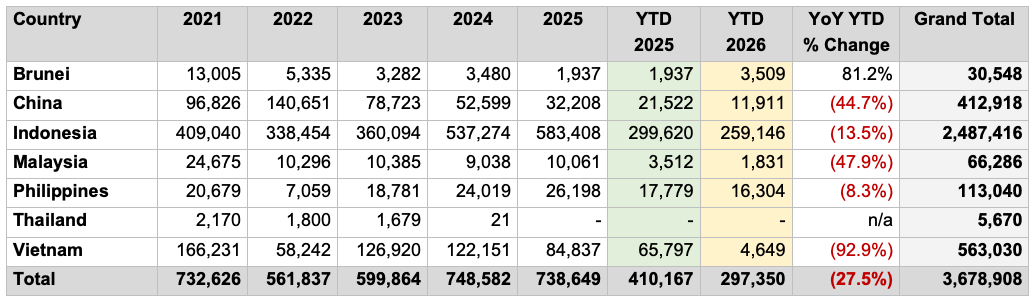
Source: DAFF website
HAVE YOUR SAY