
WHO are Australia’s active live exporting companies, and where do they operate?
We last looked at this data and the plight of live export companies in 2023, when the live export industry was going through a state of declining export volumes and a few exporters had closed up shop.
Since 2005 there have been 59 different companies that have exported by sea and the number of exporters still active in the last few years has sat at 16 (2023, 2024 and 2025), down slightly from 19 in 2022.
For the first half of 2026 there have been 12 active exporters which is in line with previous years as the remainder of exporters only do one or two shipments each year. The story is one of an industry that, excluding sheep exports, has been relatively stable and consistent in recent years in regards to the live export companies that service it and how active they are.
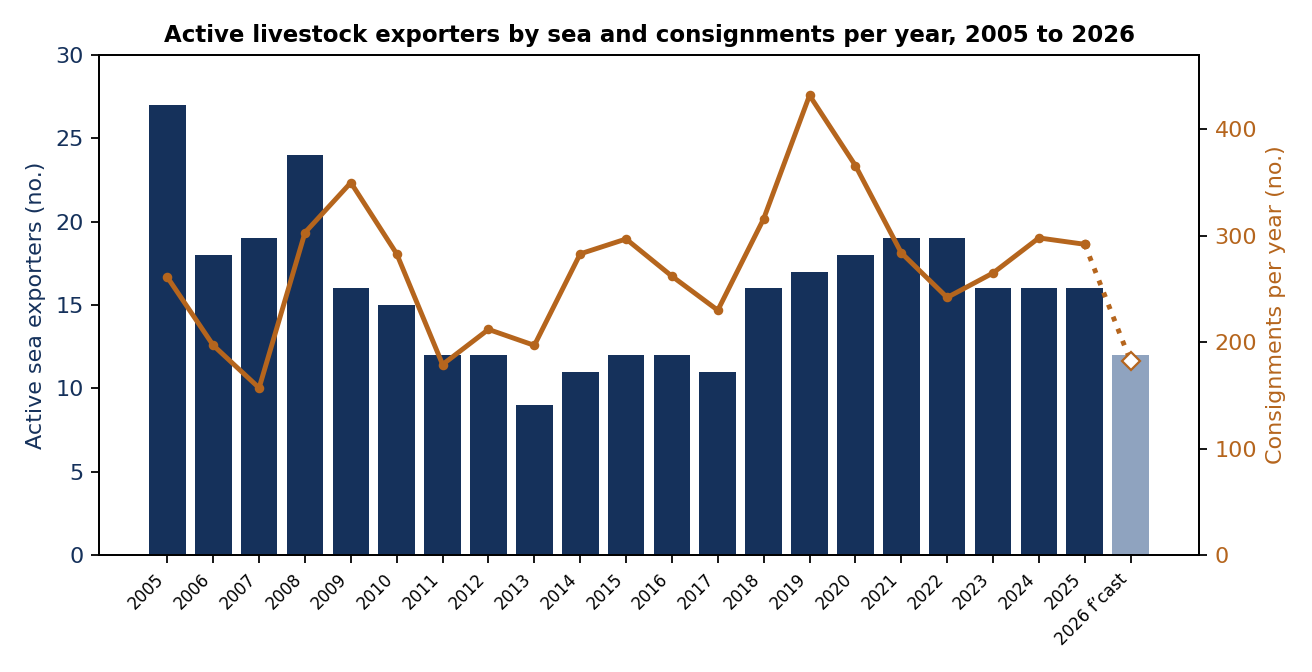
Active livestock exporters by sea and consignments (sheep, buffalo and cattle) per year, 2005 to 2026. Source: DAFF live animal export statistics. Click on graphs and tables for a larger view.
Movement at the top
A small group of exporters are still responsible for most consignments. Eight companies accounted for 94.6pc and 92.1pc of consignments in 2024 and 2025 respectively.
The balance of exporters only shipped once or twice each year, usually for specialty breeder jobs, sometimes to less frequented markets such as Pakistan or Mexico.
What has changed slightly in recent years is the order of consignment volumes among the leaders. In 2023 the top few were tightly bunched. By 2025 Frontier International Northern Pty Ltd (Frontier) with 57 consignments and Australian Rural Exports Pty Ltd (AUSTREX) with 52 consignments had pulled clear of the rest. International Livestock Export Pty Ltd (ILE) went from top exporter in 2024 (59 consignments) before falling to 40 consignments in 2025, it is now running second through the first half of 2026.
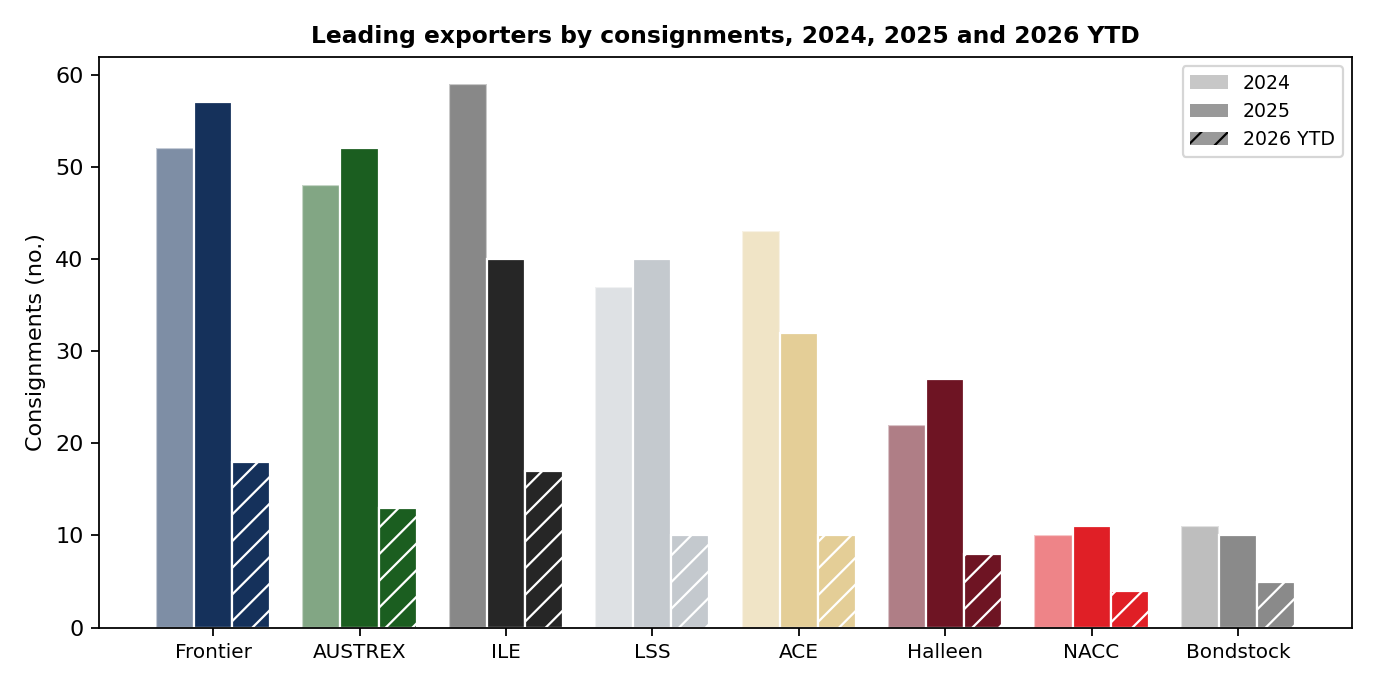
Leading exporters by consignments, 2024, 2025 and 2026 YTD. Source: DAFF live animal export statistics.
More exporters, smaller shipments
Back in 2015 and 2016 there were only about 12 companies shipping around 1 million cattle and close to 2 million sheep, compared to the 16 companies exporting around 800,000 cattle and just over 300,000 sheep in 2025.
Those earlier large volumes were largely down to a few big operators, Wellard among them, that moved hundreds of thousands of sheep and cattle a year, before they left the trade. Bigger vessels and those large operators carried far more animals per shipment, even though the number of consignments was much the same as today, at 297 in 2015 against 292 in 2025.
The number of shipments leaving has barely changed but what has changed is how much each one carries and how many companies share the work, with the trade in 2025 and early 2026 spread across more exporters running smaller loads.
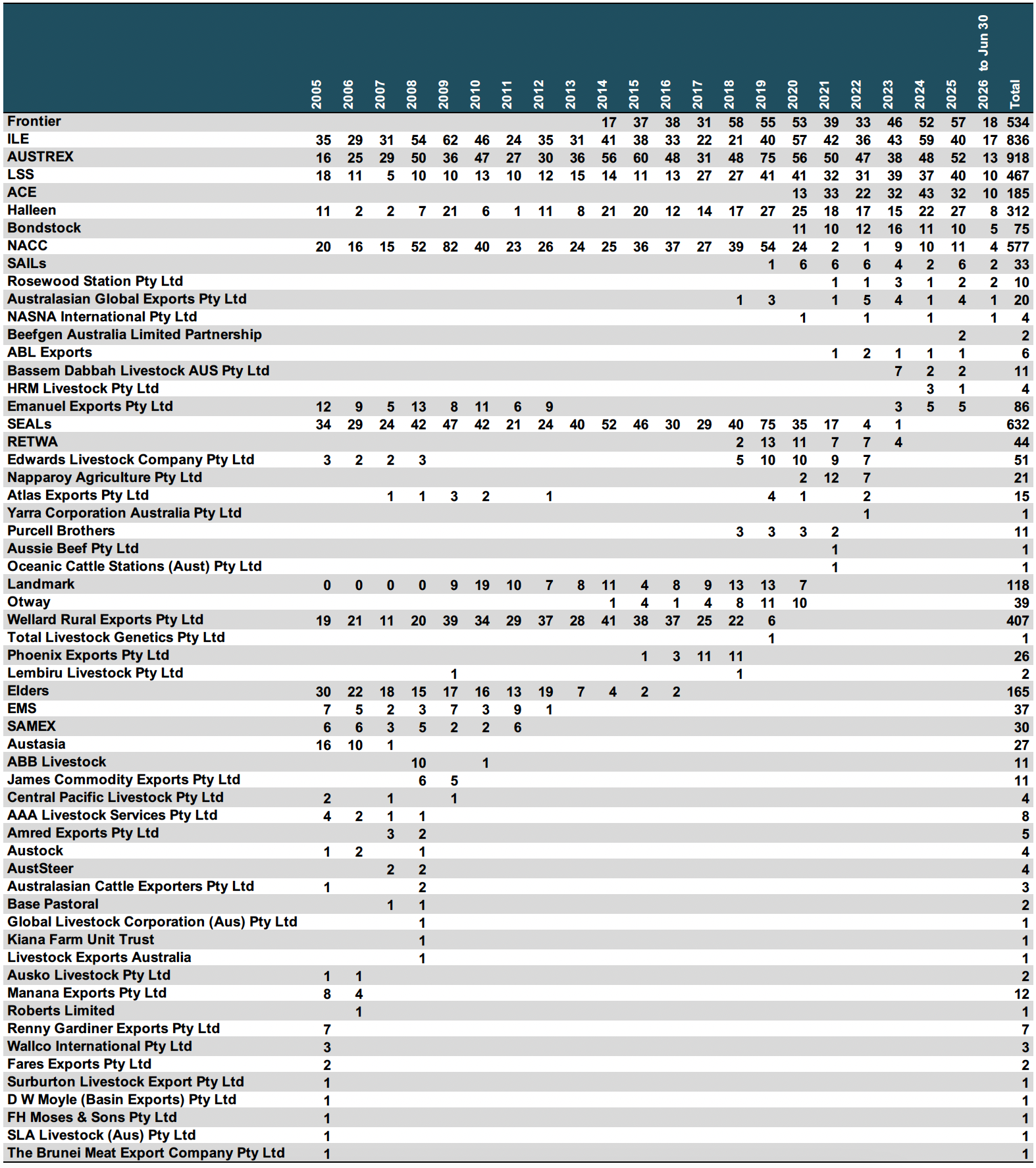
Leading exporters by consignments, 2005-2026 Year-to June 30. Source: DAFF reports to Parliament. Click on image for a larger view.
Market share
Indonesian market share as a proportion of all live export consignments continues to grow, taking 69pc of consignments in 2024, 73pc in 2025 and 77pc in the first half of 2026. Vietnam, the number two for most of the past decade, has fallen away, from 46 consignments in 2024 to 30 in 2025 and just one before June 30 in 2026. There have been a couple more shipments to Vietnam since this data was published in June, but it is still running well below average.
 On top of being the largest market, Indonesia is also the most hotly contested. In 2025 nine of the sixteen active exporters shipped cattle there, and no single one held more than a quarter of the market share. Frontier was the largest at 24pc, with AUSTREX, ILE, Halleen, ACE and LSS all close behind, each holding a share in the low to mid teens. Several of these exporters are heavily reliant on Indonesia, Halleen and Bondstock focused only on Indonesia in 2025, and NACC sent all but one of its consignments there.
The smaller markets have less competition. Vietnam is LSS’s stronghold, where it was responsible for 40pc of consignments, with AUSTREX next and ILE, ACE and Frontier splitting most of the rest.
China is almost all AUSTREX, which handled six of the ten consignments into what is largely a breeder and dairy market, the balance going to Beefgen, SAILs and Australasian Global Exports. The Philippines runs mostly through ILE and Frontier, which between them took eight of the nine consignments. The remaining consignments went to a spread of smaller markets, included in the graphic below.
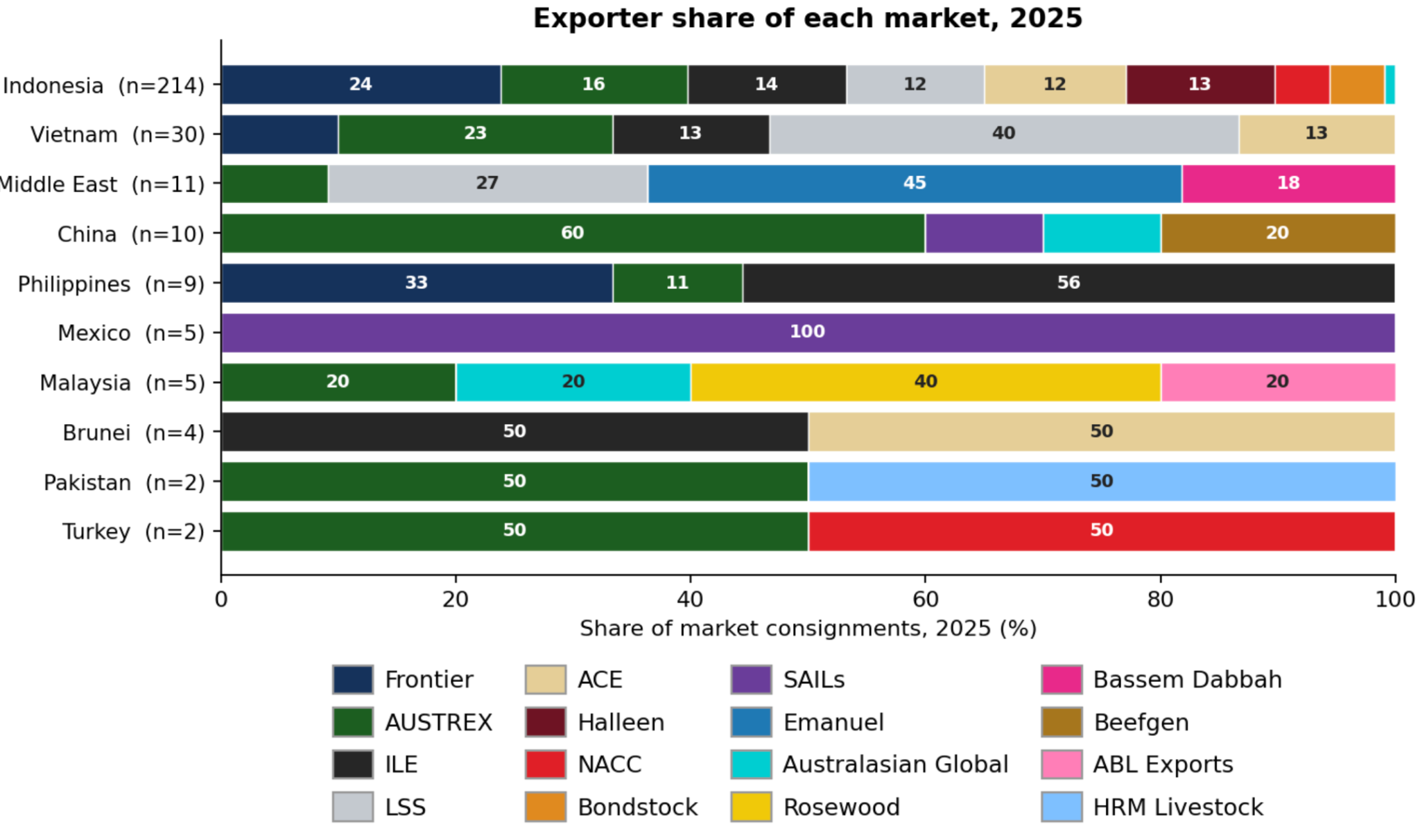
Share of consignments by market, 2025. Source: DAFF live animal export statistics.
Note: Includes sheep shipments to the Middle East.
A weaker start to 2026
From 2023 to 2025 the average consignment numbers have been around 270 to 300 a year. There were 142 consignments in the first six months of 2025, the same period this year has managed only 91 consignments.
It is likely that some of that gap may close as voyages are only logged once their reports reach the department, however this will only impact a handful of consignments. Fewer consignments in the first half of the year is in line with the softer first-half cattle export figures out of Australia.
Notes on the data:
The figures come from the Department of Agriculture, Fisheries and Forestry’s public reports to Parliament on livestock mortalities on sea voyages, which it publishes every 6 months. The data exists to track animal welfare rather than market share, but it remains the most complete public record of who is shipping and where, though limited to the number of consignments an exporter has sent, not the number of animals, due to quirks in the way the data is presented. Consignments are also not the same as shipments. A single ship may carry cattle, buffalo and/or sheep for more than one exporter, so one ship can produce several consignments. The count also says nothing about the size of each load, so it reads as a measure of how busy a company is, not the volume of trade.
What a fantastic article highlighting the importance of international export. Taking excess numbers out of the washing machine.
Backed by world class animal welfare standards.
Maybe we should start to appreciate the importance of this industry creating value for the producer at a political level.