
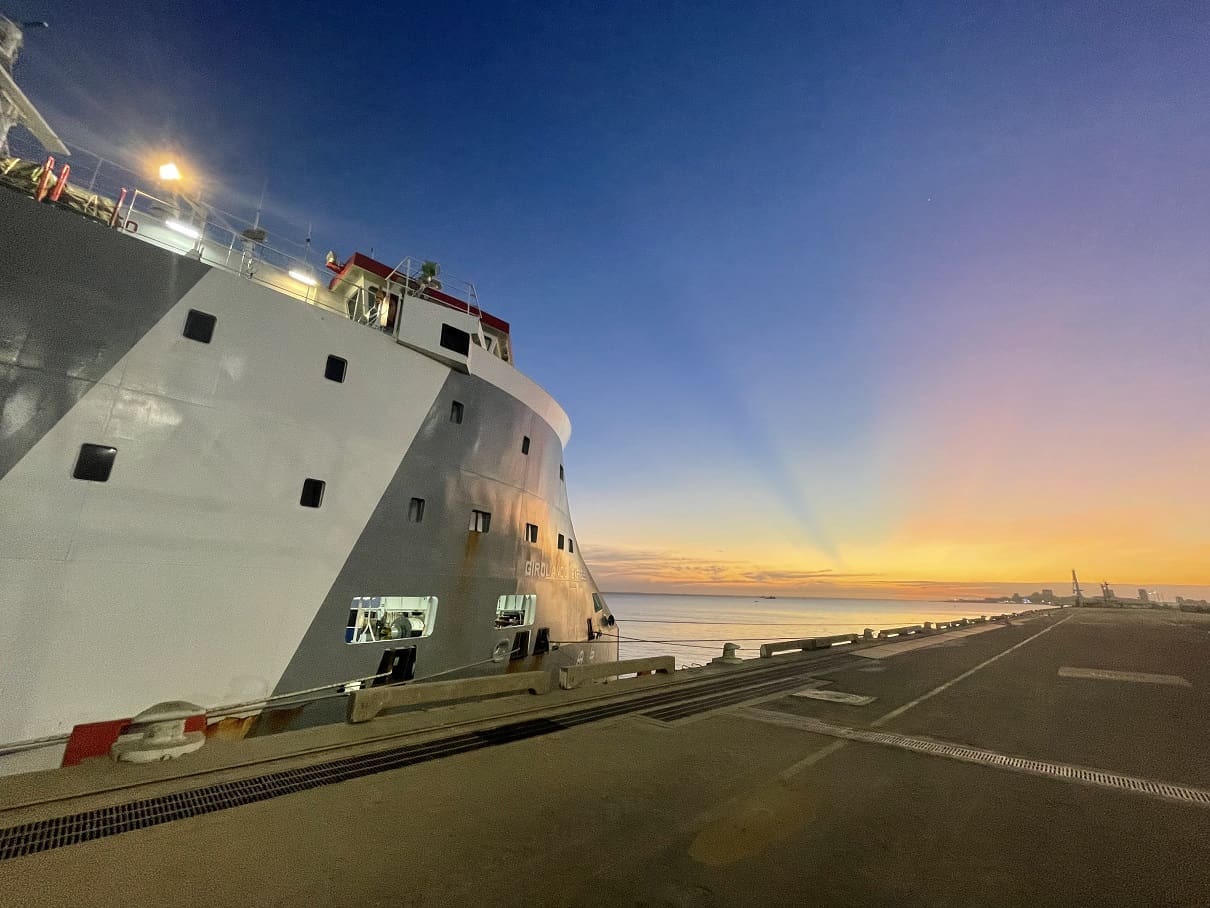
CATTLE exports climbed to their highest monthly volume of the year in August, with 71,711 head shipped, including 58,966 to Indonesia.
Both figures were well above the rolling five-year average for August, with total national exports 13 percent higher and shipments to Indonesia 43 percent over the average for the month.
Higher supply often correlates with lower prices, yet despite the increased August volumes, the price of live export steers ex-Darwin has climbed and is now sitting at about 440–450c/kg for good lines.
This also appears to defy recent market intelligence highlighting several challenges in Indonesia.
So what is driving the apparent contradiction?
Conversations with people close to the trade, who preferred to speak anonymously so they could talk freely, identified several potential factors.
Currency and price-cap pressures
First, the headwinds are real.
Currency is the major concern continued to be cited by trade participants. Indonesian feedlots pay for Australian cattle in US dollars, so the IDR/USD exchange rate has a direct bearing on the Australia to Indonesia cattle trade.
A weaker Indonesian rupiah against the US dollar makes Australian cattle more expensive for Indonesian feedlots, even if the acutal per head price in Australia does not change.
For more than a decade, the rupiah traded below 15,000 IDR to one US dollar. It broke out of that range a few years ago due to a combination of factors including rising global energy costs, shifting trade dynamics and domestic economic concerns in Indonesia.
As of today 17,600 IDR is required to buy one US dollar. That represents a slight improvement from June 2026, when the currency reached an all-time low of 18,209 IDR to the dollar. Despite stabilising a little, it remains historically weak.
an Australian feeder steer now costs an Indonesian lot feeder more in rupiah terms than when the Darwin price reached the dizzying heights of 550c/kg in early 2022
One market expert pointed out that, although the current price for live export steers is about 450c/kg ex-Darwin, an Australian feeder steer now costs an Indonesian lot feeder more in rupiah terms than when the Darwin price reached the dizzying heights of 550c/kg in early 2022.
Importers are also facing significant pressure on their ability to make a profit because of the Indonesian Government’s price cap on finished cattle sold from feedlots.
Many importers traditionally absorb price fluctuations throughout the year, knowing they can make strong profits during the Ramadan/Lebaran period. However, that opportunity has been curtailed by capped prices which are designed to keep beef affordable for consumers.
The price cap itself is not new. What has changed is the Indonesian Government’s decision to retain it year-round rather than lift it around major festivals.
Despite these challenges and others, Indonesia continues to prove itself to be a “pretty bloody resilient market”, as one long-standing live export trader candidly described it.
‘Use it or lose it’ permits
One factor that is thought to be supporting continued cattle purchases is the Indonesian Government’s ‘use it or lose it’ permit policy.
If importers do not use at least 80 percent of their annual permit allocation in any one year, they risk receiving a substantially smaller allocation the following year.
 It is also thought that many importers allowed their inventories to run down earlier this year when cattle prices were high. The August figures may reflect a recognition that feedlots were operating below capacity and needed to restock.
Ramadan and Lebaran have been creeping forward each year in line with the lunar calendar. The next festival will run from early February to early March 2027, meaning shipments of feeder cattle to enter feedlots in time to supply that period of strong demand period should be in full swing by November.
But despite those challenges facing the market, the same long term drivers do not go away.
As one trade source explained, if you put all of the world factors including currency and inflation into a pot and boiled them all down, the same long-term factors still underpin it all.
“It still comes down to supply and demand – that is if available supply is tight, away she goes.”
Indonesia’s enduring demand for Brahmans
The fundamentals underpinning the Australia to Indonesia cattle trade have not changed.
At least 90pc of the beef produced from the hundreds of thousands of Australian cattle sent to Indonesian feedlots each year is sold through wet markets.
Early-morning customers buy pieces of warm beef from cattle slaughtered only hours earlier in nearby abattoirs, sometimes with the meat still twitching as it hangs from wet-market hooks, a guarantee of freshness to local consumers.
The beef is cooked and consumed on the day it is bought. It is an efficient and safe meat distribution system that has served Indonesia and many other cultures for thousands of years without relying on household refrigeration.
Australian cattle leaving Indonesian feedlots are slaughtered at about 480–500kg. At that weight, high-grade Brahmans provide a meat-to-bone-and-fat ratio that is perfectly suited to the requirements of wet-market butchers and their customers.
This is one reason said to be underpinning the ongoing 30–40c/kg premium for pure Brahmans over crossbred cattle for Indonesian feedlots.
Not a bottomless barrel
While it is easy to assume there are vast and almost inexhaustible numbers of Brahman cattle across northern Australia, it is easy to overestimate the
number of high grade purebred Brahman herds that are there.
Many northern stations have responded to negative headlines and uncertainty surrounding live export markets, particularly since 2011, by crossbreeding to make their cattle more suitable for domestic markets.
The trend towards black herds in the north – particularly Angus, Ultrablack and Wagyu genetics – has also been well documented.
As result there is finite number of high-grade purebred Brahman herds, and that lack of supply along with the strong preference A-grade Brahmans from Indonesian feedlots is another factor keeping upward pressure on prices.
Darwin exporters have a limited pool in which to fish
Darwin exporters have also had limited ability this year to source cattle beyond the traditional NT and Kimberley supply pool.
Early in the year the wet season was so big they didn’t have access to the Queensland cattle that they normally would, while toward the middle of the
year, their access to the same stock was limited by price as backgrounders and lot feeders competed heavily for Queensland cattle.
WA shipments hit year high
The August figures also highlight the strength of shipments from Western Australian ports.
Broome exported 14,718 head, Fremantle 5320 and Wyndham 3578, giving WA ports a combined August total of 23,256 head—the State’s largest monthly volume for the year.
Darwin also recorded its biggest month of 2026, shipping 40,845 head.
Other destinations for Australian cattle during August included the Philippines with 3486 head, Vietnam with 2859 and Malaysia with 1170.
Australia exported 400,122 cattle in the first eight months of 2026, compared with 516,598 during the corresponding period last year.
Shipments to Indonesia totalled 318,112 head, down from 352,943 at the same point in 2025.
HAVE YOUR SAY