
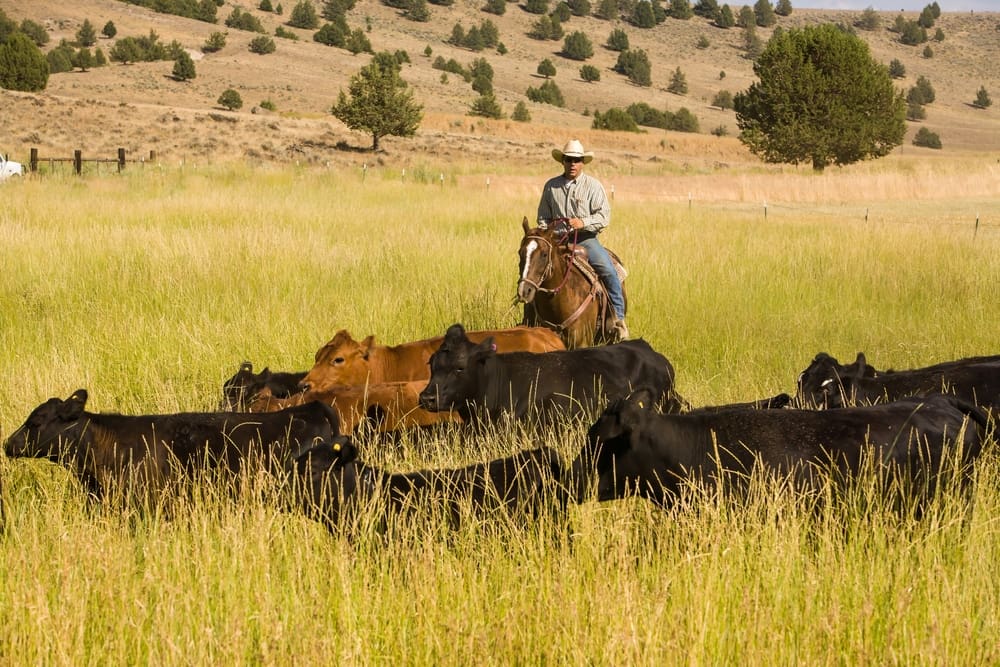
A cowboy herding cattle on a ranch in eastern Oregon. Picture: Shutterstock
WHILE the United States Government was publicly criticising Australia for applying what it terms as “non-scientific trade barriers” against US beef imports, it quietly removed protocols enabling Australian cattle imports to the US from its website, something Australia’s trade only discovered at a later date.
The protocol was last used to facilitate small shipments of Australian breeding cattle to the United States as recently as 2017, according to Australian industry records.
Beef Central understands Australian government and trade officials only became aware of the removal of the protocol after members of the Australian cattle export industry discovered it was no longer appearing on the USDA’s website last year.
The change was noticed after several major US lot feeders began approaching Australian live cattle exporters inquiring about prospects and feasibility for live feeder cattle from Australia to help fill the US beef supply void.
With the US cattle herd at historic lows and strong domestic demand driving cattle prices in America far above those in Australia, the economic equation is said to strongly support the concept. Figures quoted this week show US feeder cattle are currently A$2100 a head more expensive per head than Australian equivalents. One Australian export industry source told Beef Central this week it would be an “economic no-brainer”.
 The US cattle shortage has been further exacerbated in recent months after the US Government suspended live cattle imports from Mexico, due to the presence of New World Screwworm in that country. More than one million Mexican cattle typically flow into US feedlots each year, but that supply line is now also suspended due to the biosecurity threat. (See earlier Beef Central article on Mexican cattle exports to US here).
Beef Central understands Australian officials contacted the US Department of Agriculture (USDA) to inquire about the status of the live cattle protocol after being alerted to its disappearance from the USDA website.
In response, they were advised that the United States does not recognise Australia’s freedom from bovine tuberculosis, and before the protocols could be reactivated, the US would need to undertake its own assessment of Australia’s TB status.
This was despite Australia having been officially recognised as free of bovine tuberculosis by the World Organisation for Animal Health (WOAH) since 1997, following a successful 27-year national eradication program.
The US has worked to eradicate tuberculosis from its own livestock population since 1917, but the bacterial disease remains at very low levels with an estimated prevalence of 7 per 1 million cattle screened, according to the USDA Animal and Plant Health Inspection Service.
Beef Central has contacted the USDA with questions about the removal of the Australian live cattle import protocol and will update this article with a response when received.
Multiple export trade sources have indicated that that demand for Australian cattle from US commercial interests to help fill the US supply gap remains strong, with cattle price differentials, the exchange rate and freight costs enabling trade to be conducted at profitable levels if the protocol was in place.