
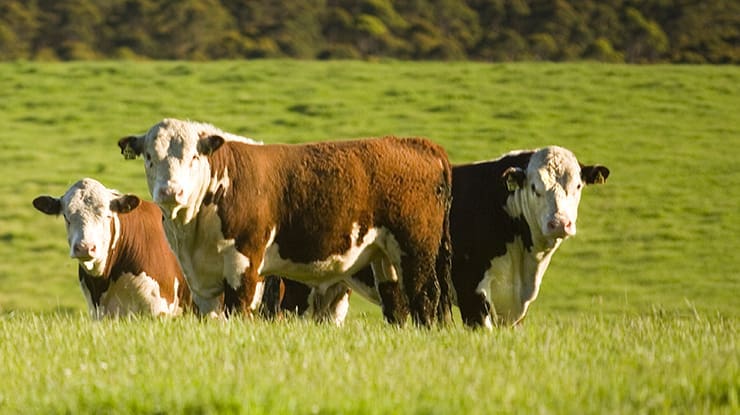
FOR most beef producers and seedstock herd managers, next year’s weaners have only just been born. How well these calves grow will be a key factor contributing to both sale income and to choosing suitable replacement females.
However, using weight as a key indicator has a limitation that is not always appreciated. Weaning weight is a final result. It doesn’t provide clear insight into how the calf achieved that weight, how much the cow contributed to it, or, significantly, whether the cow can repeat it on the feed the business can grow.
These factors have a direct bearing on the selection of replacement heifers and, for seedstock producers, on the selection of sale bulls.
A calf’s weaning weight is the result of two contributions: the calf’s own growth and what its mother provides.
Long-term research from the USDA Fort Keogh Livestock and Range Research Laboratory at Miles City, Montana, shows how these combine. The Line 1 Hereford herd* has been run there since the 1930s, and while it is a US Hereford population, the findings are relevant to interpreting weaning performance in any herd.
In a 2006 study, Michael MacNeil and Thomas Mott analysed 6835 records of gain from birth to weaning, which is the growth a calf makes from birth, within this herd.
Heritability Vs inheritance
To understand the results, it is important to be clear about the difference between heritability and inheritance. Every calf inherits half its genes from its sire and half from its dam.
Heritability is a different measure. It describes how much of the difference in weaning gain between calves in a herd can be explained by genetic differences, rather than what share of an individual calf’s weight comes from either parent.
The study found that differences in the calf’s own growth genetics, inherited from both parents, explained about 13pc of the variation in weaning gain.
A further 25pc was explained by genetic differences between cows in their ability to rear a calf, through milk production and mothering ability. Another 18pc came from lasting, non-genetic differences between cows, such as how well they were reared themselves or from other physical factors, such as an old udder injury. The remaining 40pc reflected seasonal and other temporary effects that vary from one year to the next.
This means the cow influences her calf’s weaning weight twice. The first is through the half of the calf’s genes she passes on, and secondly through the environment she provides as a mother.
The bull’s influence on weaning weight comes only through the calf’s genes, although his daughters will later carry his maternal genetics. Combined, the maternal genetic and permanent effects mean a little under half of the variation in how well a cow rears her calf is repeated from one calf to the next, which is why several calves give a far better picture of a cow’s production and performance rather than from a single calf.
Milk production
Milk production is an important part of that maternal contribution. The study estimated a genetic correlation of 0.80 between maternal pre-weaning gain and milk production measured by weigh-suckle-weigh, and the authors concluded that selecting on the maternal breeding value could be nearly as effective at changing milk production as measuring milk directly.
Australian producers already have tools to separate these contributions. The BreedPlan 200 Day Growth EBV describes genetic differences in a calf’s own growth to 200 days. The Milk EBV estimates the maternal genetic contribution a cow makes to her calf’s 200 day weight and, despite its name, is expressed in kilograms of calf weight rather than litres of milk.
For bull buyers this matters, as a bull’s growth genetics are passed to his calves, while his Milk EBV shows up later through his daughters and the calves they rear.
Being able to separate these contributions is useful, but it raises a second question, which is how much maternal production the business can actually support. Higher Milk EBVs can be valuable, and BreedPlan notes that selecting for them may be warranted where cows are run under good nutritional conditions and/or calves are sold as weaners.
However, BreedPlan also points out that the optimum level depends on the production system and environment, and that under poorer conditions, cows with high Milk EBVs may not get back in calf as easily the following year.
Environment
The environment also influences how cattle rank. A later Fort Keogh study, published in 2017, examined how genetic effects on pre-weaning gain changed between poorer and better years. Direct heritability was estimated at 10pc in an average year, rising to 18pc and 22pc towards the poor and good ends of the range.
The study also found that rankings for the calf’s own growth shifted more between those extremes than did the rankings for maternal effects. While these results are specific to that herd, they reinforce the need to select cattle for the conditions they will actually face.
Feed intake
Faster growth also says nothing about how much feed was required to achieve those levels. Neither Fort Keogh study measured feed intake.
However Australian research through the Beef CRC Maternal Productivity Project ran 500 Angus cows over three parities at Struan in South Australia and Vasse in Western Australia. Cows from a low residual feed intake (RFI) selection line ate around 7pc less feed a year and were more efficient at producing weaner calves.
However, they were also leaner, had a 6.3pc lower weaning rate and calved about 5.4 days later on average. The researchers recommended a balanced breeding program that includes selection for improved reproduction as well as low RFI.
Taken together, the message is that pushing any one trait can come at a cost elsewhere. The better target is a balance of growth, maternal performance, cow size and fertility that matches the feed the business can grow and the market it sells into.
This work highlights that a single weaning weight can’t usefully determine the value of a breeding female.
Calf weight is best considered alongside the cow’s condition at weaning and whether she is back in calf, with any differences in feeding or management taken into account. Linking calf weights to individual cows, along with condition scores and pregnancy results over several years, shows which cows consistently wean a good calf and get back in calf on the farm’s own feed.
For seedstock breeders, weighing calves before any of the group are treated differently and recording management groups accurately are what make EBVs reliable for their clients.
Weaning weight is an important measure. Increased weaner weights are a key target for many producers, either for their sale value or to maximise selection opportunities among replacement females.
However more value can be found in this measurement, particularly for breeding decisions, when producers understand what contributes to that weight.
Of equal importance is to appreciate if that weight has been achieved with the assistance of a cow that suits the environment and can repeat that outcome in following years.
* 90 years of research in Line 1 Hereford closed herd
Long-term studies on genetic selection and linebreeding of cattle have been ongoing at ARS’s Fort Keogh Livestock and Range Research Laboratory in Miles City, Montana, since 1934.
According to this USDA website page, the Line 1 herd was founded in 1934 from two sons of Advance Domino 13. These bulls, Advance Domino 20 and Advance Domino 54, were purchased from Fred C. DeBerard of Kremmling, Colorado, and bred to 50 cows purchased from George M. Miles of Miles City, Montana. Then, daughters of Advance Domino 20 were bred to his paternal half-sibling, Advance Domino 54, and vice versa. Ever since, Line 1 Hereford cattle maintained by USDA at Miles City descend solely from this foundation.
The increase in inbreeding per generation has been kept low as matings between close relatives have been avoided. Line 1 illustrates a successful linebreeding program in which a high degree of relationship (39pc) to the founding sire has been maintained for 18 generations. Without linebreeding, the relationship to an ancestor 18 generations ago would be less than one one-thousandth of a percent.
Nearly all academic and commercial tests that assess production characteristics of individual bulls can be traced to original research with Line 1. Such practical things as the length of feeding period and number of animals required to measure economy of gain in progeny testing were pioneered in developing Line 1 and are now codified in the Beef Improvement Federation Guidelines for Uniform Beef Improvement Programs. Data from Line 1 also contributed to the first estimates of heritability and genetic correlation for beef cattle.
Work with Line 1 has also contributed greatly to the understanding of maternal genetic effects in beef cattle. The influence of a cow’s milk production on the growth of her calf is one well-recognised example.
 Alastair Rayner is the Strategic Account Manager for Southern Australia with Vytelle and Principal of RaynerAg. He has over 30 years’ experience advising beef producers and graziers across Australia. Alastair can be contacted here or through his website: www.raynerag.com.au
HAVE YOUR SAY