
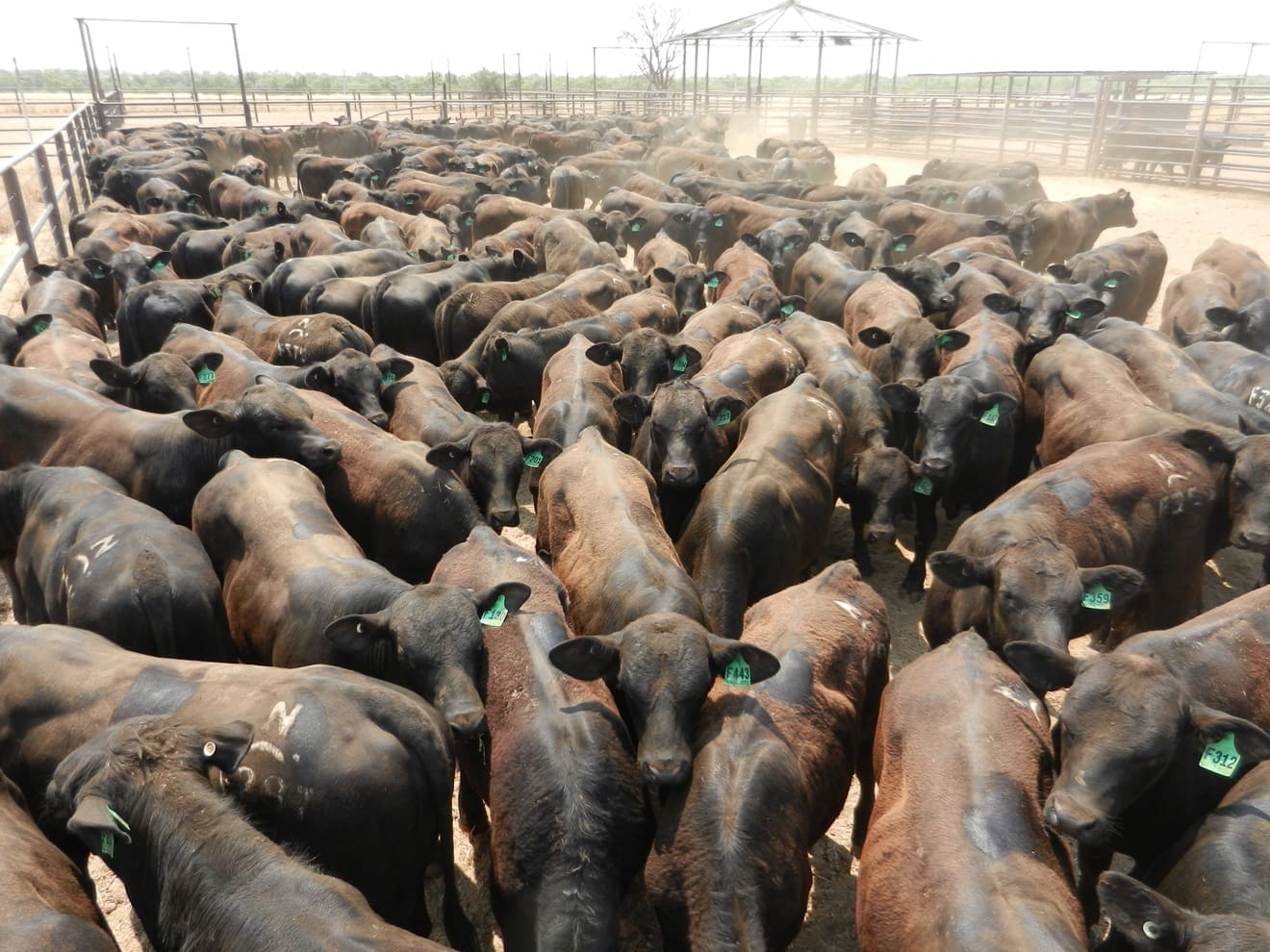
Ultrablack bulls bred for use in Northern Australia
FOR most producers seeking new bulls, sale catalogues are the primary source of information.
Many receive several printed catalogues throughout the selling season. Although online catalogues published through breed websites and sale platforms are increasingly important, the printed catalogue remains a primary resource.
However, receiving a catalogue doesn’t mean that all the information it contains will be read. Buyers often concentrate on the individual bulls, including their pedigrees, EBVs, photographs and performance information.
The introductory pages explaining sale arrangements, health programs, fertility testing and vendor guarantees may receive less attention, or none at all.
This can be an issue because important information about the reproductive assessment of the bulls may appear in those introductory notes rather than alongside each individual lot. Before a bull can deliver the genetic contribution suggested by his EBVs, pedigree or genomic information, he must be physically and reproductively capable of getting cows in calf.
Fertility statements
Looking through a cross-section of current sale catalogues from British and tropically-adapted breeds shows considerable variation in how fertility testing is described. Bulls may be reported as “semen tested”, “morphology tested”, “fertility tested”, examined under a Veterinary Bull Breeding Soundness Evaluation or simply guaranteed to be fertile.
These statements appear reassuring, but they don’t necessarily describe the same assessment or provide buyers with the same level of information.
In most of the catalogues we reviewed, it was clear that some form of fertility assessment had been undertaken. What was often less clear was which components had been examined, which standards had been applied, the results achieved by individual bulls and when those results would be available.
From a practical perspective, the issue is not simply whether the bull was tested. It is whether the catalogue provides enough information for a buyer to understand what was tested and what the result means. Providing more detail is useful only if producers read it and understand how it relates to their selection decisions.
Four levels of information
There are effectively four levels of information that can be presented, progressing from a basic statement to detail that is more useful for selection.
The first is a general statement that the bulls were tested. The second identifies the components examined. The third explains the standards and thresholds applied. The fourth provides the results for each individual bull.
Only the fourth shows how a particular bull performed and whether his report contains a qualified result or a component that was not assessed.
Individual results are often provided on supplementary sheets. The challenge for producers is when those sheets become available. If results are released only on sale day, buyers can’t use them when developing their initial shortlist. This can be particularly limiting for producers bidding online or relying on an agent to inspect bulls on their behalf.
A bull described as “semen tested” has not necessarily undergone a complete reproductive examination.
A crush-side assessment begins with a gross examination of semen colour, density and contamination, followed by microscopic assessment of mass activity and progressive motility.
 Under the Australian Cattle Veterinarians (ACV) BullCheck system, progressive motility is the required individual motility measure. It records the proportion of sperm moving forward effectively.
This differs from total motility, which includes all sperm showing movement. Some may be moving forward, while others may be circling, vibrating or moving without making effective progress. Total motility therefore can’t be interpreted as equivalent to progressive motility.
For producers reading a catalogue or fertility report, the first step is to check whether the result is for progressive motility. Under BullCheck, a result above 60pc progressive motility receives the higher tick classification. Results between 30pc and 60pc may be classified as qualified for natural service, while a result below 30pc doesn’t meet the minimum threshold.
A qualified result doesn’t automatically rule a bull out for natural mating, but it should be interpreted with the examining veterinarian in light of his intended use, particularly for single-sire joining or a higher mating load.
If the catalogue provides only total motility, or simply states that the bull was semen tested, buyers should ask for the progressive motility result.
Morphology
Producers should also check whether morphology was assessed. While motility examines how sperm move, morphology examines the physical structure of individual sperm cells, normally using a preserved sample assessed under high magnification in a laboratory.
A sperm cell can be moving but still be structurally abnormal. A high progressive motility result therefore doesn’t demonstrate acceptable morphology.
The most useful starting point is the percentage of normal sperm. Under BullCheck, 70pc or more normal sperm can receive the higher tick classification, provided the limits for particular abnormalities are also met.
Results between 50pc and 69pc may be classified as qualified for natural service. If a bull has a qualified morphology result, buyers should ask what caused it and whether it adds risk to the intended joining program.
The percentage normal is important, but the types and concentrations of abnormalities also influence how the result should be interpreted.
Even acceptable motility and morphology results don’t amount to a complete reproductive assessment. A comprehensive BullCheck considers five components – starting with physical structure and the reproductive tract; the testes and scrotal circumference; semen motility; sperm morphology; and serving ability.
A bull may have acceptable semen but still have physical problems that prevent him from serving cows.
Scrotal circumference indicates testicular size and sperm-producing capacity, but it doesn’t establish semen quality. Serving ability was rarely mentioned in the catalogues reviewed. There may be practical reasons, particularly with tropically adapted bulls that can be reluctant to serve while being observed.
However, unless serving ability was assessed, buyers shouldn’t assume that libido and mating ability were demonstrated.
Catalogues may also include Scrotal Size and Days to Calving EBVs, puberty measurements and other genetic fertility information.
These are valuable selection tools, but they don’t assess the bull’s current reproductive soundness.
Genetic information predicts what a bull may pass to his progeny, while BullCheck assesses his physical and reproductive function at the time of testing.
Before bidding, buyers should establish who examined the bull, when the examination was completed, whether the veterinarian was BullCheck accredited and which components were assessed.
The individual report should show any qualified results or components that were not tested. If that information isn’t in the catalogue, buyers should ask for the report before the sale.
A fertility guarantee should be considered separately. It may provide recourse if a problem emerges, but buyers still need to understand how long it applies, what evidence is required and what is excluded.
The catalogues reviewed showed that substantial testing had often been undertaken. However, the largest limitation was that buyers couldn’t always determine its extent or outcome. Publishing individual results before the sale adds value to that testing. For buyers, the practical message is to establish what was assessed, understand what the results mean and ask for the individual report.
 Alastair Rayner is the Strategic Account Manager for Southern Australia with Vytelle and Principal of RaynerAg. He has over 30 years’ experience advising beef producers and graziers across Australia. Alastair can be contacted here or through his website: www.raynerag.com.au
HAVE YOUR SAY