
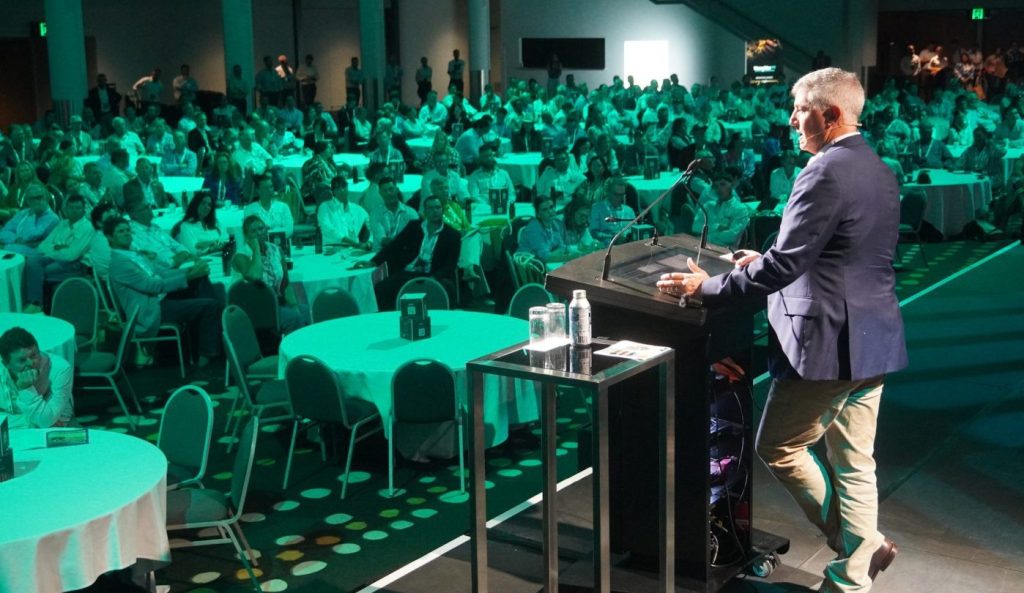
Matt McDonagh addresses last week’s WagyuEdge conference
LAST week’s WagyuEdge conference in Brisbane was an extraordinary showcase, not only of a breed, but of the culture that has driven it to become highly influential and recognised as incredibly progressive.
There is a distinct focus on data-driven decisions that extends from individual breeders through to the entire Wagyu sector. That was on display across the technical presentations and the Branded Beef Awards, where the quality and focus on excellence were celebrated at a scale that is now a benchmark for the broader industry.
For many outside the Wagyu industry, there is possibly less appreciation of the depth and extent to which Wagyu has developed and is influencing the Australian sector.
It is easy to overlook or not consider what has been demonstrated and how it may apply in other applications. There are a few take-homes from the conference that are relevant to any breed or seedstock operation.
Shift away from BreedPlan
The Wagyu industry’s recent move from BreedPlan to Wagyu Breeding Values was one of the most fundamental changes presented at the conference. It is important to note that the move is not a reflection on the value of performance data. Rather, the breed has evolved to the point where BreedPlan was no longer able to provide breeding values aligned with the decisions being made within the breed.
That change has only been possible because of a significantly large database informed by production data, carcase evaluations, genomics and pedigrees.
The Australian Wagyu Association’s Chief Operating Officer Dr Christian Duff made the point that the AWA has around 690,000 animals in its evaluation, with about 75 percent of animals with phenotypic records also genotyped. He described that as genuinely unusual, and a reflection of where the breed has put its effort over the past decade.
The rest of the change allows Wagyu a real opportunity to address traits that have potentially been overlooked while the focus sat on marbling.
Australian Wagyu Association chief executive Dr Matt McDonagh was direct about that imbalance.
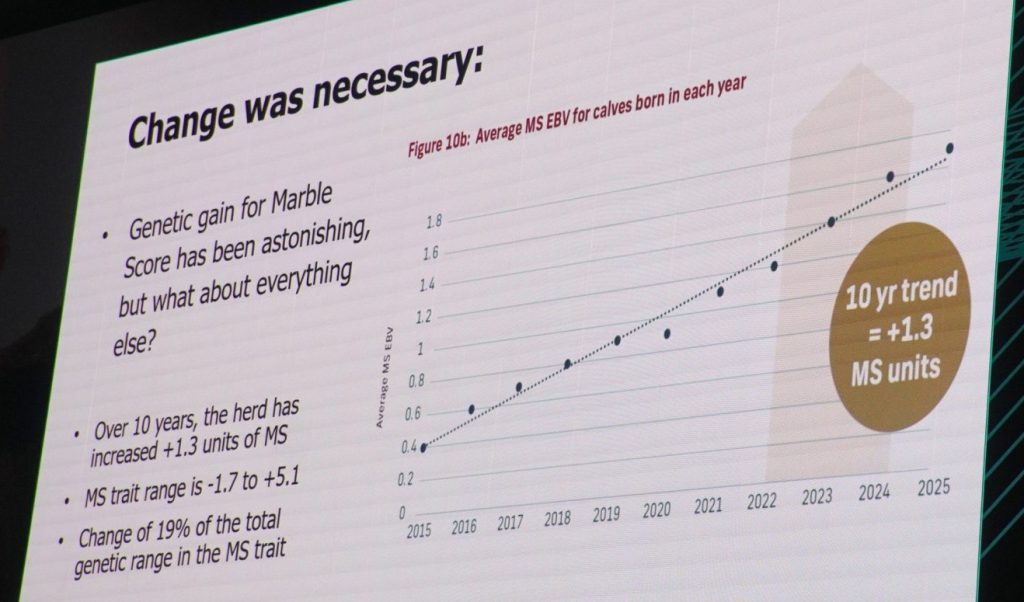
Over the past ten years, he pointed out that marbling score genetics within the breed have lifted by around 1.3 units (see image below) – a trend he described as ‘astonishing’.
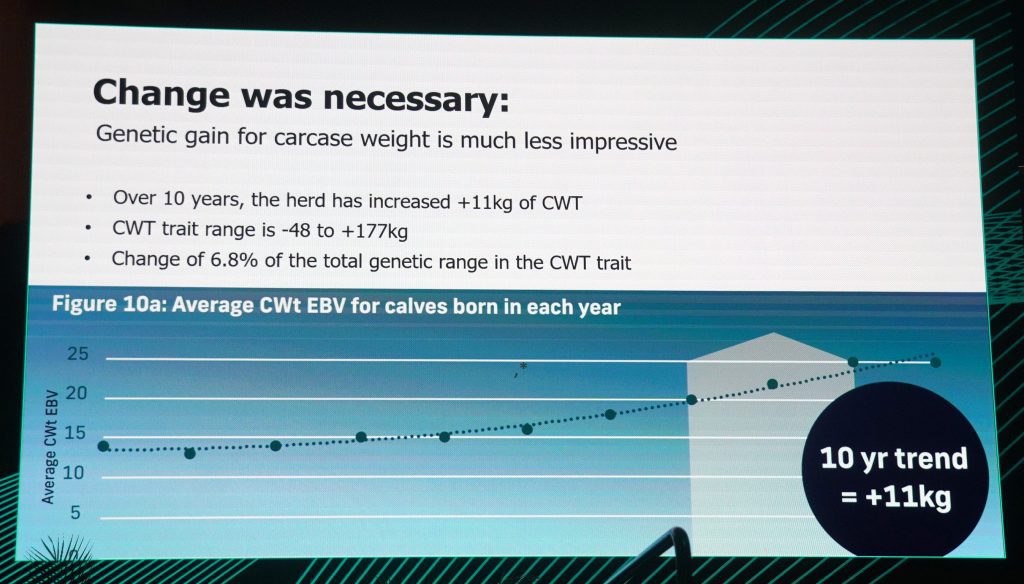
Over the same period, carcase weight (see image below) has moved upwards by only about 11kg, against a range running from minus 48kg to plus 177kg. In essence, the breed has made significant progress in marbling and much less in the traits sitting alongside it.
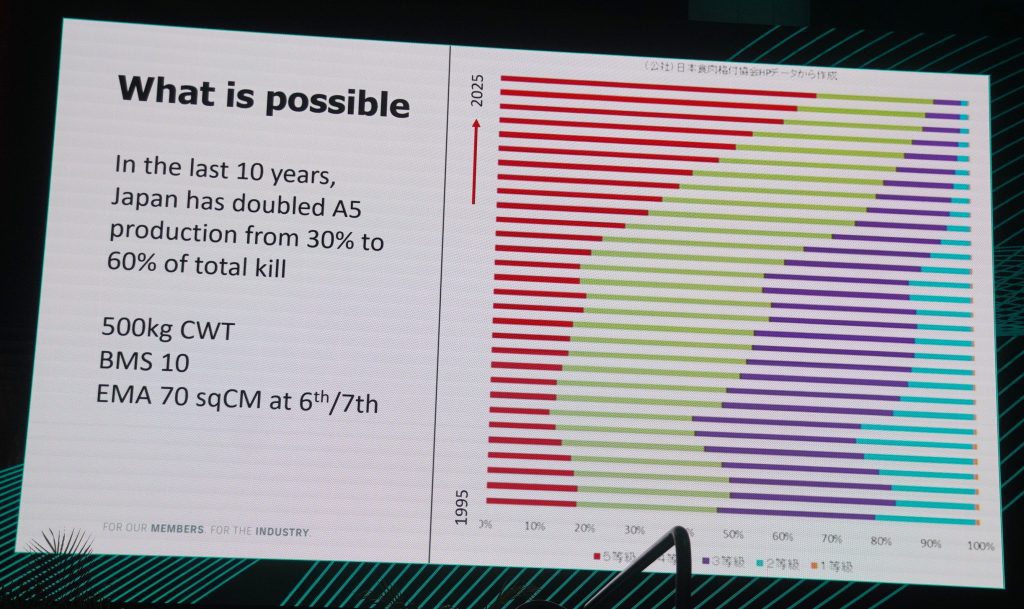
And in illustrating what is possible, Dr McDonagh used the slide below, showing how the Japanese Wagyu industry has pushed the proportion of A5 carcases (the highest yielding and highest marbling under the Japanese grading system – marked in red) from 30pc to 60pc of all carcases processed over the past ten years.
The new Wagyu Breeding Values assessment system makes it possible to push growth, carcase weight, eye muscle area and feed efficiency more deliberately, with net feed intake now included in the evaluation for the first time.
There are other significant opportunities, not only in production traits but also in the identification and management of recessive conditions. Work presented at the conference has already identified exon A10, a dominant variant carried by around six percent of the population that causes pregnancy loss in carrier females, and hepatic fibrinogen storage disease, a recessive condition carried by around 16.5pc of the population.
As Matt McDonagh noted, these conditions are already costing production – whether they are identified or not. The value is in identifying them and managing them.
Capacity to manage data
The capacity to manage, as a breed, the data that matters for future progress is the point observers should note.
 It reflects the rapid change the industry has gone through and the maturation of markets, and the need for the entire system from breeder to market to be more closely aligned.
Weekly evaluation runs mean that information flow is now aligned with the pace of the market the breed is selling into. That matters because, for all the change around the system, cattle are still the slowest part.
Joining, gestation, growth and slaughter all take time, and genetic decisions compound over years. Timely, accurate information is what allows breeders to make the decisions that will shape their herds for the next decade.
Take-homes for broader industry
For the broader seedstock industry, there are several points that are worth considering.
Performance data is essential. For many breeds, BreedPlan will continue to be the right service provider, and there is no reason to change that. For breeds where change is happening more swiftly, where markets are developing, and where there is a large volume of performance and carcase data being collected, there may be opportunities to take greater control over their own evaluations and produce breeding values more closely aligned with the breed and its direction.
Angus Australia’s own recent decisions reflect that.
As Christian Duff pointed out, in quoting the famous Scottish geneticist Mike Coffey, “In the age of genetics, phenotype is king.” What is meant by that is that without quality data recording, genetic evaluations and genomic predictions lessen in value – regardless of the system running underneath them.
While BreedPlan has always been breed-specific in how it is delivered, the Wagyu industry’s move to WBVs highlights that breeds themselves, rather than independent service providers, may play an increasingly greater role in producing breeding values.
That is workable, but producers will need to be more aware that when they are using performance data, they understand who has developed and published it, because there can be differences in how information is presented across systems.
That is not to say the data will be inaccurate. With the database Wagyu has built and the focus the breed has placed on data collection, WBVs are very accurate. The point is one of provenance rather than quality.
More broadly, the key message for observers is that a focus on data collection, from the paddock through to the chiller, adds significant value to a breed and will be essential if beef breeds want to develop or shape their own future and capture the opportunities they are pursuing.
 Alastair Rayner is the Strategic Account Manager for Southern Australia with Vytelle and Principal of RaynerAg. He has over 30 years’ experience advising beef producers and graziers across Australia. Alastair can be contacted here or through his website: www.raynerag.com.au