
ACROSS Northern Australia there is a substantial spread in reproductive, production and financial performance in beef enterprises. Some of that spread reflects differences in country, seasons, nutrition and management. However, environment alone doesn’t explain all the variation seen among enterprises or among animals managed under similar conditions.
Nutrition is a key limitation on herd fertility. Breeding cows cannot maintain body condition, resume cycling and conceive if their energy, protein and mineral requirements are not being met. Because pasture quality and availability change between seasons and years, supplementation may provide the fastest improvement when those requirements cannot be met from the feedbase alone. However, supplementation is a recurring management input. Its cost and delivery must be repeated whenever the nutritional shortfall occurs, and its benefit depends on supplying the right nutrients at the right time. It can improve performance in that season, but it does not permanently change the genetic capacity of the herd.
Genetic improvement works differently. It cannot replace adequate nutrition, but favourable genetics retained in the breeding herd can be passed to future generations and become part of the herd’s genetic starting point. Continued selection can therefore progressively increase the proportion of cows more likely to reach puberty, maintain body condition and resume cycling within the available environment.
Although adequate nutrition allows cows to express their reproductive potential, animals managed under comparable conditions still differ in the age at which they reach puberty, how quickly they resume cycling after calving, their ability to maintain body condition and their likelihood of conceiving within a defined period. Some of these differences are genetic and can be passed to the next generation. Continued selection can therefore progressively increase the proportion of cows better able to rebreed within the available environment.
A calf from every cow each year is an important goal for a breeding enterprise, but the reproductive calendar is unforgiving. Data from the Repronomics project recorded adjusted gestation means of 291.5 days for Brahmans, 288.2 days for Droughtmasters and 285.1 days for Santa Gertrudis. In order to maintain a 365-day calving interval, a cow needs to conceive again within about 74 to 80 days of calving.
If a cow doesn’t return to oestrus until 45 to 50 days after calving, there are only about 24 to 35 days remaining for them to conceive. In reality this is only one or two cycles. For cows in low body condition this post-partum anoestrous interval increases and reduces the chance of returning to a 12 month calving interval.
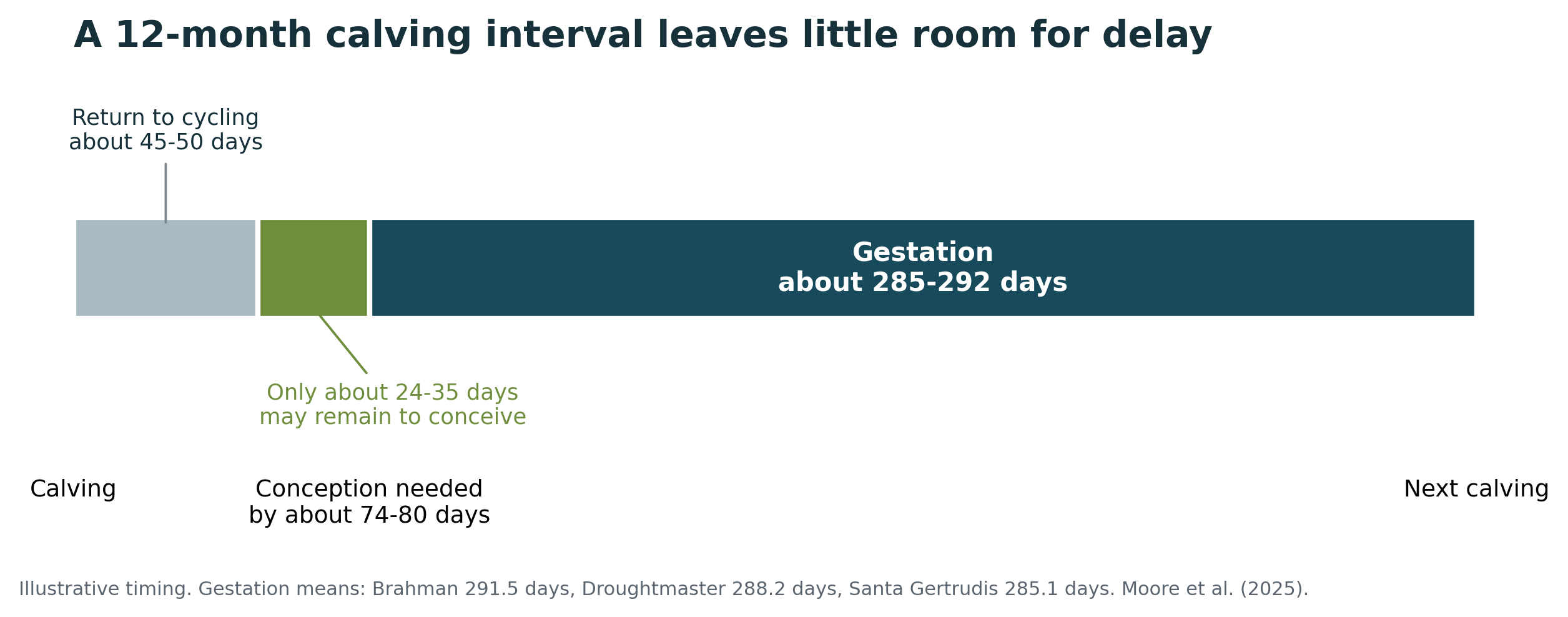
Figure 1. An illustrative 365-day reproductive calendar. The time available for conception varies with breed, gestation length and when the cow resumes cycling.
The CashCow project identified pregnancy within four months of calving, or P4M, as a major driver of annual weaner production. While P4M is a valuable measure of a cow’s ability to rebreed, it is not the same as a 365-day calving interval. A cow conceiving four months after calving will calve later the following year. This means that for producers aiming for an annual target, conception needs to occur considerably earlier.
The influence of nutrition and management determines whether cows can resume cycling within the target windows. The genetic variation within the herd influences when females reach puberty, how quickly they return to cycling and their probability of conceiving under comparable conditions. While selection won’t overcome an inadequate feedbase, it can increase the proportion of the herd capable of performing within the environment available.
 The Northern Repronomics project recorded more than 5,700 Brahman, Droughtmaster and Santa Gertrudis cattle for traits including puberty, return to cycling after first calving, body condition, weight and hip height. The data highlighted significant genetic variation in these traits. Comparisons between Brian Pastures and the tougher Spyglass environment also found genetic correlations of 0.93 for age at puberty and 0.81 for the post-calving anoestrous interval, with no evidence of meaningful sire re-ranking.
This doesn’t mean environment was unimportant. Performance levels and the spread between animals changed between sites. However, it did demonstrate that sires whose daughters performed better at one site generally remained better at the other. Although tougher conditions made differences harder to see from raw performance, the genetic differences did not disappear.
Led by Professor Ben Hayes at UQ’s Queensland Alliance for Agriculture and Food Innovation, the Northern Genomics Project worked with commercial producers to develop multi-breed genomic predictions for purebred, crossbred and composite cattle. Its 2023 analysis used 29,391 animals. A 2025 AAABG paper used an expanded reference population of 34,292 heifers from 60 northern herds representing at least 14 breeds.
The analysis found measurable genetic differences in P4M, heifer puberty, body condition, 600-day weight and hip height. P4M had the lowest heritability at 0.10. This means that only a relatively small proportion of the variation in P4M was associated with additive genetic differences, while season, nutrition and management influenced much of the observed performance. It doesn’t mean P4M can’t respond to selection. It means genetic merit is difficult to identify from a cow’s result alone, making large reference populations and genomic information particularly valuable.
The genomic breeding values were then validated using an independent Beef CRC population that had not contributed records to the reference population. This allowed predicted genetic merit to be compared with reproductive performance without the same animals appearing in both the development and validation datasets. As Figure 2 shows, animals in the highest puberty GBV quintile reached puberty about 80 days earlier than those in the lowest quintile. The proportion pregnant also differed by about 30 percentage points between the highest and lowest P4M quintiles.
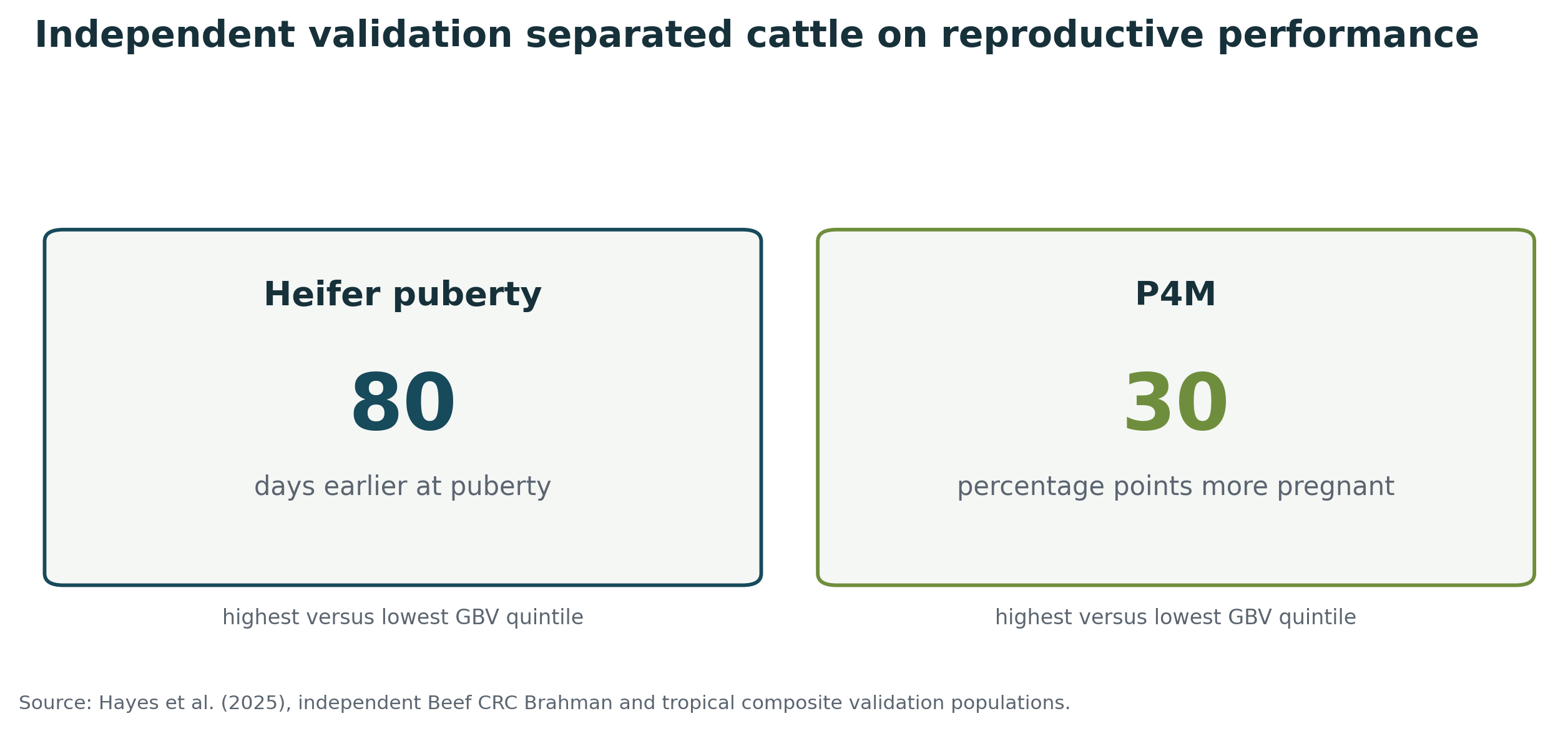
Figure 2. Differences reported by Hayes et al. (2025) between the highest and lowest predicted GBV quintiles in the independent Beef CRC validation set.
The independent validation showed that genomic predictions could separate cattle for important reproductive outcomes outside the population used to develop them. This provides evidence that genetic differences in fertility can be identified and used in selection.
From a producer’s perspective, improving fertility doesn’t require growth to be sacrificed. Among 2,438 Repronomics heifers, there was no observed relationship between sire EBVs for age at puberty and 600-day weight. Sires were identified whose daughters reached puberty earlier while retaining above-average growth. Producers can use BREEDPLAN EBVs and indexes, or multi-breed predictions such as RePRO BI, to consider fertility alongside growth, body condition, mature cow size, temperament and adaptation.
There are some producers expressing concerns that genetic improvement diminishes over time. While the influence of an individual sire becomes more widely dispersed through the herd and his proportional contribution declines with each generation, the improvement doesn’t automatically disappear. Progeny receive half their genetics from each parent, so a 20-unit difference between two sires is expected to produce about a 10-unit difference between their progeny averages when the dams are genetically similar. Continued selection of favourable males and females shifts the genetic average of the herd, with that progress becoming the starting point for the next generation.
This distinction is also important when interpreting Days to Calving EBVs. A bull’s EBV describes his estimated genetic merit for the performance expected in his daughters. It doesn’t describe the bull’s own fertility or gestation length, and an EBV of zero doesn’t represent an observed period of 340 days. Bulls with Days to Calving EBVs of -10 and +10 are 20 EBV days apart, giving an expected difference of about 10 days between their daughters’ averages.
Lower Days to Calving EBVs are more favourable as their daughters are expected to conceive and calve earlier. Where nutrition and management allow females to resume cycling, earlier conception buys valuable time within the narrow reproductive window, increasing the chance of maintaining a 12-month calving interval or, at the least, being pregnant within four months of calving.
The practical message is that genetics can’t replace nutrition. Nutrition sets the limit on what cows can achieve, while body condition, supplementation, health and joining management determine whether their potential is expressed. Genetic selection allows producers to progressively increase the proportion of cows more likely to reach puberty, resume cycling and conceive within those limits, without unnecessarily compromising growth or other traits that drive value.
 Alastair Rayner is the Strategic Account Manager for Southern Australia with Vytelle and Principal of RaynerAg. He has over 30 years’ experience advising beef producers and graziers across Australia. Alastair can be contacted here or through his website: www.raynerag.com.au
‘Cows for Country; and, Bulls for Market’ … an old saying; that is, and remains, true.
Yes, rain makes good Managers … yet …
Milk production is key to it all … whether you join or calve (or both) on a rising plane of nutrition.
Cull cows … and Bulls … appropriately.
Soil-quality underwrites it all … and sub-soil moisture, at-depth, is very important for enduring, quality pasture growth … and being slower into a drought and quicker out the other side of one.
Pressure-on/Pressure-off, nomadic style, rotational grazing, will assist with Silvipasture improvement, and increased ground-cover.
Excess livestock production above replacement to sell, all falls straight to the bottom-line cash-flow … and operating-profit.
What’s not to like?
We were based for around 90-years in Central-Queensland, ex-Gidyea-scrub country between Blackall-Barcaldine-Springsure (but west of the range): and put Red-Poll Bulls over the big-frame Beef-Shorthorn cows … the cows produced plenty of creamy milk and no cows were walking away from twins (of which there were plenty) … and then pure-ish Charolais Bulls over a selection of them … and terminal Grey-Brahmans Bulls over those Charolais-X heifers at around 13-months. Mean long-term Calvings around 94% … and mean Weaning around 87% … and never over-stock.
Lighter carrying regions a bit further out, where mean weaning-rates might be around 60% per Annum, and it’s a numbers game, require a smaller, lighter cow … yet, still must have the milk available for the calves, for that 1st x 4-months, as they transition to grass and processing cellulose … drought or not. IMO
In harsh conditions I have found: the smaller framed cow with only low to medium milk supply and early weaning resulted in higher weaning percentages within a 12 month calving period. I like the redpoll and shorthorn cross.
Alf Collins from CBV Brahmans at Marlborough has being successfully working on this for many decades.