
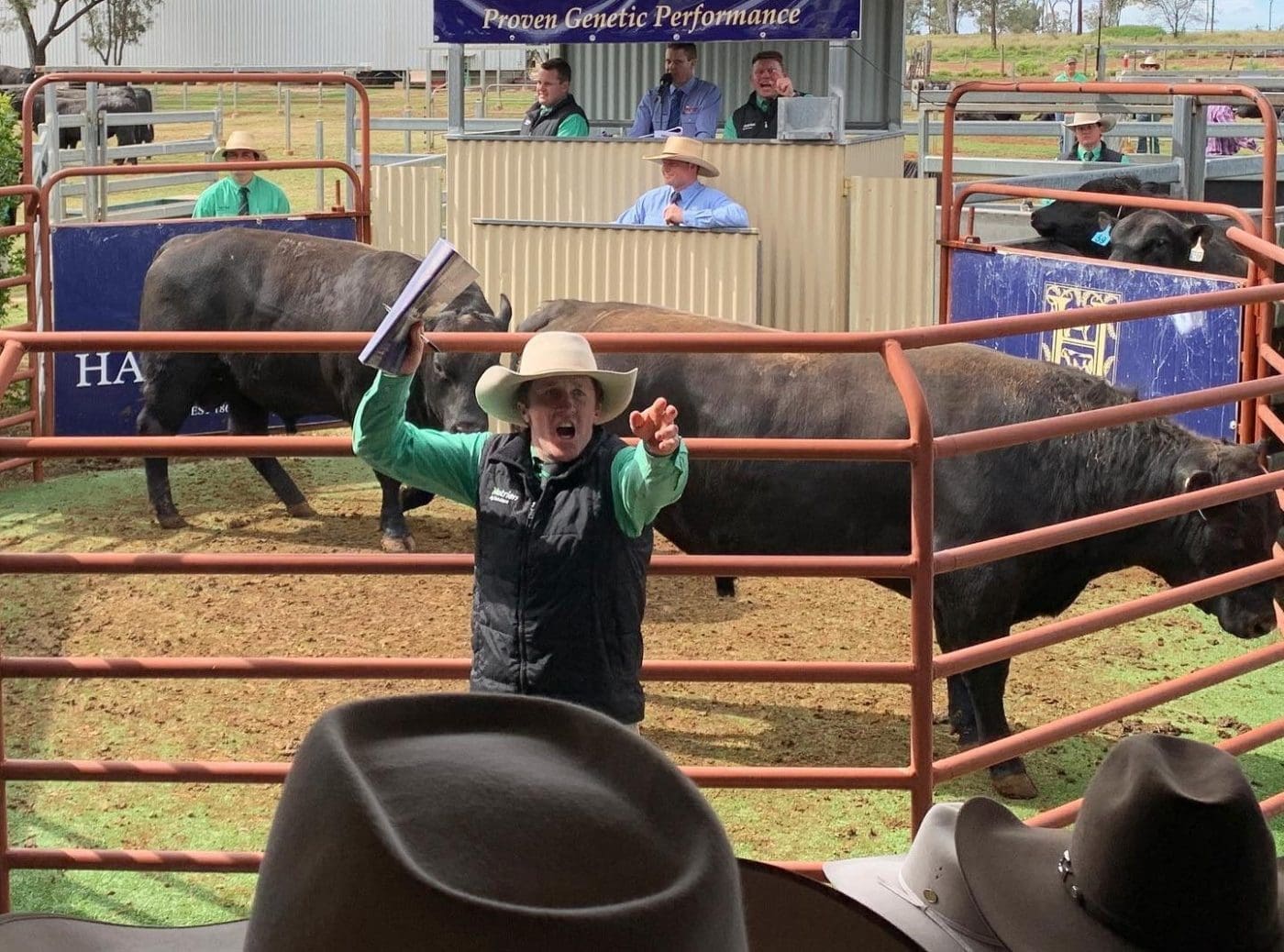
THE Australian beef industry – and commercial cattle breeders in particular – have never had more information to work with.
Genomic testing, DNA parent verification and a steadily expanding suite of EBVs mean breeders can identify high-merit young bulls earlier, and with more accuracy, than they could a decade ago. So, it would be reasonable to assume that more information makes the selection decision easier.
However, this assumption may not always be the case. As has been the focus of several Beef Central genetics columns, and in many readers’ responses, more information on a bull – particularly genetic information – doesn’t always mean that bull is a suitable choice for a breeding program.
This is a message that is often presented with producers seeking to purchase bulls for breeding purposes as the target audience. However, it is a message that is very closely aligned with the approach most seedstock breeders have when preparing their sale team.
In conversations with breeders over recent weeks regarding their forthcoming sales, many of them commented on how their preparation starts well before the sale. These conversations shared many commonalities regarding sale teams. These could be best summed up by Josie Copely of Copely Brahman who described the interaction between genetic information and phenotype.
 “The data tells us which bulls are genetically worth a closer look,” she said.
“It doesn’t tell us whether the bull is structurally sound, whether he will get cows in calf, whether he has the temperament to work, or whether he suits the country our clients run him on. We still have to go and look.”
This comment reflects the reality that many seedstock breeders have in setting a sale team up. Listening to a pre-sale comment from a NSW seedstock breeder at a recent sale, he mentioned how the earlier forecast of a difficult year made him look more closely at his team.
And “given the strength of sales seen so far this year, it would have been good to have kept a few more in the team. But the quality we have kept is very good.”
The temptation to retain high genetic merit bulls, or to include a couple more in the team, is a challenge most seedstock breeders grapple with, and as strong sale averages continue, there may be some later sales that will wrestle with this decision. This decision can be more difficult if the bull is still on hand and may look like a late candidate for the team.
However, just as frequently, the decision can be less challenging.
In commenting on team selection, Josie Copely provided an example of a more straightforward decision.
“We had a bull that was actually in the top few percent for the Live Export Index, worth $180. On paper he was an obvious sale prospect, but we had already culled him, as not up to our expectations for a bull to go into someone’s program.”
These decisions are similar in every seedstock program offering bulls to breeders across the country. Another comment offered by seedstock breeders was that “A high index earns a bull a look, not a place in the catalogue.”
Neither genetic data, no matter how accurate it may be, or physical soundness or temperament outweighs the others when finalising a sale team. Even as genomics makes the genetic part of a bull’s potential clearer, it potentially draws even greater focus onto phenotype and function.
The reality is that a bull can be excellent on paper and still not earn a place in the team. Breeders put real effort into selection for balance, and the bulls that do not make the catalogue are as much a part of that process as the ones that do.
Breeding objectives are as essential for a seedstock operation as they are for any commercial program.
Preparation begins with the breeding objective
Preparation begins with the breeding objective, which decides what kind of commercial herd the genetics are appropriate to and which traits carry the most importance for these herds.
These objectives both define the direction of a program and guide the recording of phenotype including weights, scans, fertility measures and structural scores, ensuring these occur at the appropriate stages and within contemporary groups.
Breeding objectives are equally important in guiding culling decisions, nutritional management to ensure bulls express their potential without being over-conditioned.
As a practical result the sale team, and every bull included in the team, is the result of a long process of selection, measurement and observation.
A sale team that has been catalogued and presented for sale day is the result of intense scrutiny. The bulls on offer are described on their merits, and those merits are real. But the scrutiny it took to reach the catalogue is not as apparent, and it matters as much as any trait or phenotype printed against a lot.
For a producer, that scrutiny is essential and important that this be considered before sale day. It is fair to say that the rigour applied to this sale team scrutiny varies between programs, and this isn’t always visible in a catalogue.
The strength of a sale team isn’t just the figures printed against each lot. It is the standard the breeder applied before deciding which bulls were worth including in the team.
Asking questions
As an approach, before selecting bulls within a catalogue to consider for a program, it is worth asking the seedstock breeder a few questions.
A good starting point is to ask: “What decides whether a bull makes the sale team?” as well as “At what stages are bulls assessed and removed?”
Many catalogues and breeders already provide information on how bulls have been fed and handled. Just as many also offer the assessments on structure and temperament.
And while this information is helpful, it doesn’t replace the usefulness of asking those questions to the breeder before a selection decision is finalised.
Sale day is still the day the final selection gets made, and buyers should assess every bull against their own objective.
But the preparation that matters most has already happened. A breeder who has defined the purpose of the program, collected good information and been willing to castrate a high index bull has already taken a lot of the risk out of what walks into the ring.
 Alastair Rayner is the Strategic Account Manager for Southern Australia with Vytelle and Principal of RaynerAg. He has over 30 years’ experience advising beef producers and graziers across Australia. Alastair can be contacted here or through his website: www.raynerag.com.au
HAVE YOUR SAY