
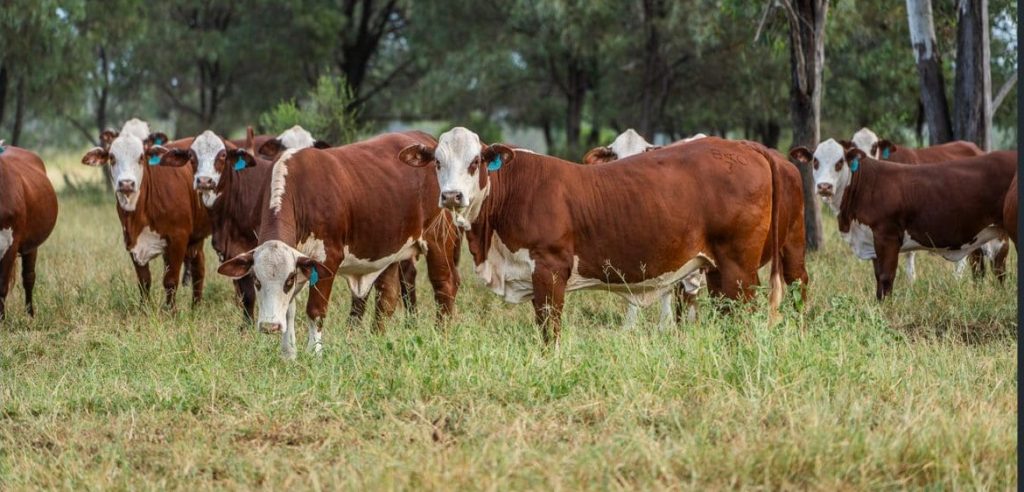
Braford heifers on Rhodes grass
FOR most beef enterprises, profitability depends heavily on kilograms of beef produced per hectare.
Producers often focus on the sale weight of cattle. Underpinning that productivity is reproductive rate. While producers may intuitively accept this, practically appreciating how a focus on reproduction and fertility can improve income is often an area that is underestimated.
Research conducted in northern Australia and published in 2015 offered some early insights into the scale of opportunity, and remains highly relevant today.
Dr Andrew Ash and a team from CSIRO modelled a range of management scenarios across three northern beef regions. One scenario modelled genetic improvement in reproduction, increasing weaning rate by five percentage points and lifting average annual net profit by around 20 percent.
When reproduction was combined with better growth genetics, improved rumen function and cheap protein supplementation, weaning rates rose 28pc, liveweight gain rose 41pc, and net profit rose 130pc. This work demonstrated that gains in reproductive performance – particularly when combined with other management improvements – can produce substantial gains in profit.
Future reproductive rate
At a farm level, future reproductive rate is underpinned by heifer conception rates. The foundation for a breeding female’s reproductive lifetime is established during selection and management as a heifer.
In many cases, management of heifer weight pre-joining is the area where producers can have the greatest impact. Professor Wayne Pitchford of Adelaide University recently presented results from southern research projects at the BestWool/BestLamb and BetterBeef Conference in Ballarat, quantifying the scale of losses experienced in many herds.
Research conducted with more than 14,000 heifers across nine commercial farms in four states showed only 44pc of heifers in southern herds go on to conceive a third calf.
Joining weight and growth rate during joining are the two key drivers behind heifer conception. The research showed that a lighter heifer can still conceive if the heifer continues growing well through mating. However, approaching the heifer’s second joining, body condition score becomes the more important factor, with Dr Pitchford identifying a BCS of 2.5 to 3.5 as the target range.
Earlier northern work
This reflects earlier northern work on heifer weight and lifetime productivity.
Repronomics data from a high-fertility Brahman herd at Douglas Daly Research Farm found heifers that conceived and reared a calf at their first yearling mating went on to reconceive at higher rates later, even if they missed at their second mating.
Heifers that succeeded in their first two matings had the best result, achieving 89pc back in calf at their fourth mating.
However, this doesn’t mean simply selecting for heavier cattle is the answer. The relationship between growth and fertility is genetically more complex.
 Research presented at the Northern Beef Research Update Conference last year by UQ researcher Mehrnush Forutan highlighted the genetic influences on fertility that may have been overlooked previously. Forutan’s team matched fertility records from more than 27,000 cattle against genome data and found 225 regions of DNA linked to female fertility.
Their work identified the genes PLAG1 and HMGA2. Both these genes drive growth and reproduction at the same time. This work helps explain why selecting solely for increased growth doesn’t necessarily improve fertility.
Forutan’s team also found several of these fertility genes are more active in the calf during gestation than in the adult animal.
These findings raise interesting questions about foetal programming. If important fertility genes are active before birth, maternal nutrition and management during pregnancy may influence the future reproductive performance of the heifer calf, although this remains an active area of research.
It’s a reminder that fertility is shaped well before joining, starting with selection decisions and extending back to how the pregnant cow herself is managed.
Some of these markers have been incorporated into commercial SNP arrays, so genomic testing can now select breeding females and sires for fertility traits with more precision than before.
Producers have always kept fertility in mind alongside growth. This research adds a clearer picture of where the two traits share the same genetic pathways, so selection decisions can balance both more deliberately rather than assuming gains in one will carry the other along with it.
The message from this research is consistent: Management determines whether heifers reach their reproductive potential, while genetics helps define what that potential is.
Producers who manage joining weight, maintain body condition and make balanced selection decisions are building the foundation for more productive breeding herds over the long term.
 Alastair Rayner is the Strategic Account Manager for Southern Australia with Vytelle and Principal of RaynerAg. He has over 30 years’ experience advising beef producers and graziers across Australia. Alastair can be contacted here or through his website: www.raynerag.com.au