
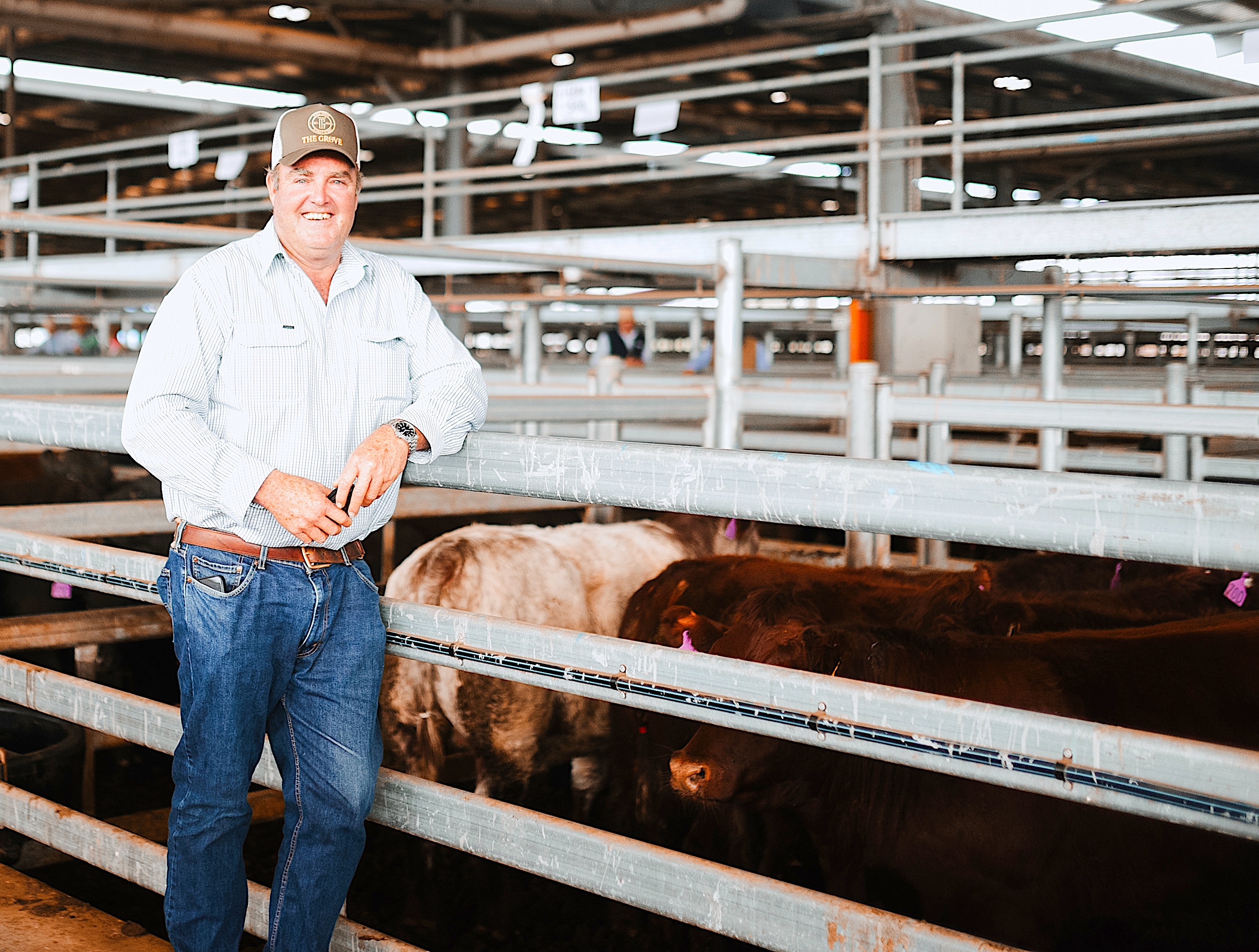
Spencer Morgan, The Grove, Condamine, pictured at the 2026 Ekka Prime Cattle Championships at the Dalby saleyards earlier this year where a pen of The Grove’s Shorthorn HGP-free steers took first place in the class of grainfed pen of six steers.
A LONG-ESTABLISHED Queensland stud is trialling a novel selling method for its 2026 bull sale, in which it will conduct the entire sale over a 24-hour period through its own self-developed online bidding platform.
The Grove Shorthorns will offer its 2026 bull draft online from 2pm Wednesday, September 9 until 2pm Thursday, September 10, with all bidding conducted directly through the stud’s website.
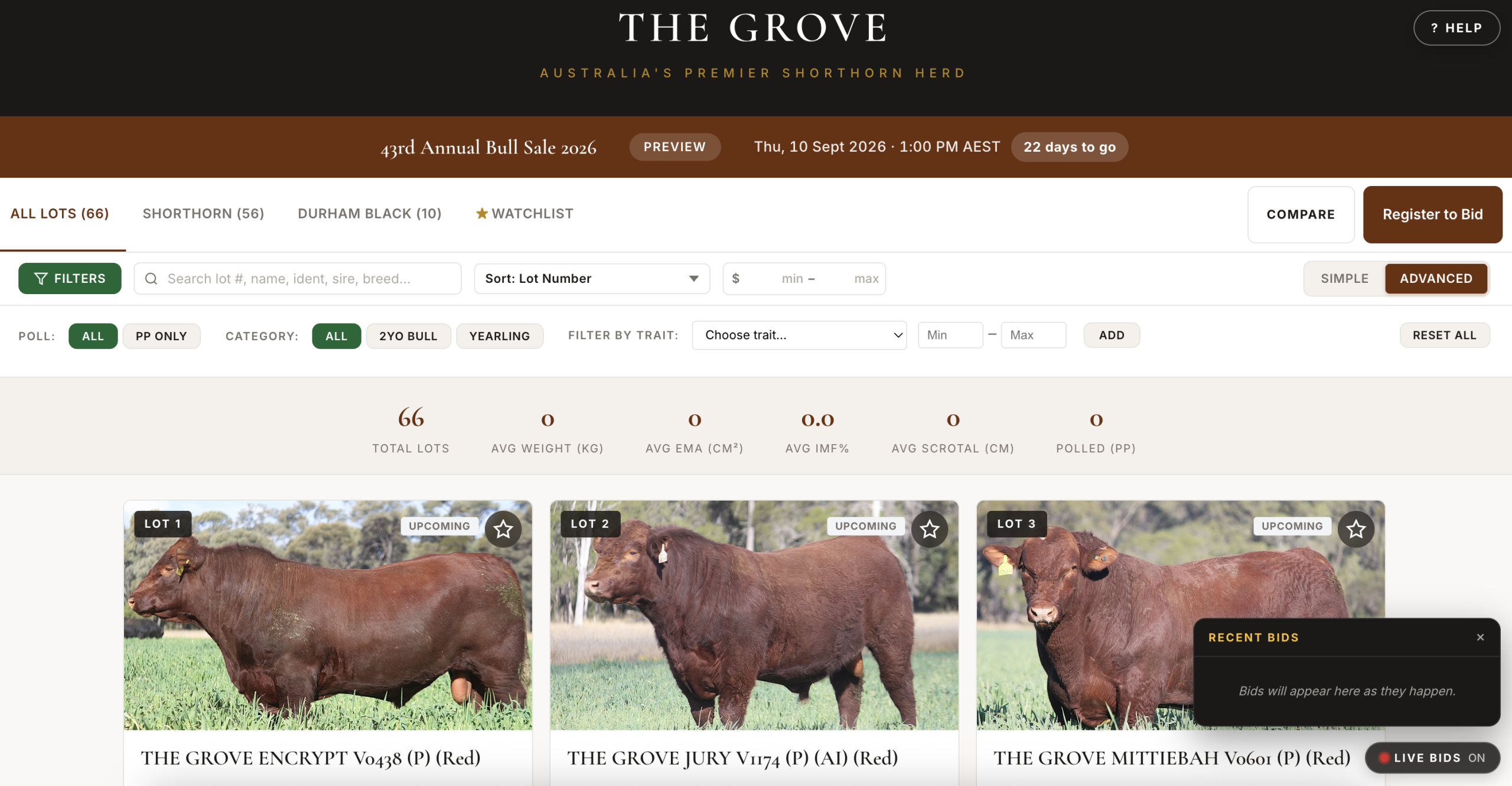
A sample page from The Grove’s online selling platform on its website.
There will be no physical auction and no third-party online auction platform used for the sale.
Instead, prospective buyers will be have the opportunity to inspect the bulls at an open day beforehand – on Wednesday, August 26 – before bidding remotely over the 24-hour sale period a fortnight later.
The move is effectively a continuation of a long-running endeavour by Spencer Morgan of The Grove to trial different selling methods that he believes can give commercial buyers more time to identify and secure bulls suited to their particular requirements.
In 2011 The Grove used its annual on-property bull sale, which until then had been a traditional physical auction, to host the world’s first electronic helmsman auction.
A helmsman sale differs from a conventional auction by offering multiple lots simultaneously. Rather than having only one opportunity to buy each bull as it moves through the sale ring, buyers can bid across multiple animals while bidding remains open.
Mr Morgan said the initial reaction to the move was not universally positive – “Mum thought I’d gone mad, a lot of fellas did too, probably,” he said.
But a measure of its effectiveness lies in the fact that The Grove continued to use the method for several years until the company behind the technology moved offshore, making it more difficult to operate.
The Grove then subsequently moved to an AuctionsPlus interface sale through the COVID years.
However this year, the Morgans have decided to move solely to conducting their annual sale via their own website and online bidding platform, taking a leaf from the book of how many online auctions in other industries are conducted these days.
“Just seeing how the machinery sales work and Thoroughbred horse sales work online, with an online sale presence only, it is a continuation of where we started in 2011,” Mr Morgan said.
Giving buyers more time
Central to the thinking behind the 24-hour format was a desire to improve something the family had observed repeatedly over many years of selling bulls.
“We have always tried to make it easier for buyers to get the right bull, I guess, to save that auction pressure where you get lumped with a bull at the end that you didn’t really want, but you hadn’t bought one during the sale, and you took him home to do a job that was probably not the job that he was suited to do.
“We just noticed that over the years, after the sales when you were loading people’s bulls and you were going through them, and you’d think, ‘Gee, that wasn’t the right bull for them’.
“And then you’d talk to them and that was ultimately the story – they had panicked because they’d missed the bull they had wanted.
“So that is why we adopted the electronic helmsman to start with, to keep all bulls open till the very end.”
Economic outcomes
He said there was still a concern in the early days that by taking the auction atmosphere away, the top-end prices could be lost.
To account for that the Morgans trialled a hybrid sale for several years where they would auction 15 to 20 top bulls up front, and then sell the rest of the bulls via the helmsman system.
Yet in some of those years, bulls sold via the helmsman system still topped the overall sale.
The format inevitably sacrifices some of the atmosphere and immediacy of a live auction, but ultimately Mr Morgan believes the results even out over time.
A fascinating insight comes from his observation that over the years he believes the format may have reduced the higher-end prices paid for bulls at their sales, but has also simultaneously lifted the lower-end prices.
“I think we probably in some respects have lowered the top end spending a bit by giving people more time to go back and go back on the cheaper bulls, but I think we have lifted the bottom end up.
“So the average sits about where it would have sat anyway to be honest.”
Agents still play a role
Asked if another primary motivation was to reduce commission costs, Mr Morgan was quick to reject that suggestion.
“It is nothing to do with commissions, it is just about us having our own in-house show.”
He said agents would still play an important role in the sale, with every agent entitled to a six percent rebate if they introduce a buyer on the platform.
“And we would encourage buyers to use their local stock agent to introduce them, it is not about cutting agents out of their commission. This way if they actually buy the bull they’re getting six percent which is more than they would as part of a joint sale or as an outside agent.”
Prospective buyers can view the online sale and catalogue without registering.
Buyers register through the stud’s website and, once approved, can bid in $500 increments, nominate maximum bids and receive alerts if they are outbid.
Mr Morgan said familiarity with online purchasing had increased considerably among cattle producers, reducing one of the potential barriers to adopting such a model.
“I think people are becoming more and more accustomed to being online,” he said.
For more information on The Grove’s new selling system click here
HAVE YOUR SAY