
LATE last week, the Australian Brahman Breeders’ Association announced its decision to suspend the Live Export and Central Production Indexes, pending a review of those indexes.
This occurs at a critical time for the breed, as it faces strong headwinds with growth of the feedlot sector and expansion of adapted Bos taurus and composite genetics into the north.
What’s going on?
ABBA’s reasoning for the decision is that the Indexes, particularly Live Export, are weighted too highly on fertility and not enough on growth, citing feedback from members and feedlots that the indexes did not appropriately represent market value.
Why the current weighting to fertility?
The intention of indices is to reflect profitability of the production system. Reproduction and Days-to-Calving are #1 in the current Live Export index, because number of calves on the ground is the main profit driver for commercial breeding herds.
It is not accurate to say growth is not included or weighted in the index: it is the 2nd most important trait. High growth animals can (and do) index well; a fertile, high growth animal indexes very well indeed.
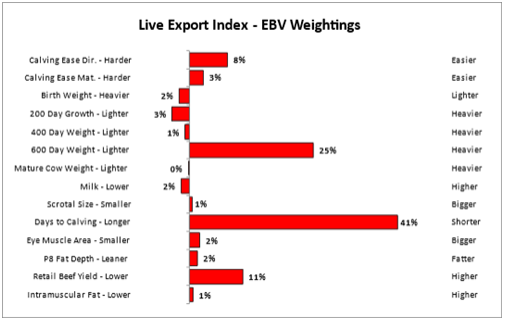
Growth and fertility are negatively correlated, so an unbalanced selection emphasis for growth inevitably results in big, higher maintenance cows that are less fertile. The existing index pushes for early growth, while trying to keep cow weights moderate.
The Northern Repronomics project has found that among Brahman sires, there is a 13-month spread in the age of puberty of their daughters and a six-month spread in the time it takes females to cycle again after calving. Selecting a bull whose daughters reach puberty 13 months earlier and reconceive six months earlier has significant impact on how many calves the cow produces in her lifetime, which is what drives the bottom line of commercial breeding herds. This is why fertility is weighted highly in the index.
Feedlot growth is important, but for breeder operations, the number of animals they have to sell is more important. For every steer going on a boat or truck, there is a heifer left in the herd whose sole job is to produce a calf every 12 months.
Now what?
Brahmans in northern Australia appear to be at a major crossroads on how they use objective data to improve genetics and in the advancement of the breed. The Angus breed has achieved much in Australia by wholeheartedly embracing data. This is an opportunity for the Brahman breed to do the same, as some within the breed are already doing.
I believe this issue has arisen due to an increasing number of commercial producers asking their seedstock source for objective data on the genetics they are buying, in the form of EBV’s & Indices. This demand for data, along with the advances in genetic data available from genomics has caused some bull breeders to look at their EBV profile more than they have in the past. In doing so, they have found their genetics did not measure up as well as they expected, in direct contradiction to the sale ring records set and show ribbons hanging on the wall.
The solution is not to tweak the indices to achieve a desired outcome or turn them off altogether. If this is done, those buyers seeking objective data and confidence in the genetics they are buying will simply look to other breeds.
 Other breeds have reviewed the names and composition of their indices, and it is timely that Brahman breed should have a similarly thorough review and revamp of the Brahman indices. It could already be argued that that the current live export index would be better called the ‘high fertility index’ and the current central production could be the ‘high growth index’. Including a further index with fertility removed altogether is an option also, providing it is described accurately as a terminal index.
It is essential that this review be done in an open and transparent way, with details of the production system and underlying assumptions used to derive the revised indices publicly communicated. This is a good opportunity for all involved to learn more about indices, how they are derived and what their application and limitations are. This will ensure they can be used appropriately and with confidence going forward, for the better of the breed.
There is ample time for this process to occur before the self-imposed December deadline, if the process is not completed properly by then, the existing indices should remain in use until replacements are ready and communicated to industry. The existing indices are far better than none and having none would be a backwards step for the breed.
Of greater significance to discerning bull buyers is the upcoming multibreed genetic evaluations. There will be one set of measures for tropical genetics and one for temperate cattle. This will allow commercial producers to select for genetics across breeds by enabling them to compare like for like traits, rather than being limited to within breed comparisons as is currently the case.
The multi-breed EBV is a golden opportunity for commercial and seedstock businesses who are serious about profitable genetics.
“Reproduction and Days-to-Calving are #1 in the current Live Export index, because number of calves on the ground is the main profit driver for commercial breeding herds.” That’s something I must have missed. Could someone point me to the appropriately constructed proof that has shown selecting for days to calving will either improve weaning rate in commercial breeding herds in northern Australia or improve profitability by providing benefits greater than the costs associated.
In real terms, show me a herd that is more profitable as well as meeting the commercial carcase traits required to be a profitable enterprise, whilst focused solely on the Live Export Index. Fertility is important in a profitable breeding and fattening enterprise, and so to is meeting market specifications. Approximately 40% of a commercial enterprises annual income is the cull female market income, as has been the case with a majority of Live Export Index/Breedplan disciples, this is nearly impossible to achieve due to market weights being too light and discounts being placed on underweight female carcases. After years of judiciously breeding for Indices these herds are now finding it harder to market their stock into finishing markets due to lack of carcase weight and ability to meet market requirements. If breed societies don’t question the legitimacy of the “science” on offer, then they are not doing their job in representing the breeders or the recipients of the seedstock. It has already been proven that genetics from some of these herds are less profitable than genetics developed without figures, by up to 60kg carcase weight( in todays price @$9.15/kg = $549/head), you don’t need to be a big operator for this to start and effect your bottom line. Also, who is to say that the users of Breedplan figures have better fertility/growth/more profitable herds than those that utilise the age old and somewhat proven version of selection- “The Eye” and weight/scan data. Carcase feedback does not lie or make assumptions.