
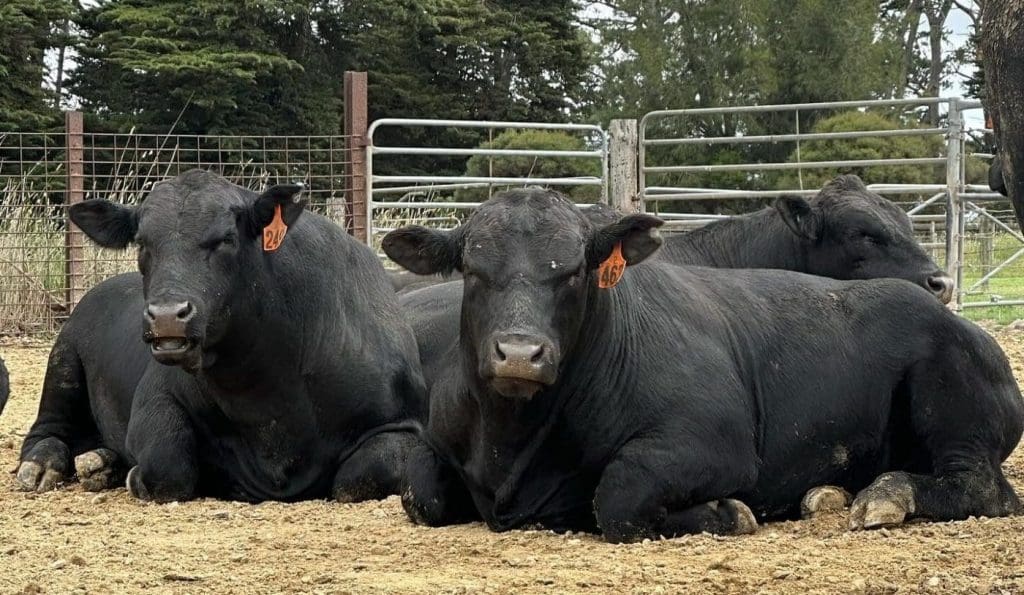
Angus bull breeders preparing for the upcoming spring bull selling season are in the middle of evaluating the realistic size of the market this year and how many bulls can be effectively offered, as a result of recent drought impacts.
Estimates have suggested anywhere between 50,000 and 100,000 breeding cows have been removed from the system in the drought-hit zone across the New England, Northern Tablelands and southern Queensland border region over the past six months, as severe conditions set in.
That comes on top of the Victorian, Eastern South Australian and southern NSW region hit hard by drought the previous year, which is still in the primary stages of herd rebuild. Some estimates suggest 20-30pc of breeding cows in those regions were removed last year and the year before.
ABS data for the March quarter released yesterday showed the national Female Slaughter Ratio – the proportion of females in the national adult cattle kill, expressed as a percentage – rose to 53pc. That figure was up from 52pc in December, still well above the 47pc ratio regarded as a ‘breakeven’ point between herd expansion and contraction.
As a result, Bos Taurus bull breeders – and particularly Angus – are currently considering their options. Too many bulls catalogued for spring sale will simply depress the market for all, while at the same time no bull breeder wants to offer less bulls than he or she can find homes for.
 While most of the points raised in this article are relevant to all Bos Taurus breeds, Angus will be most acutely affected, on the basis of the breed’s sheer popularity and geographical alignment with areas impacted most by drought over the past two years.
According to the Angus Australia website, there are 91 sales listed between today (Greg Chappell’s Dulverton Angus sale) and November. Up to four sales are scheduled on some individual days during August and September.
Beef Central spoke to a number of Angus bull breeders – large and small – about how they are approaching the issue of matching supply with demand this year.
One large southern Angus bull breeder told Beef Central this week he had already cut about 40 bulls from his 2026 offering, anticipating less buyer demand, in terms of volume. In contrast, another large northern NSW Angus breeder is advertising this year’s sale offering at 300 bulls – up another 18 on numbers offered last year.
Clearly, all of them have been furiously manning the phones, trying to gauge bull client requirements for this year. Some have already made moves to reduce their offering size this year; others are yet to make a decision; while some are sticking with their original offering size, but plan to market their bulls differently.
There’s a clear trend among some Angus bull breeders this year to try to find more homes for this year’s offering in Queensland, for example.
Either way, there is a lot at stake, with a typical investment of $3500 to $4000 to bring a two-year-old bull to sale readiness. Once a big investment has already is made in sale preparation, it makes it even harder to cull numbers, one stud manager said.
Inevitably, some left-over sale bulls from some breeds will find their way to processors this year. The sheer strength of international demand for grinding meat means their salvage value makes their disposal less painful.
Using an example of a 750kg two-year-old bull, the top-cell on processor grids this week is 650-700c/kg dressed weight, depending on which part of the country he’s in.
Dressing percentage on bulls can vary depending on breed (up to 60pc on some Euro types), but a typical fed Angus sale bull like this is likely to dress 57pc. That means a 750kg liveweight bull is likvely to dress around 430kg, which at a grid price of 700c/kg represents salvage value of a little over $3000.
It’s part of the reason why many stud managers have already made the call to reduce offering size now, rather than wait until much closer to sale date when feeding costs mount up even higher.
Smaller studs impacted
For smaller Angus bull breeders, the opportunity to reduce the size of their sale offering becomes problematic, quickly reducing income-earning potential if they cut too deep.
Near Tenterfield on the NSW/Queensland border, Inglebrae Farms will stick with its conventional catalogue size of 40 bulls this year – but manager Dean Battistuzzi plans to market the offering differently.
He said while the property had received 30mm from this week’s rain event, many of his bull clients were in ‘proper drought’ this year.
“Typically, we have a percentage of our bulls that stay local, but that’s going to be challenged this year because a lot of cows have been taken out of this area,” Mr Battistuzzi said.
“But equally, we also sell bulls down into the Northern Rivers area around Casino, Kyogle and Bonalbo, and that area this year is good, season-wise.
“Then we also take bulls across the border into Queensland, as far as Augathella and north to Emerald. This year, we will focus more on marketing our bulls into Queensland and the Northern Rivers region, hopefully to pick up the deficit that see from lower demand on the New England,” he said.
“Talking to our Queensland clients who tell me how well the season is going for them, and with minor flooding in parts of the Northern Rivers this week, we’re going to put more resources into promoting our bulls that way.”
“Being only a small stud, we normally budget on a 100pc clearance from our sale. We don’t do enough bulls for the markets we service, but this year may be the first for a long time that we struggle a little to achieve that. But having said that, we thought the same back in the 2019 drought, and still sold all our bulls.”
While the Inglebrae Farms property also runs a large Angus commercial herd, any ‘leftovers’ this year from the stud’s annual sale of 40 bulls in July may be used to replace older bulls in the commercial herd.
Mr Battistuzzi said Inglebrae Farms concentrated on calving ease and lower birthweights in genetic selection, and this had proven an advantage for buyers seeking young bulls to join to heifers after earlier droughts. That may be an asset again for spring joinings later this year, as more Angus commercial herds retain heifers to try to get herds back on their feet.
The decline in Angus cow numbers may also produce a positive impact in demand for Angus bulls from those Northern NSW breeders who have drifted into F1 Wagyu breeding, another bull producer suggested.
“Those people who have been breeding F1s will be looking to rebuild their Angus cow numbers, when seasonal conditions allow. That means returning more cows to Angus bulls, rather than Wagyu – at least for a period – until cow numbers are restored,” he said.
HAVE YOUR SAY