
Image: Shutterstock
THE market for Australian Carbon Credit Units has jumped in the past couple of weeks after companies covered by the country’s “safeguard mechanism” squared away their balance sheets at the end of March.
According to carbon trading website Jarden, the prices of ACCUs is today hovering around $37.80, which is up from around $36 earlier this month.
 The slight uptick in prices has come after large emitting companies covered by the Federal Government’s safeguard mechanism squared away their balance sheets for the 2024-25 financial year.
Companies in the legislation are required to report their emissions by October 31 and if they exceed their limits, they have to reconcile them with ACCUs by the end of March the next year.
The Clean Energy Regulator has released the report of the safeguard mechanism performance showing the impact of the Labor Government’s changes to the laws when it came into power.
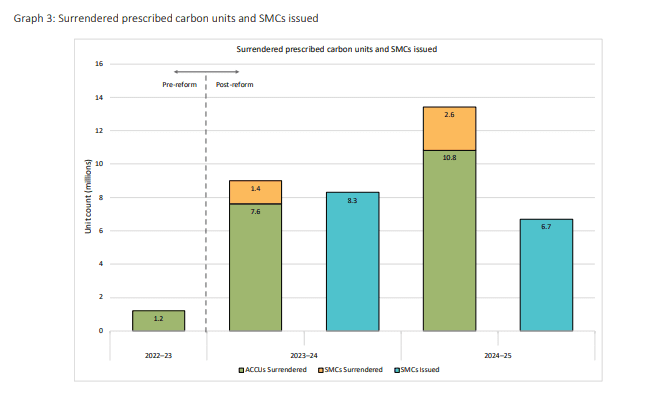
Purchases of Australian Carbon Credit Units have increased significantly since the Labor Government’s new regulations came in. Graph: Clean Energy Regulator
The number of ACCUs purchased for compliance has increased dramatically from 1.2 million in the 2022-23 financial year, to 8.8m in 2023-24 and 13.4m last year.
It has also been issuing “Safeguard Mechanism Credits”, which are issued to companies who emit less than their limits.
Concern about long-term supply of ACCUs
The Government’s legislation will lower the limits on the companies it covers progressively until 2035, when it is trying to lower emissions by 62-70 percent on 2005 levels. Meaning that there will be more pressure on those companies to decrease their own emissions and likely more demand for ACCUS.
While increasing the ambition for its emissions targets, it has also made it harder to generate ACCUs.
A pie chart of last year’s safeguard reporting period shows the avoided deforestation and human-induced regeneration methodologies accounted for more than half of the ACCU surrenders – both methodologies no longer exist.
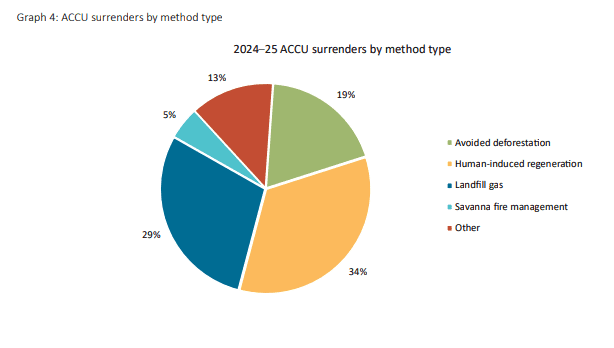
Graph: CER
A new version of human induced regeneration has been drafted, although the carbon industry says new projects will be largely unviable under its rules.
According to the Clean Energy Regulator’s, there was 400 new projects signed up last year, which was the second biggest year for new projects since the scheme started. However, some projects that are held by the same landholder have been registered as multiple projects, which appears to be part of the reporting.
The agriculture-based soil carbon projects are taking up a bigger share of the new projects, with many in the industry saying the ACCU issuances from this methodology have been underwhelming.