
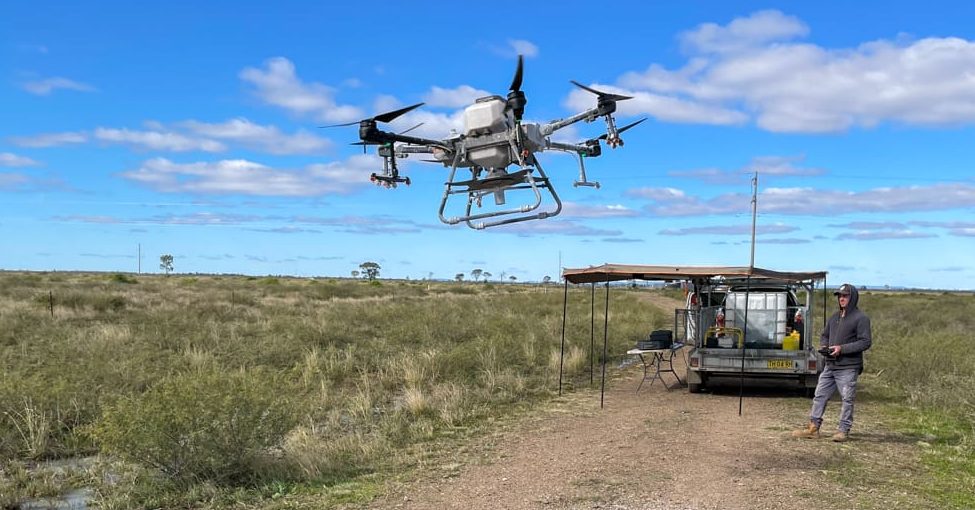
LAND managers are closer to harnessing the benefits of Artificial Intelligence and Machine Learning technologies to help them manage Australia’s large and diverse exotic weed pest challenge.
A new software platform called WeedRemeed – developed by the Centre for Invasive Species Solutions in partnership with technology developer 2pi Software – claims to be easier to use and poised to reduce labour-intensive manual surveys.
WeedRemeed uses advanced colour picking, AI and Machine Learning technology to analyse drone imagery to identify and locate target native plants and weed species.
The initial project was funded through a Department of Climate Change, Energy, the Environment and Water Saving Native Species Program grant.
ACEN Australia’s support through its Social Investment Program has enabled the first of three planned stages of usability improvements. This critical first stage provides the foundation for further work to simplify model training and make the platform even more accessible.
How does it work?
WeedRemeed utilises either AI colour detection or a Machine Learning model to identify target plant species within drone imagery, and to geolocate them for treatment.
AI colour detection compares the drone image set to a customised colour swatch.
Machine learning YOLO models are trained on an annotated image set, which the algorithm learns from to detect target plant species. YOLO, which stands for “You Only Look Once,” is a revolutionary deep learning algorithm used for real-time object detection in computer vision.
The AI or Machine Learning models can be used in isolation, or together, to get a better overall detection rate.
Making WeedRemeed technology more accessible allows land managers to make better use of their on-ground resources, its developers say.
CISS chief executive Shauna Chadlowe said the project was helping to make advanced technology more practical for stakeholders responsible for caring for land.
“Powerful technology can only make a real difference if people can use it easily and affordably,” Ms Chadlowe said.
“For people managing large and often complex landscapes, better weed intelligence can support biodiversity protection, environmental compliance and transparent reporting, while helping target resources where they will have the greatest impact.”
CISS business and science portfolio manager Sean Freney said the platform’s new features were a “game-changer.”
“They break down useability barriers to help land managers use the technology to detect and map their weeds earlier, monitor changes across landscapes and assess the effectiveness of their management actions – ultimately supporting better environmental outcomes on the ground,” Mr Freney said.
WeedRemeed made drone-based AI technology accessible in addressing the challenge of detecting and monitoring both priority weeds as well as endangered native species, he said.
“Now that the platform is easier to use, we’re confident more landholders will be able to deploy this technology, allowing them to use their on-ground management resources more effectively.”
The platform’s new features allow users to simply create colour detection swatches of target plants and weeds in minutes. This is ideally done when the plant is most obvious in the landscape (usually when flowering).
“This will significantly improve their experience and enable them to get improved results quickly,” Mr Freney said.
Beef Central asked if particular extensive area weed species had been targeted – for example prickly acacia, rubbbervine or parkinsonia.
We were told WeedRemeed is not one model, but a platform that allows users to create their own detection models or access pre-developed models. The platform does not have a pre-developed model for these species at this stage, however developers have been working to improve a model for parkinsonia (not yet released).
“But to boil it down, no matter what weed species, the idea is to pick a colour particular to the species being targeted,” Mr Freney said. “It’s important to note that this can be supported by seasonal surveys which allows the operator to choose a colour from a flower or berry, for example.”
“Looking at the three weeds raised in your question, I can see they have quite distinctive colourings, which would likely help with detection when used in this way.”
“However as WeedRemeed continues to build, we are aiming to have a variety of publicly-available models targeting a variety of species that users can utilise,” Mr Freney told Beef Central.
HAVE YOUR SAY