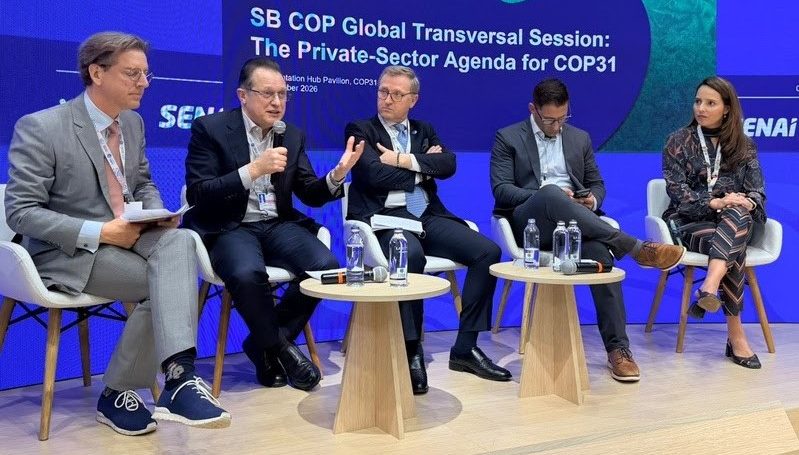
JBS Global CEO Gilberto Tomazoni making a point during the United Nations Climate Change Conference (COP31) being held in Türkiye this week
JBS Australia’s Great Southern Farm Assurance program was selected as one of 50 initiatives recognised as examples of private-sector climate action during the United Nations Climate Change Conference (COP31) being held in Türkiye this week.
The recognition took place during the Sustainable Business COP, a global business initiative that unites companies, industry associations, and investors.
JBS Global CEO Gilberto Tomazoni represented JBS at COP31 in Turkiye. He highlighted JBS Farm Assurance as a practical example of how improved agricultural productivity can strengthen food security, support farmers’ economic sustainability and deliver better environmental outcomes.
JBS Australia chief executive officer Brent Eastwood said the recognition showcased the achievements of Australian beef producers on an international stage.
“This recognition belongs first and foremost to the Australian producers participating in the JBS Farm Assurance program and demonstrating that high-quality beef production, strong farm businesses and improved environmental performance can work together,” Mr Eastwood said.
“The strength of Farm Assurance is that sustainability isn’t treated separately from farm productivity and commercial outcomes. Producers need practical pathways and commercial incentives to maintain and build on better practices.”
“The SB COP recognition provides an important international platform to showcase what Australian producers are achieving.”
JBS Farm Assurance connects about 3000 Australian beef suppliers, combining independent certification with practical tools and performance data to support continuous improvements in farm management, livestock productivity and environmental stewardship.
 The program links verified sustainability practices to premium grass-fed beef brands, including Great Southern, King Island Beef, Pinnacle and Little Joe.
The program supports producers across seven sustainability pillars: soils, pastures, vegetation, water, livestock, people and carbon management.
Better farm management
Through independent audits, performance data and producer engagement, JBS Farm Assurance helps identify opportunities to improve livestock management, productivity and environmental outcomes.
Results demonstrate how better farm management can translate into higher productivity, stronger farm economics and improved environmental performance.

JBS Global CEO Gilberto Tomazoni making a point during the UN Climate Change Conference (COP31) being held in Türkiye this week
Compared with Australian averages, participating producers have achieved lifetime average daily weightgains 15 percent to 50pc higher, slaughter weights 7-18pc higher and slaughter ages 16-30pc lower.
JBS Australia’s 2024 Farm Assurance analysis also found participating producers received an average 7.8pc above the MSA Steer program average price over the previous five years, demonstrating how improved farm management and productivity can be supported by commercial incentives.
CO2 footprint
Recent peer-reviewed carbon-footprint research of JBS’s Farm Assurance program carried out by consultants Integrity Ag calculated an average footprint of 11.7g CO2-e per kilogram of liveweight and 24.1kg CO2-e per kilogram of boxed beef.
The research also found emissions intensity about 10pc below the Australian average, with the best performing farms recording footprints up to 29pc below the supply-chain average.
JBS Global Chief Sustainability Officer Jason Weller said the findings reinforced the connection between agricultural productivity, farm profitability and environmental sustainability.
Productivity and sustainability are not competing priorities
“One of the most important lessons emerging from efforts to build more sustainable food systems is that productivity and sustainability are not competing priorities,” Mr Weller said.
“JBS Farm Assurance demonstrates how effective animal husbandry, natural resource stewardship and farm management can help producers create economic value, produce more food and reduce GHG emissions at the same time,” he said.
Growth rate key contributor
Lead researcher for the carbon footprint work, Dr Stephen Wiedemann, said the key connection between the lower carbon footprint and on-farm productivity was animal growth rate to market weight.
“This improves feed efficiency, reduces emission intensity, and leads to better meat quality outcomes,” he said.
“JBS Farm Assurance incorporates independent auditing by Bureau Veritas, with its certification program accredited to ISO 17065. The carbon-footprint assessment was undertaken in accordance with ISO 14067 and internationally recognised life-cycle assessment methodology.
The recognition follows an SB COP Award presented to JBS’s Green Offices program
at the previous COP30 event in Belém, Brazil in November last year. The award was presented for its work supporting cattle producers in the Amazon and Cerrado regions.
Together, the initiatives demonstrated how better management, higher productivity and stronger farm economics can contribute to more sustainable food systems, the company said.
Source: JBS
HAVE YOUR SAY