
Editor’s note: Tonight’s report is the last for the 2026 season by genetics editor Alastair Rayner. We thank Al for his great efforts in bringing interesting, topical and relevant genetic topics to readers’ attention throughout the year. Alastair will be back in early February to kick off coverage for the 2027 Autumn bull sales period.

THE 2026 bull selling season is drawing to a close. There are several notable tropical sales that will be conducted over November, with the recent heavy rainfall impacting the timing of some sales.
The bull selling season now stretches across almost ten months of the year. As noted in previous Beef Central Genetics columns, the distinct spring and autumn sale seasons are gradually drawing closer, with less of a break between. The start and end of both seasons are also extending, which adds to the overall impression of a much longer bull selling year.
Numbers sold
It is difficult to accurately note just how many bulls are sold annually in Australia.
While many sales are reported through selling agencies, and through breed societies, the reality is that not every sale or breed is reported. The growth of online bull sales also makes reporting on numbers more difficult and so any seasonal review will invariably overlook some sales and breeds.
 And it’s impossible to gauge how many herd bulls are sold each year out of the paddock.
Nonetheless, this review recorded publicly available results from 450 sales across 18 breeds – a statistically large sample.
Although the ‘autumn’ sale season commenced in late January and ended in May, there were only 94 sales and 5052 bulls listed for sale during the period. The’ spring’ season dominated the year, volume-wise, with 356 sales and 19,500 bulls offered across 17 breeds.
This is not a final total, as previously noted, several northern sales are still to be held in the next few weeks. The Strathmore Santa sale near Longreach, for example, has been postponed twice due to rain, and will now be held on 9 November.
However there are a number of useful data points from the records we have compiled. Across the 450 sales recorded, the 2026 bull selling season cleared 91.5 percent of bulls offered, at a weighted average of $12,084 a head.
Across the sales recorded, bulls turned over approximately $271 million, and total spending on bulls for the year will be higher again once final sales are completed.
Breeds
Although there were sales conducted across 18 separate breeds, not all breeds offered significant numbers for sale.
Angus, Santa Gertrudis, Hereford, Brahman, Charolais, Droughtmaster and Simmental were the breeds that offered more than 1000 bulls at auction in 2026. The Brangus breed presented 972 bulls and Shorthorn, 616. Collectively, these breeds accounted for 93pc of the bulls offered across autumn and spring.
Across those nine larger breeds, 22,837 bulls were offered against 22,132 in 2025, up 3.2pc. Clearance also lifted from 89.7 to 91.6pc, and the weighted average rose 4pc, from $11,647 to $12,113 per head.
The 2025 figures cover the full year, while 2026 runs to late October, so a handful of sales are still to be added.
Records fall
There have been several notable sales records and outcomes throughout the year.
The highest priced bull was sold by Millah Murrah Angus, located near Bathurst in NSW on 3 September. Millah Murrah Wyatt W50 sold for $420,000, setting both a new Angus and all-breeds national seedstock record. The bull was purchased by a syndicate of Gundungarra Angus at Robertson and JS Grazing at Injune, with Millah Murrah keeping a 20pc.
The price passed the $360,000 paid for Texas Thunderstruck T383 in 2023 and the $400,000 Wagyu donor heifer record from 2022. Click here to access Beef Central’s comprehensive list of record prices for bulls and females, by breed.
In the north, this year’s Rockhampton Brahman Week cleared 98pc of 720 bulls over three days at CQLX in early October. This strong sale saw Yenda 1200, offered by Yenda Cattle Co, Mundubbera, knocked down for $210,000 which equalled the sale’s 2020 record. Across the three-day sale, 709 grey and red bulls sold to a strong average of $13,708.
Individual sale highlights
Of the nine breeds that dominated Australian bull sales in 2026, at least 15 sales posted a six-figure top price. Several of the strongest results combined a high top price with a full clearance and a strong average:
- Glenlands Droughtmasters cleared 177 bulls at $20,706, topping at $170,000
- Dunlop Santa Gertrudis cleared 132 bulls at $20,318, topping at $140,000
- Waco Santa Gertrudis cleared 96 bulls at $21,292
- Knowla Angus cleared 78 bulls at $20,025, topping at $140,000
Clearly, a number of breeds of different genetic types were in strong demand at these sales.
A feature of 2026 was several larger catalogues. There had been some concern that seasonal conditions back in February-May might impact sales, especially for breeds used in temperate zones where the drought impact was greatest.
However these concerns were not realised. Texas Angus sold all 302 bulls offered averaging $13,921; Landfall sold all 245 bulls for an average of $13,446 while Rennylea saw all 215 bulls sold to average $15,089. Across these nine breeds, 160 sales cleared every bull offered.
Selective buyers
While strong averages were a feature in 2026, these have overshadowed a market that was increasingly more selective. Across the nine breeds, 44 sales cleared fewer than 70pc of their bulls, and most of them averaged less than $8000.
Buyers paid well for the bulls they wanted, while demand for the rest was uneven. The softer results sat mostly with smaller catalogues and lower-priced bulls. Two small sales sold no bulls at all, and several others cleared well under half their offering.
Average price trends, by breed
Most breeds increased their average price per head on last year’s figures, with Shorthorns, Brahmans and Herefords recording the largest percentage gains. Brangus and Droughtmasters were the only larger breeds to finish below last year’s averages.
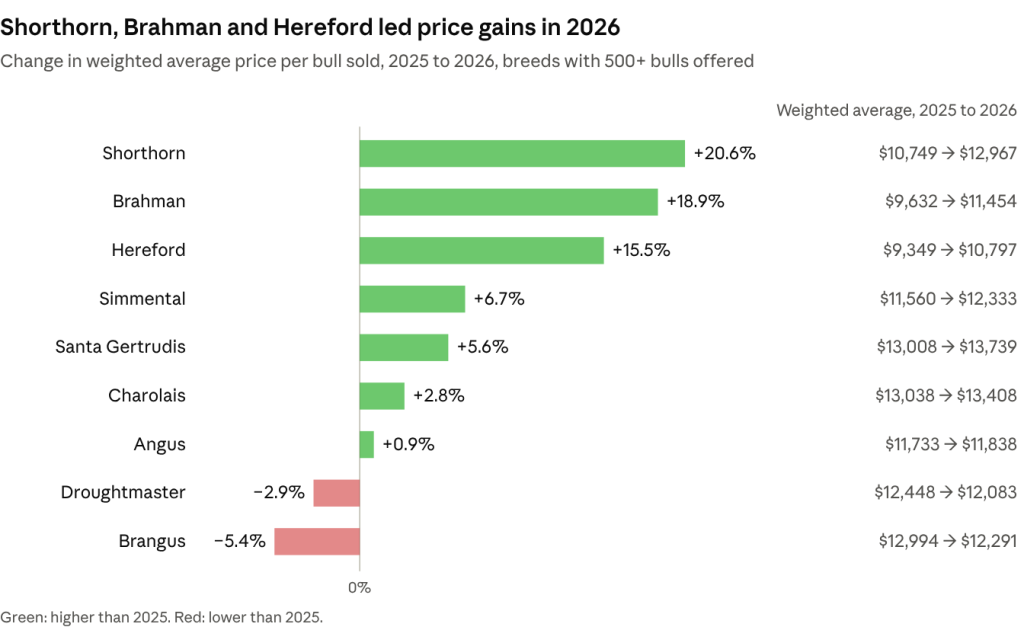
The Hereford breed saw the strongest turnaround, lifting clearance rates from 75.2 to 85.7pc. This is particularly notable as in the 2025 season, a quarter of the bulls offered went unsold.
Shorthorn clearance rates rose from 81.8 to 90.6pc alongside a 20.6pc price lift, and Brahman averages rose 18.9pc. Agents linked the Brahman and Santa Gertrudis strength to drier conditions late in the season, when buyers tend to favour Bos indicus cattle.
Angus offered by far the most bulls of any breed in 2026, however when compared to 2025, the sale results were very similar, clearing 92.4pc at an average of $11,838.
While this was a small increase, within the breed those studs that sold in both years lifted their average by 4pc, while sales recorded for the first time in 2026 sold for less on average.
In the tropically adapted breeds, Santa Gertrudis recorded the highest averages, clearing 94.7pc at an average price of $13,739.
Brangus sales cleared at a higher rate than in 2025, recording 93pc against 88.5. However, the weighted average price per head fell 5.4pc, from $12,994 to $12,291. Droughtmasters softened on both measures, with clearance down from 90.7 to 88.6pc and the weighted average down 2.9pc, from $12,448 to $12,083.
Across the nine breeds, 270 seedstock producers held sales in both 2025 and 2026, and the comparison that follows is limited to those studs. Between them, they offered 5.1pc fewer bulls in 2026 than in 2025.
The lift in total bull numbers came from 125 sales recorded in 2026 that have no 2025 result. These are not necessarily new sales, and many are likely to have been held previously without their results being reported.
Of the 270 studs, those that cut their catalogue by 10pc or more made the biggest gains in clearance and price. Part of that was recovery, because in 2025 they had the lowest clearance and averages of any group, at 87.5pc and $10,363 a head.

The highest price for the year rose in five of the nine breeds.
Angus, Brahman, Charolais, Santa Gertrudis and Simmental all lifted their top price on 2025 numbers.
Only Angus set a new breed record, while Weebollabolla Vegas V271 equalled the Shorthorn record at $120,000. The highest Hereford, Droughtmaster and Brangus prices were below last year’s.
More generally, top prices at sales also increased. The median sale top, the top price at the middle sale when all sales are ranked, rose from $24,000 in 2025 to $26,000 in 2026.
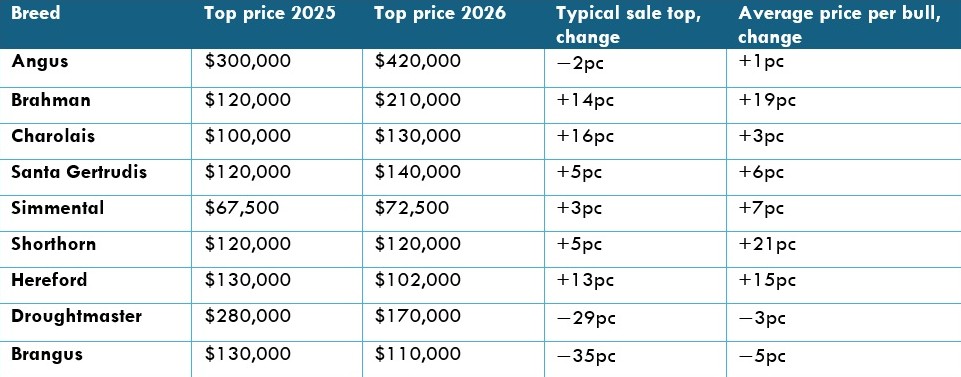
Typical sale top is the average of the top price at each sale in the breed. Average price is the weighted average per bull sold.
For most breeds, the typical sale top moved in line with the average price per bull.
The two exceptions were Droughtmasters and Brangus. Their typical sale tops fell by around a third, while their average prices eased only 3pc and 5pc. In both breeds, one or two exceptional 2025 prices account for much of that fall. Leaving out the single highest 2025 top, the Droughtmaster fall is 11pc and the Brangus fall 19pc.
Part of the Droughtmaster fall reflects a highlight that was not repeated this year. The 2025 National Sale was topped by Oasis A Cracker Jack at $280,000, sold to Sam and Jane Barton, Huntly Droughtmasters, for a three-quarter share and possession.
Nothing reached that level in 2026, when the top was $170,000 for Glenlands D Heads Will Roll. Shorthorns showed the opposite pattern. Their average price rose 21 per cent, while the typical sale top rose only 5 per cent. This is consistent with a broad lift in prices rather than a few large individual results.
Calculating an average price
As noted in previous Beef Central genetics columns, how an average price is calculated matters. An unweighted average of the 404 individual sale averages across the nine breeds is $10,880.
Weighted by the number of bulls sold, this year is $12,113, about $1230 a head higher. A sale average is a useful measure for an individual sale, but simply averaging those figures across the season gives a sale of six bulls the same weight as a sale of 300, and in 2026 it understated what bulls actually sold for.
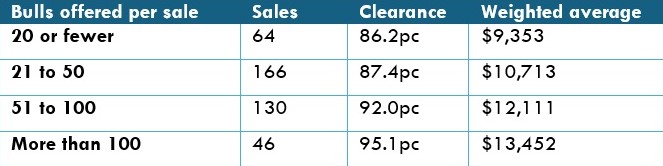
Looking back over 2026, the headline averages tell only part of the story.
Demand was strong overall, but uneven between sales, and larger catalogues generally recorded the stronger results, which gives vendors something to weigh up when planning catalogue size.
For commercial buyers, plenty of bulls sold well under their breed average, and matching visual appraisal and genetic merit to their own breeding objectives remains the most reliable way to find value in those sales.
- Beef Central’s full-year statistical summary of numbers of bulls sold and average prices will appear as normal in early December
Alastair Rayner is the Strategic Acc ount Manager for Southern Australia with Vytelle and Principal of RaynerAg. He has over 30 years’ experience advising beef producers and graziers across Australia. Alastair can be contacted here or through his website: www.raynerag.com.au
HAVE YOUR SAY