
A PROSPECT has emerged that Australia may be able to get beef into China tariff-free over the next three months, by utilising unused quota allocated by China to Uruguay at the start of the year.
With only three months of the year remaining, Uruguay has a large volume of unused China quota left this year, and other large exporters like Australia and Brazil are lining up to do deals that would see that tonnage re-allocated, or transferred.
Both Brazil and Australia have now filled their 2026 China quotas, activating a steep 55pc tariff on all exports to China for the remainder of the year. In Brazil’s case, they also pay an additional 12pc MFN tariff.
 China unexpectedly announced a new Safeguard tariff on imported beef at the start of the year, designed to protect the domestic beef industry. Australia was allocated 205,000t, which filled by 20 June.
At the time, the Australian beef sector, through the Australian Meat Industry Council and the Federal Government, explored a range of measures designed to try to moderate the impact of the quota. That included seeking to get certain items like bones and chilled beef (deemed to be non-competitive with local Chinese domestic beef) excluded from the quota tally, quota management schemes and other possible solutions. One of these was the prospect of utilising other beef exporting countries’ unused Chinese quota.
China at the time signalled that it would be happy to entertain that – provided the country holding the quota was happy to cooperate.
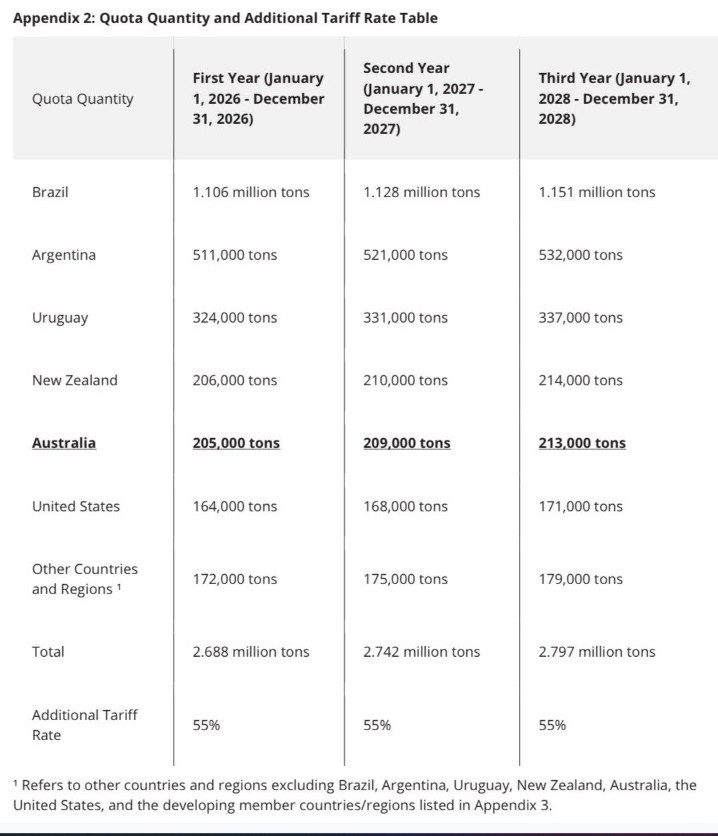
Australia approached Uruguay and at least one other export nation unlikely to fill its large 2026 quota this year. Uruguay was granted a quota this year of 324,000t, on a 2025 shipment volume of about 190,000t. New Zealand’s 2026 quota, as shown in the table below, was larger than Australia’s, at 206,000t.
See the table below setting out the quotas allocated to seven supplier countries, for 2026-28.
There have been precedents for quota re-allocation in other countries where such Safeguard tariffs have applied in the past. Some of those, however, were more ‘automated’, meaning they were not so much subject to negotiation as the current China situation.
Uncertainty, speculation remains
Australian Meat Industry Council chief executive Tim Ryan told Beef Central that a request had been lodged through the Australian Government with Uruguay earlier in the year, anticipating that the current circumstance would arise towards the end of 2026.
“Now that Uruguay has signalled that it is open to an arrangement such as this, all parties are now effectively under discussion,” Mr Ryan said.
However there was still a lot of uncertainty and unknowns about how things might develop, he warned.
 “There’s not that much of the year left, so time is very important,” he said.
The China quotas re-set at zero from 1 January, so it quickly gets to a point where there is little real value in accessing extra quota, unless an agreement can be reached quickly.
“We currently don’t know the quantum of any tonnage in an agreement, the timing, or how it might be treated,” Mr Ryan said. “Nor do we know whether China-eligible product that is currently in bonded cold storage, intended for shipment to align with the new quota year, might be eligible.”
“So there’s still a lot of uncertainty – but ultimately, it is positive that we at least have a window here that may help effectively increase our quota this year, and reduce the current bottleneck.”
Mr Ryan agreed that such a quota re-distribution system may have even greater significance next year, when it’s widely predicted that both Australia and Brazil will fill their China quotas in rapid time – in Australia’s case, possibly by Easter.
“If some of that China-destined product currently sitting in bonded cold storage can be shipped early, it just takes the pressure off next year’s quota a little,” he said.
Cold stores servicing the Chinese market must be licensed for that market, under much the same process as meat processing plants are. This has limited bonded cold storage capacity in Australia.
As is currently best understood, any agreement is purely a country-to-country negotiation between Australia and Uruguay, without any Chinese involvement. Worth noting, however, the Uruguayans have been in dialogue with Brazil over similar arrangements, although Australia is understood to be ‘at the head of the queue’ in its request timing.
While there has been some speculation that Brazil may have already used some Uruguayan quota this year, there’s been no official advice that that is the case, Beef Central was told by a trade source.
One of the big constraints at the moment may the speed that China can come up with and process a mechanism to facilitate the transfer of quota from one country to another, one stakeholder said.
Exactly how any transferred Uruguayan quota might be distributed in Australia, in what is a highly competitive market serviced by quite a number of processor and non-packer exporters, has not been made clear. Most likely is that access would occur on the same basis as that which applied for Australia’s own quota share, Beef Central was told.
Exclusions?
Beef Central also asked about any progress in seeking to carve-out certain products from next year’s China quota (209,000t), such as lower-value bones and chilled beef.
“We’re still actively pushing on both fronts,” Tim Ryan said.
“Together with the Federal Government, we hosted a China delegation a few weeks ago, where the topic again came up. The design of those meetings was to build those connections, to help facilitate areas of mutual cooperation, and make some of these outstanding requests more appealing for both sides.”
But the biggest benefit to Australia in the Uruguayan quota transfer proposal applying this year, is that we could utilise some more quota, for product either currently on its way to China or sitting in bonded cold storage, waiting for next year’s quota, Mr Ryan said.
“It would certainly take some of the pressure off that first quarter next year, but we’re up against the clock, and there’s a lot of detail to be ironed-out yet to make it happen,” he said.
HAVE YOUR SAY