
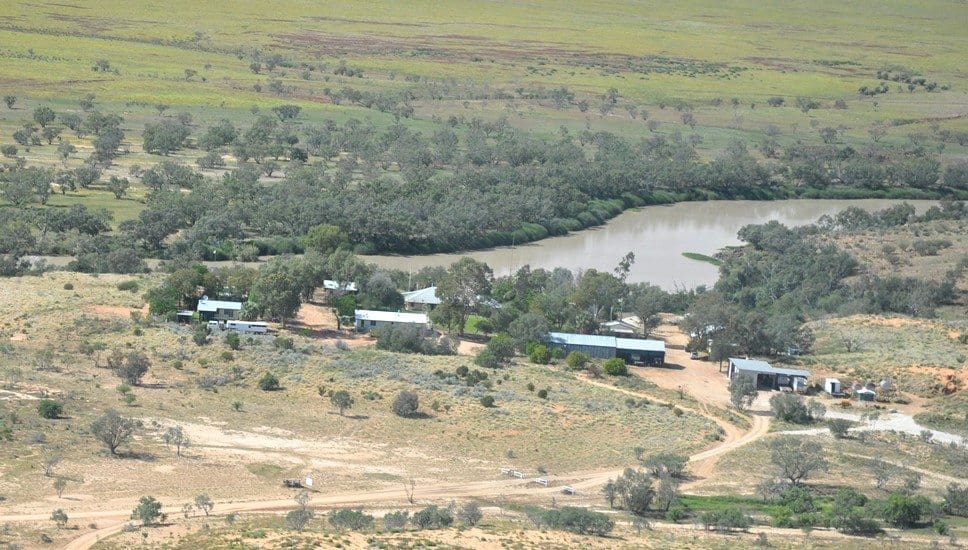
Nappa Merrie homestead complex, on Cooper Creek
NORTHERN and western Queensland take centre stage in this week’s property review, where the lasting benefits of a strong wet season earlier this year continue to influence grazing market trends.
According to Roger Hill, Preston Rowe Paterson’s director for regional North Queensland, the 2026 rainfall has profoundly shaped end of year grazing decisions, from the Channel Country to the Gulf of Carpentaria and across to the coast.
“The Channel Country is in incredible condition, marking its fourth consecutive excellent season. This production powerhouse is in full force, with cattle rapidly gaining weight,” Mr Hill said
He said a major talking point across the state is the high-profile sale of Nappa Merrie.
The famed 727,000ha Channel Country grazing property, which spans three holdings, changed hands in July.
Roger Hill, Preston Rowe Paterson
Mr Hill noted that because this region is a low turnover-volume property market, it takes time for the market to adjust when such a significant sale occurs.
“Currently, the Channels landscape looks spectacular, prompting some graziers to travel to the region to observe the land and livestock after this prolonged good run.”
Mr Hill said many areas of central and north-western Queensland are boasting a substantial volume of grass.
“While the pasture has now hayed off, green growth remains around the crowns of the tussocks, supported by a very good subsoil moisture profile. With rising temperatures, the grass is expected to respond rapidly as soon as the next rain arrives.”
Mr Hill noted at present, cattle weight gains are variable.
“Some livestock are losing weight due to a lack of energy and protein, others are maintaining condition and cattle in a few areas are putting on a small amount of weight.”
In terms of the northern and western property market, Mr Hill said a few smaller holdings have recently sold for much stronger prices than last year, fetching $1100/ha to $1200/ha ($450/acre) and above.
“No larger properties have been offered to the market this year, as producers have been focused on maximising cattle weight gains rather than sell those places.”
He said prices for these smaller blocks were being driven by a lack of market supply, opportunities for dryland farming development and an overall affordable price bracket.
“This trend may continue into next year if the season proves exceptional, potentially driving up the value of larger properties if any come to market.”
At the same time, Mr Hill said the north was evolving its grazing model to incorporate sorghum being grown in the area.
“The growing demand for, and expansion of second-round weaner feeding programs is an encouraging development, giving graziers the option to feed up lighter second-round weaners to give them a strong start.”
Mr Hill said north and northeastern Queensland had also enjoyed a successful year, highlighted by healthy weaner weights.
“The property market in this region has recorded several transactions, specifically in the Collinsville, Home Hill and Ravenswood areas, alongside a couple of sales near Croydon and Normanton. Values in these areas have remained stable for several years.”
“The Gulf of Carpentaria market area has been stable for a few years now. It is dry up there, however there are small coastal showers starting to pop up in the afternoons, so the season is changing,” he said.
Central Queensland
Mr Hill said meanwhile, Central Queensland was looking dry but plenty of grass remains available.
“Scattered showers have triggered fresh green shoot in some melon hole areas. Weightgains have been highly favourable this year, as has property market growth, with capital values rising by 20 to 25 percent.”
Driven by the current positioning of the cattle market and robust producer confidence, he anticipates strong property market activity in the year ahead.
He said a delayed wet season and a late start to the year have driven a surge of property transactions, currently in the pipeline, particularly in regions backed by strong cattle pricing.
“While rising concerns over a dry spell are keeping buyers cautious, long-term asset value remains the priority over single-season conditions. By years end, we should see around 20 properties contract or settle across north and north-west Queensland.”
Mr Hill said this marked a healthy recovery from the lower volumes of the past two years when weaker cattle prices drove market caution.
“Property values for northern breeding country have remained flat since the cattle market peaked in late 2022. However, if cattle prices lift next year, northern breeding country values are expected to follow.”
He said current buyers were avoiding ‘silly money’, resulting in ‘nice, sensible pricing.’
Mr Hill said Central Queensland had enjoyed another robust year, characterised by solid volumes and strong capital growth.
“A high-quality selection of properties is hitting the market, ranging from smaller blocks around Dingo and Duaringa, to larger holdings across the wider region. This strong momentum is expected to flow well into next year.”
“Smaller blocks have performed strongly this year. However, whether larger blocks have matched this success remains up for debate and probably won’t be confirmed until Laglan Station settles,” he said.
A 101,600ha Central Queensland cattle enterprise with almost a century of operating history has been brought to market, with the sale of Laglan Pastoral Co’s assets.
End of year outlook
Despite rising operational overheads, such as increased diesel and lick costs driven by the Middle East conflict, Mr Hill said the broader property market has had a remarkably healthy year.
“Uncharacteristically for this late in the season, new property listings are still emerging that cannot yet be publicly disclosed. Property activity normally winds down by this point, but strong transaction volumes are expected right up until Christmas and into the end of the year.”
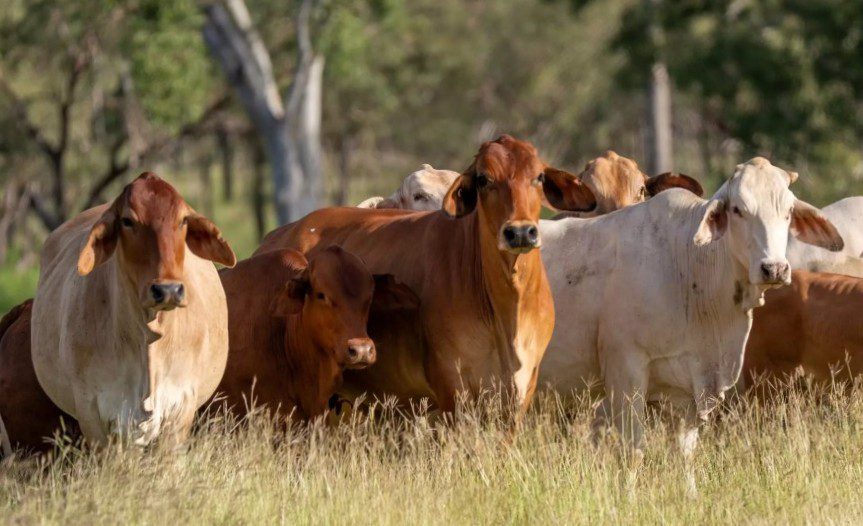
Brahman cattle on Panhandle
North Qld 2026 sales
September – 31,800ha Panhandle – a breeding opportunity, 43km west of Collinsville and 125km south-west of Bowen.
September – 18,400ha Sayah Park – well grassed, well-located calf factory in the tightly held Llanarth/ Cape River area of North Queensland.
August – 30,284ha Woodhouse Station – 50km south-west of Ayr and 100km south of Townsville. Sold for $33.1m WIWO including 6530 head of quality Red Brahman cattle.
August – 10,084ha Mugwee – breeding, backgrounding or finishing property in a tick free area, 37km west of Stamford and 97km from Hughenden. It achieved $8m bare.
August – 41,900ha Yappar River Station – 80km south of Normanton and 100km south-west of Croydon. Sold under the hammer for $10.4m WIWO including 3465 head of Brahman-cross cattle, plant and equipment.
July – 6123ha Spellary Creek – breeding, backgrounding and finishing country with farming potential, 25km east of Julia Creek. Made $7m ($1143/ha).
June – 16,622ha Inkerman Station, 15km south of Home Hill and 110km south-east of Townsville. EU accredited property achieved $34m+.
June – 39,229ha Valley of Lagoons Station – a breeding, backgrounding and finishing operation north of Greenvale. Sold for $30m including more than 4000 breeders.
February – 43,500ha Gorge Creek Station – breeder property with renewable energy potential adjacent to Blackbraes National Park and 220km north of Hughenden. WIWO with 2000 cattle and some plant.
February – 31,300ha Ronlow Park – well grassed desert uplands breeder block near Pentland, 250km north-east of Barcaldine and 260km south-west of Charters Towers. Made more than $8m.
HAVE YOUR SAY