
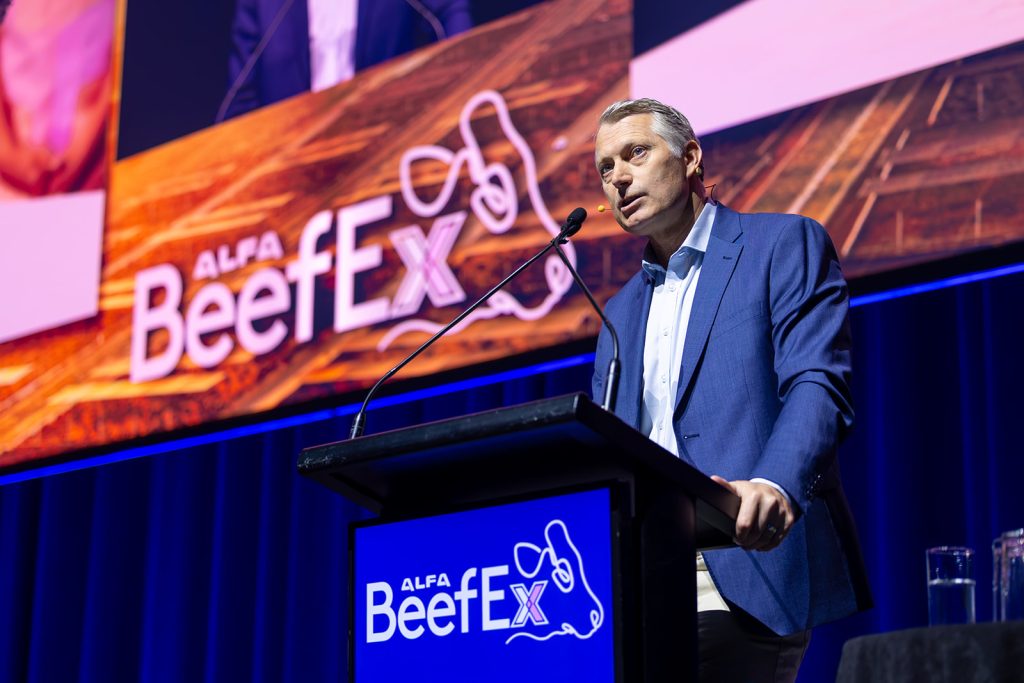
What can other intensive livestock industries teach cattle lotfeeders about responding to community expectations? Egg industry leader Rowan McMonnies provided some sage advice during last week’s BeefEx conference….
ALONG a road not far from Tamworth in northeastern NSW is a ‘big pile of dirt’ providing a visual barrier to passers-by about what lies behind it: a cattle feedlot.
“There’s an industry that’s comfortable in its own skin,” BeefEx conference speaker Rowan McMonnies told his colleague at the time, somewhat ironically, while driving past the site.
Mr McMonnies, managing director of Australian Eggs, provided a deep-dive during last week’s BeefEx conference into the egg industry’s response over the past ten years to community pressure and expectation.
He used the Tamworth feedlot observation made years ago to illustrate the theme of his BeefEx address – “Are you comfortable in your own skin?”
In posing the question, Mr McMonnies was asking lotfeeders whether they are happy and relaxed about their position in the world, and whether they are open to other perspectives.
“If you are – and I’d encourage you to be – that’s going to be an asset in building and managing your industry’s reputation,” he said.
Fighting a losing battle on reputation
A legal practise partner and ACCC staffmember in earlier parts of his career, Mr McMonnies, said ten or 15 years ago, the egg industry was fighting a losing battle on reputation.
 “There was a lot of activist and broader public conjecture – particularly around caged egg production. And as an industry, we were contributing to that conjecture: we were fighting it; being loud, and sometimes assertive; and amplifying the issues – regularly in the press.”
“That was hugely negative, and ‘just a rolling maul (clearly a Rugby fan) of disaster’,” he said.
Egg farmers could not send their kids to school without them being the subject of comments or bullying, not only from other kids, but from some teachers as well, he said.
Pressing re-set
In response to this, the egg industry realised its approach wasn’t working, and pressed ‘re-set.’
“We decided to broaden our approach to one of sustainability (all of the impacts and all of the contributions), and on the back of that, created a cycle of community driven engagement,” Mr McMonnies said.
The egg industry now does a national survey every year, published in its unedited form, to take on board the public’s perceptions of the egg industry – and take those priority areas identified by the public and put them into a cycle of research, and then further public engagement.
“The reason I am here at BeefEx is because it has been hugely successful,” he said.
“We took community trust over egg production nine years ago from 56pc (we were surprised it was even that high, because we thought everyone hated us), to 60pc the following year, then 64pc, and for the past five or six years it has sat around 68-69pc. Our community researchers tell us that is about as good as it can get, comparative to other institutional organisations and industries.”
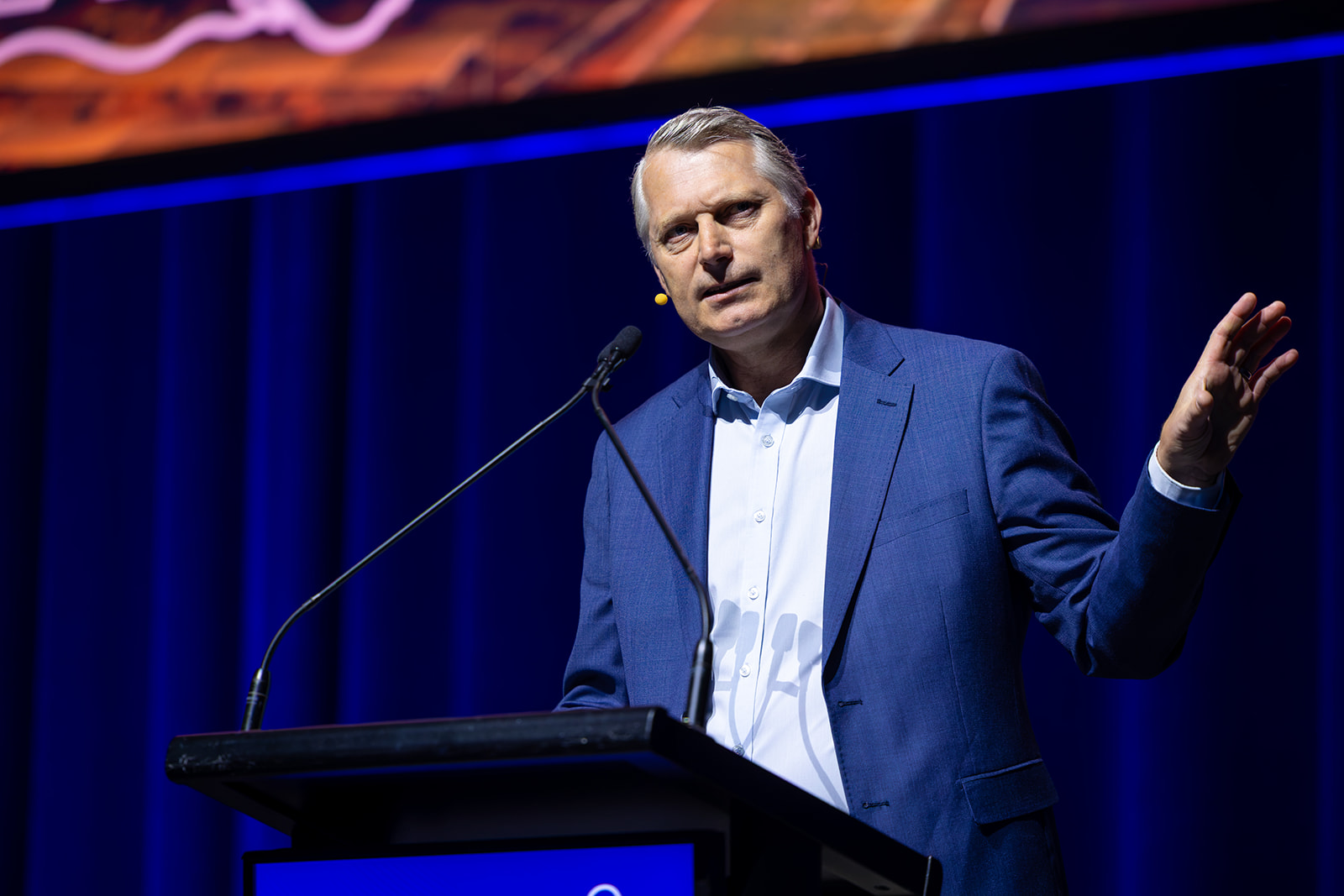
Australian Eggs CEO Rowan McMonnies
What part of that is relevant to lotfeeding?
The obvious question from that is what part of the egg industry’s experience might be relevant or useful for other livestock industries, including grainfed beef, to learn from.
Mr McMonnies decided to focus on a particular community perception issue of relevance to the lotfeeding industry – covered housing.
“I understand that covered housing represents an exciting opportunity for the feedlot industry, and results of research are very strong – significantly improving welfare outcomes,” he said.
“But like everything in life, there is a trade-off – in this case, intensification or stocking density, that must come with a big investment in fixed (shed) infrastructure.”
Dispassionate, accurate and honest view
While professing to having no direct experience as a lotfeeder, he was happy to share what he would do, under the circumstances.
 “Firstly, I’d take a dispassionate, accurate and honest view of my operating environment, and break the problem down to our key objectives. Too many of these issues of reputation and standing tend to relate to how we feel about ourselves, and how others feel about us – it’s often the emotive side of these issues that attracts the most attention, energy and activity.
“But really, this isn’t a matter of principle, when you break it down: it’s about mitigating investment risk. I understand that something like 5pc of the whole grainfed beef industry currently has covered housing (95pc to go, if indeed it is proven to be enormously beneficial), and we all know that the cost of building anything is absolutely enormous.
“So there’s going to be a huge amount of capital at risk, if this step is taken. And at some time it could all get washed away if the tide of public opinions turns, given an investment life of say, 30 years.
“Once you have realised or set your objective as mitigating your investment risk, the game is to develop a program of activity to promote that objective.”
“Have a singularity of focus on that objective,” was his advice.
Three key elements to success
Mr McMonnies stepped through what he described as three key elements to success.
“The first is kind of controversial: the suggestion is that you actually take risks – including at an industry level, and industry leader level. This involves being uncomfortable, which some people are not always happy with.
“Ultimately it is very easy to create content which lotfeeders themselves might like to see or hear. But in the end it is profoundly ineffectual, because you are talking to the wrong people.
“What is required is genuine engagement. This is inherently risky, because you don’t get to control everything, and that’s where the discomfort comes from.”
“With risk comes discomfort, but also, authenticity – and the opportunity for genuine improvement in the reputational standing of your industry.”
The second key element, partly referred to above was, “It’s them, not us.”
“What is your target audience? Ultimately, it’s the Australian public who determines whether covered housing is going to be acceptable, so they must remain the target audience for all of your activity.
“You certainly don’t want to be spending your time talking to yourselves (others involved in lotfeeding) about it, because you will be very easy to convince.”
“But as Christopher Pyne also told this conference earlier, don’t spend too much of your time thinking or worrying about what are ultimately fringe groups. There’s a bell-curve of public opinion in Australia; some people might be wildly for or against a particular thing, but its that middle 80 percent that tends to determine what will, or won’t happen in this country.”
“I really see this playing out across many, many industries in the food sector. Everybody seems to be worried about what animal activist groups are saying or thinking. I see their perspective as a relevant perspective, but a confined perspective – sitting at the end of the bell-curve, and it isn’t the main game of public opinion.”
Getting on the front foot
The third key element to success was to ‘get out on the front foot.’
“Don’t wait for the issue to come to you. You won’t like the way it arrives,” Mr McMonnies warned.
“You only get one chance to frame an issue, so my suggestion is, be ready; do your homework; know exactly what you are going to say; be bold, and be prepared to go and stand in front of a crowd and have the conversation. Talk about the ‘why,’ share the dilemma and explain the trade-offs. It gives you the opportunity to explain the benefits (in this example, covered housing), as well as acknowledging, freely, that there are some trade-offs as well, including intensification.
“That opportunity is so regularly missed, and we see it time and time again, where people become shy, because their lawyers advised them to ‘be so.’ They don’t want to take on an issue, wait for it to come to them, and then ultimately they have lost control of it, because it is all focussed on a particular footing – and you can never get it back.”
Process of public engagement
Mr McMonnies said with the three elements of success outlined above, the stakeholder ultimately gets into a process of public engagement.
While this was a broad topic, he limited his comments to a couple of points.
The first was that in order to be heard, you need to be relevant.
“You can’t simply say, ‘I want to talk about covered housing and why intensification isn’t a bad thing in lotfeeding’, when nobody else cares about that. You have to think about it from the audience’s point of view, and find the connection that that audience has to you, and your product.”
“Ultimately it is to your product, because the consumer is trying to eat your grainfed steak – not your farm.”
The next step was to start the conversation using those points, and give the public (and the media, as the gateway to the public) a reason to care.
“I see it as two-fold: Australians love a steak; it’s part of our culture, and brings a lot of joy to a lot of people. The second important one is that Australians need protein, and nutrition is a very important point of connection with the Australian public.
Points like this would be at the heart of any public engagement campaign that might be run on a topic (even if theoretical) like mitigating risk with respect to covered housing, he said.
“A topic like nutrition is very important, because it has the ability to drive ongoing engagement with respect to your industry and any issue with respect to a topic like covered housing. That’s because community and media interest in health currently is boundless. Both the egg and beef industries benefit from that.”
“We (eggs) are able to approach media agencies with new nutrition content, and they welcome us with open arms. It’s the very definition of being relevant, and I see it as the same gateway for your industry.
“But to do that, you do need to be new – use new developments to feed public interest in nutrition, and that can flow on to other aspects of your industry, including (in this example) covered housing – whether it be environmental or animal welfare related.”
Relentless reinforcement
A final mistake often made was that even when stakeholders ‘get this stuff right’, they tend to do it once, stop and celebrate the win.
“But of course you don’t achieve much by doing it once,” Mr McMonnies said. “To win the hearts and minds of the bell curve of the Australian public, you need to be relentless – supported by a program of activity, research and outputs and regular public engagement.
“And you need to remain enthusiastic and confident in the position. Keep it fresh, well into the second, third, fourth and fifth year – it takes time to move minds and educate. Eventually, people will start to pick up on it, because they’ve ‘heard or read something about that’.”
“In the end it works: this is how you change minds, drawing people into your dilemmas to help them understand why what you are proposing to do or invest in, is fundamentally a good thing.”
Not a silver bullet?
Mr McMonnies said it was important to be realistic about the process and outcomes.
“The number of times people dismiss something because ‘it won’t address 100pc of my problems’ is common, but it’s false logic,” he said.
“The world is risky. We can’t control everything, but risk mitigation is about lengthening the odds, and ultimately reducing risks.
He saw the odds of good outcomes on a topic like shed cover in feedlots in three ways.
“One is if you address such an issue poorly, taking the old egg industry approach of being combative, or hide under a rock. That delivers poor prospects and in the end you get caught out, losing the front foot advantage.
“But you might get by on luck: I give that approach a one-in three chance.”
If it’s ignored completely, it goes to chance. I give it 50:50, but I’m not sure I’d be making the big investment in covered sheds at those odds.”
“But done well, you get to the point where you have a 75pc chance that actually, you can win the hearts and minds of the Australian public, and get support behind these investments for the life of the investments, and carry the support right through.
“I make the point that given the extraordinary amount of capital at risk, that changing of the odds, represents enormous value, and would be the focus of energy if given the challenge of taking it on.”
HAVE YOUR SAY