
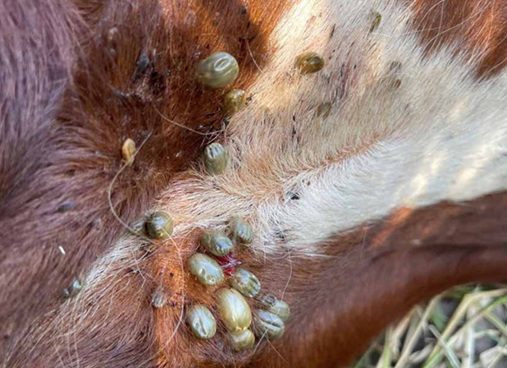
Typical appearance of cattle ticks (Source: NSW DPIRD)
STATISTICS from the Queensland Department of Primary Industries show there has been a significant increase in the amount of cattle tick fever vaccine sold to New South Wales in the last 12 months, following reports of growing numbers of infestations.
Beef Central reported last month industry groups and veterinarians were concerned about the large numbers of cattle dying as a result of tick fever.
A report by NSW’s Independent Biosecurity Commissioner earlier in the year stated as of 24 February 2026, there were over 580 properties in NSW known to be infested with cattle tick.
“Historically, there were five to six cases of tick fever each year, with increased outbreaks in recent years,” the report stated.
The Qld DPI Tick Fever Centre manufactures and supplies the only vaccine available in Australia to protect against tick fever in cattle.
Below is an overview of vaccine doses sold by the Tick Fever Centre:
| Financial Year | Total vaccine doses sold by the Tick Fever Centre | Number of vaccine doses dispatched to NSW |
| 2025–2026 | 806,105 | 17,495 |
| 2024–2025 | 740,160 | 12,400 |
| 2023–2024 | 794,685 | 13,765 |
Industry disappointed by funding top up portrayed as a boost
In April the NSW Government announced a $7 million investment to review and rebuild the state’s cattle tick program.
At the time, industry groups understood the announcement was new funding, however it has since been revealed that this figure includes the existing cattle tick program funding (which in 2024-2025 fin year was $4.66 million).
“$35 million has recently been announced for NSW shark management. The extra $3 million for the cattle tick program at a time of crisis, for an issue that threatens an entire agricultural industry, is difficult to reconcile,” Craig Huf, Chair of NSW Farmers Association Far North Coast Branch said.
“While ticks have always been present in parts of NSW, historical records show that when the program was properly resourced, tick numbers were driven to very near-eradication.
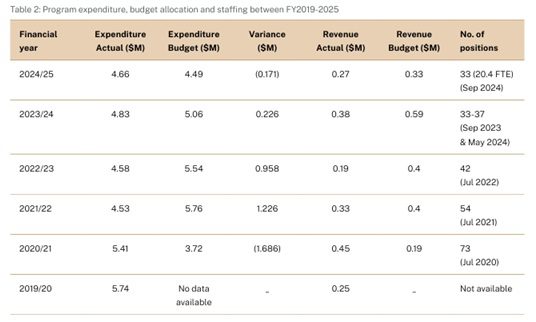
Cattle Tick Program expenditure, budget allocation and staffing between FY2019-2025. Click on image for a larger view
“This is not an uncontrollable pest. It is a pest that has been historically well managed when properly funded.
“In 2005 the program operated on a budget of around $4 million which would be equivalent to roughly $8 million today. That would be a more reasonable annual spend for the cattle tick program.
“However, the program has declined so much who knows what it will take to get this rapidly escalating biosecurity outbreak back under control.”
The NSW Independent Biosecurity Commissioner’s report earlier this year recommended a Technical Advisory Group be established by 30 June, to provide advice on the review of the NSW Cattle Tick Plan.
 Beef Central has asked the NSW Department of Primary Industries and Regional Development (DPIRD) and Minister for Agriculture several times for the details of who is on the Technical Advisory Group but has today received the following statement.
“To ensure the independence and integrity of the process, the NSW DPIRD will not be publicly naming individual members of the technical advisory group which is providing commentary, feedback and advice on the implementation of the new cattle tick program to the NSW Chief Veterinary Officer,” a DPIRD spokesperson said.
“This approach will allow the advisory group members to provide frank and expert advice without external pressure or influence.
“The group is made up of subject matter experts with relevant skills and knowledge to ensure well-rounded and thorough decision-making.
“The NSW Government has increased the funding for the cattle tick program for the 2026-27 financial year to $7.5 million.”
It is not a “cattle tick vaccine”, but a Cattle Tick Fever vaccine.
The difference might seem trivial, but is vital.
There is currently no Cattle Tick Vaccine on the market in Australia.
Thanks Johann. We don’t think it’s trivial, at all – accuracy is important to us. Article now corrected. Editor