
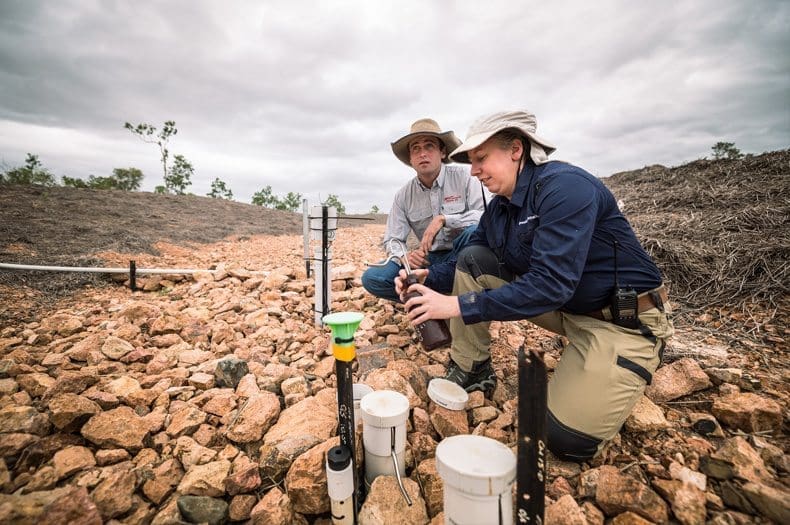
Landholder Bristow Hughes and Reef Aid Program Leader, Dr Lynise Wearne, testing water quality at NQ cattle property Strathalbyn Station as part of the Reef Aid Project. See separate article
ENVIRONMENT groups have been accused of fuelling hysteria after media commentary this week likened vegetation management in Great Barrier Reef catchments to “giving cigarettes to children”.
The criticism follows the release of a new report targeting the grazing sector ahead of next month’s UNESCO World Heritage Committee meeting in Busan, South Korea, where Australia’s Great Barrier Reef will again come under scrutiny over whether it should be listed as “in danger”.
In comments that reflect the depth of frustration on the issue, Cattle Australia chief executive officer Will Evans questioned the motivation of the group behind the report, the Australian Climate and Biodiversity Foundation.

Will Evans, CA
“If they are truly dedicated to the environment and concerned about the impacts the beef industry is having, why would they not discuss this with the industry itself? Why would they not raise these issues with the people most able to do something about it?
“While NGOs globally have proven that co-investing in solutions with industry is the most effective way to bring about positive change, in Australia the weaponisation of regulations and use of misinformation has proven to be the preferred method of practice.
“For too many of these groups, their activism is an end in itself, it is not about change or improvement in environmental conditions. It’s more about doing what’s easy – which is expressing an opinion – than doing what is hard, which is what we are left to do: actually manage the land. It is advocacy that prioritises visibility over impact and fails to recognise the work, efforts and beliefs of the people who are actually responsible.
“And so often it’s not even advocacy informed by fact. The majority of these reports are not peer reviewed. The majority of them don’t hold up to scrutiny. This most recent report used data and footage from seasons with record levels of flooding, triggered by record levels of rainfall, and somehow fails to recognise these factors as having any contributory affect to increased sediment runoff.”
A News.com.au report exclusively covering the report by the Australian Climate and Biodiversity Foundation (ACBF) stated that 856,744 hectares of forest and woodland were cleared in reef catchment areas between 2018 and 2023, with 84 percent attributed to grazing.
The article used highly emotive language, claiming “Australia’s world-famous Great Barrier Reef is being smashed by almost 400,000 dump trucks-worth of mud each year, smothering coral and choking seagrass”.
It further reported that “40 per cent of all land clearing in Queensland occurred within the reef catchments”, and that land clearing accounted for “about 60 per cent – the single biggest driver – of sediment flowing into the heritage-listed reef”.
ACBF executive director Lyndon Schneiders, noting the $1.8 billion spent by state and federal governments on reef water quality since 2014, likened the approach to “declaring you want to stop lung cancer while peddling cigarettes to children”.
 The article also quoted representatives from the Australian Conservation Foundation and World Wildlife Fund, but contained no perspectives from the grazing sector.
Mr Schneiders said Federal Environment Minister Murray Watt and the Albanese Government “deserved credit for passing the strongest laws Australia has ever had to deal with this (the EPBC Act amendments passed last year). The next step is properly enforcing them.”
According to the article, environmental groups are urging the Federal Government to fast-track National Environment Standards, under which land clearing applications would be assessed, and to establish a national Environmental Protection Agency.
The ACBF also called for a whole-of-catchment plan to address cumulative land clearing impacts, including maps identifying no-go zones where clearing would be banned.
However, industry leaders say the report overlooks more than two decades of measurable progress by rural landholders in reducing agricultural runoff and improving land management in reef catchments.
Australian and Queensland Government reef report cards have documented continued progress towards water quality targets, driven by investments in streambank repair, improved grazing management and more efficient nitrogen fertiliser practices in sugarcane.
In contrast to the ACBF claims, another News Corp masthead, The Australian, last week reported that after years of “gloom and doom”, scientists and global activists no longer believe the world’s coral reefs are nearing a tipping point for extinction.
Cattle Australia representatives said the ACBF report appeared to have been produced without consultation with industry or producers on the ground, and made a number of misleading claims.
They said the report also failed to acknowledge research showing well-managed, sustainable grazing practices can improve vegetation and soil condition outcomes in reef catchments.
Industry also points to data showing 92pc of grazing land in the Great Barrier Reef catchment maintained groundcover levels above 70pc in the late dry season of 2022.
Under Queensland’s Agricultural Environmentally Relevant Activity (ERA) standards for beef cattle grazing, producers are required to maintain land in “good or fair condition” and groundcover levels above 50pc.
The 2017 Scientific Consensus Statement found that while land cover and land condition influence erosion, rainfall and runoff also strongly affect sediment loads delivered to waterways.
That context is significant given the 2025–26 northern wet season was one of the wettest on record, with the Bureau of Meteorology ranking it the ninth wettest across northern Australia.
Disaster recovery records also confirmed severe flooding linked to the North Queensland monsoon trough and Tropical Cyclone Koji during the period.
Property Rights Australia chair Dale Stiller said there was a longstanding pattern of environmental groups intensifying criticism of grazing and land clearing in the lead-up to UNESCO reef deliberations.
“Certain environmental groups hit the media with unfounded claims that land clearing and farmers are causing harm to Reef health and water quality. These groups have cried wolf too many times”, Mr Stiller said.
“These false accusations, that ignore scientific data, are not without consequence for the health of food producers and the regulatory burden placed upon them.”
Mr Stiller said Australia’s State Party Report to UNESCO in February 2026 cited scientific evidence from the Australian Institute of Marine Science showing a slight decline in coral cover in 2024 was linked to a global coral bleaching event, two cyclones and freshwater inundation.
“A recent example of false hysteria comes from the Australian Climate and Biodiversity Foundation claiming the reef is being smothered in mud. This is despite of the scientific findings that sediment flumes do not affect the majority of the reef.”
He said the 2022 Reef Scientific Consensus Statement confirmed much suspended sediment flocculated in saltwater and settled near inshore reefs, river mouths and coastal wetlands.
Mr Stiller said more than 83pc of coral reefs are located on mid and outer shelf systems, areas he said were not affected by land-based sediment runoff.
He also criticised the Federal Government’s proposed EPBC reforms, arguing they would fast-track renewable energy developments involving vegetation clearing while imposing tighter restrictions on agriculture.
Under the reforms, he said farmers could be prohibited from clearing within 50 metres of reef waterways or regrowth vegetation older than 15 years.
“It is time for fair laws and evidence-based government policies that are not manipulated by external influences with hidden agendas,” he said.
HAVE YOUR SAY