
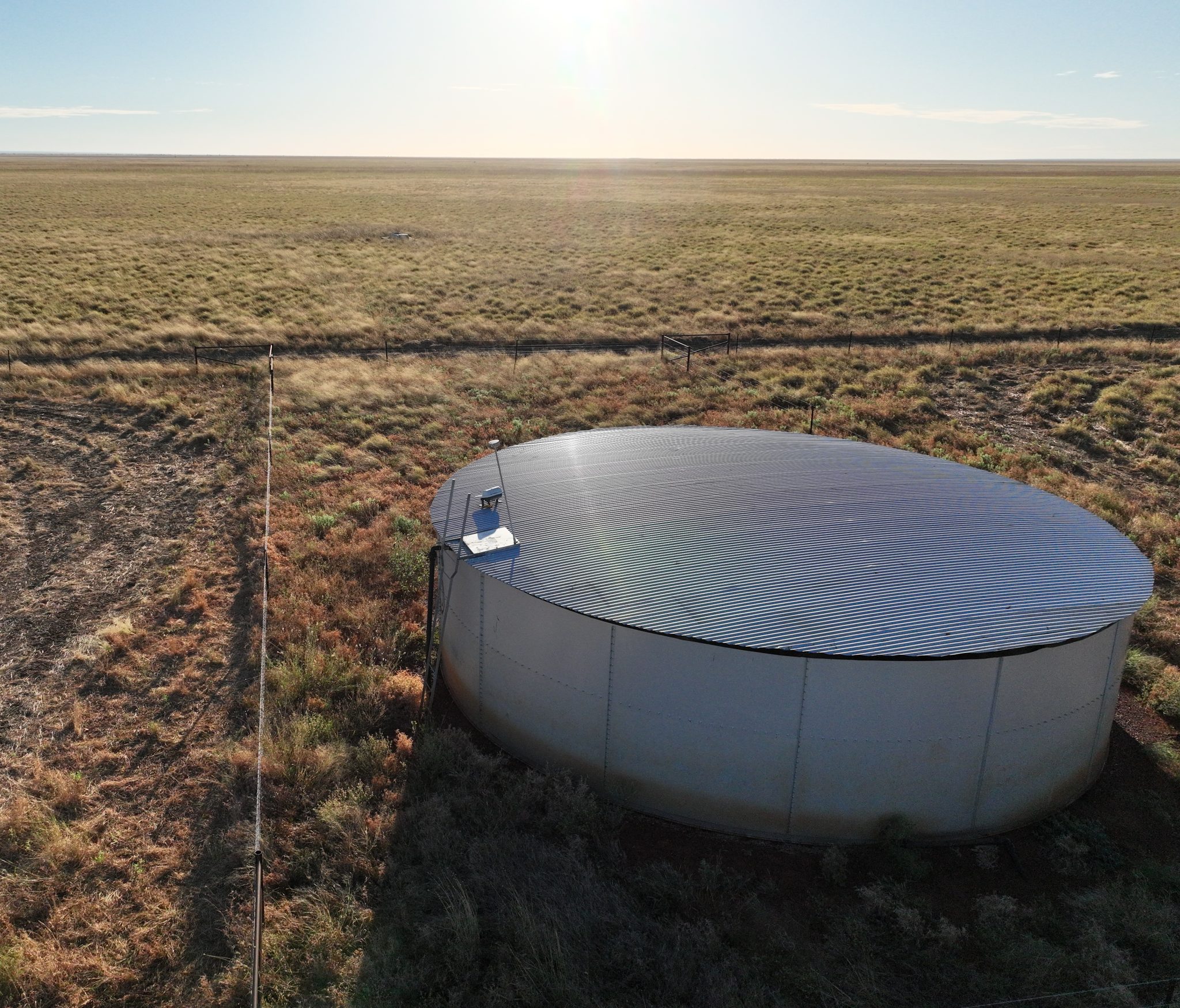
A new tank at Alexandria station as part of the four-year water development project.
ONE of Australia’s largest cattle companies is in the final stages of a major water infrastructure project, with more than 2000km of poly pipe laid across key Barkly Tableland properties.
As this earlier story outlines, in 2022, the North Australian Pastoral Co began its four-year water development program across Alexandria, Gallipoli and Soudan stations, designed to reduce cattle walking distances to water from a 5km radius to approximately 3km.
NAPCo Project Manager Lachlan Reed said the project was built around three key objectives.
“The first was to increase the long-term asset value of the properties,” Mr Reed said.
“The second was to create more management flexibility and improve the productivity and efficiency of our herd, and the third was to improve land condition outcomes across the Barkly.”
Once completed later this year, the project will deliver around 230 new watering points across the three properties.
 “Traditionally on those stations, a water point would be a standalone bore with a tank and trough, or a turkey’s nest and trough setup. But we’ve moved towards a reticulated water system,” he said.
“For the most part, the project has involved connecting multiple bores into a single reticulated system across one or several paddocks.
“Some new bores have been drilled to support the system, but a lot of the work has involved linking existing and new bores together, along with additional tanks and trough infrastructure.
“The actual design of each paddocks water system has taken into account the country type, the existing water supply and the stocking requirements.”
Mr Reed said one of the major advantages of moving away from turkey’s nests to tank infrastructure was significantly reducing water loss through seepage and evaporation — an increasingly important consideration in northern production systems.
“Water security is absolutely critical in this environment,” he said.
“Having more reliable and efficient water delivery not only improves operational efficiency, but it also gives us greater confidence heading into drier periods.”
The project has also allowed NAPCo to reduce its paddock sizes to allow for better and easier management.
“Prior to the development these properties still had paddocks over 100,000 hectares in size. The aim has been to reduce these to an average size of around 12,000 to 15,000ha,” Mr Reed said.
“This allows us to better manage smaller mobs, simplifies mustering, and also allows a more active spelling rotation.”
Production efficiency and drought resilience
While the increase in watering points technically allows for higher carrying capacity, Mr Reed said simply running more cattle was not the primary focus of the investment.
“One of the aims is definitely to increase carrying capacity and on paper and we’d be looking somewhere in the vicinity of around 30,000 adult equivalents across the three properties as a result of the project,” he said.
“But for us it hasn’t just been about adding extra cattle into paddocks. It’s really been about improving the productivity of the cattle already there, while also improving land condition.”
Mr Reed explained that reducing the distance cattle travel to water can have a significant impact on herd performance.
“When cattle don’t have to walk as far for water, they spend more time grazing and less time burning energy,” he said.
“That can translate into better weight gains, improved breeder performance and more even grazing utilisation across a paddock.”
The additional watering points and smaller paddocks have also allowed NAPCo to better distribute grazing pressure, helping prevent cattle from camping around existing water sources and overgrazing vulnerable areas.
“That’s been one of the biggest learnings from the project — water infrastructure is as much a land management tool as it is a livestock productivity tool,” he said.
“By spreading cattle more evenly across the landscape, we can improve pasture utilisation, protect preferred areas from excessive grazing pressure and encourage stronger pasture recovery following seasonal events.”
Mr Reed said the project had also strengthened the company’s ability to manage through dry seasons by providing greater operational flexibility.
“In northern Australia you can’t control the rainfall, but you can control how prepared you are for the next dry period,” he said.
“Having more connected water systems and more manageable paddock sizes gives us the ability to move cattle more strategically, rest country when needed and maintain better ground cover through tougher seasons.
“That drought-proofing aspect has become increasingly important for the long-term sustainability of the business.”
Mr Reed explained NAPCo is now applying lessons learned from the Barkly project across future developments on other properties.
“Things like water supply modelling, solar efficiencies, pasture management and the importance of designing systems with future flexibility in mind have all been valuable takeaways,” he said.
“We’ve also learned a lot about staging projects properly and ensuring infrastructure can continue operating efficiently during expansion.”
Project exposed to rising costs
While increases in poly pipe prices and other materials linked to global supply pressures and the conflict in the Middle East have presented challenges, Mr Reed said rising diesel prices had been one of the biggest impacts on the project.
“It has made everything more expensive to run — all the machinery involved in trenching and laying pipe,” he said.
“Across NAPCo more broadly, it has definitely forced us to reassess certain development projects where fuel is a major input cost.
“We haven’t cancelled any projects, but we are taking a good hard look at some of those developments that are more fuel intensive, assessing alternatives and carefully reviewing the economics before proceeding.
“Thankfully we have seen diesel prices come back from their highs in the last few weeks, but it is certainly something we continue to monitor closely.”