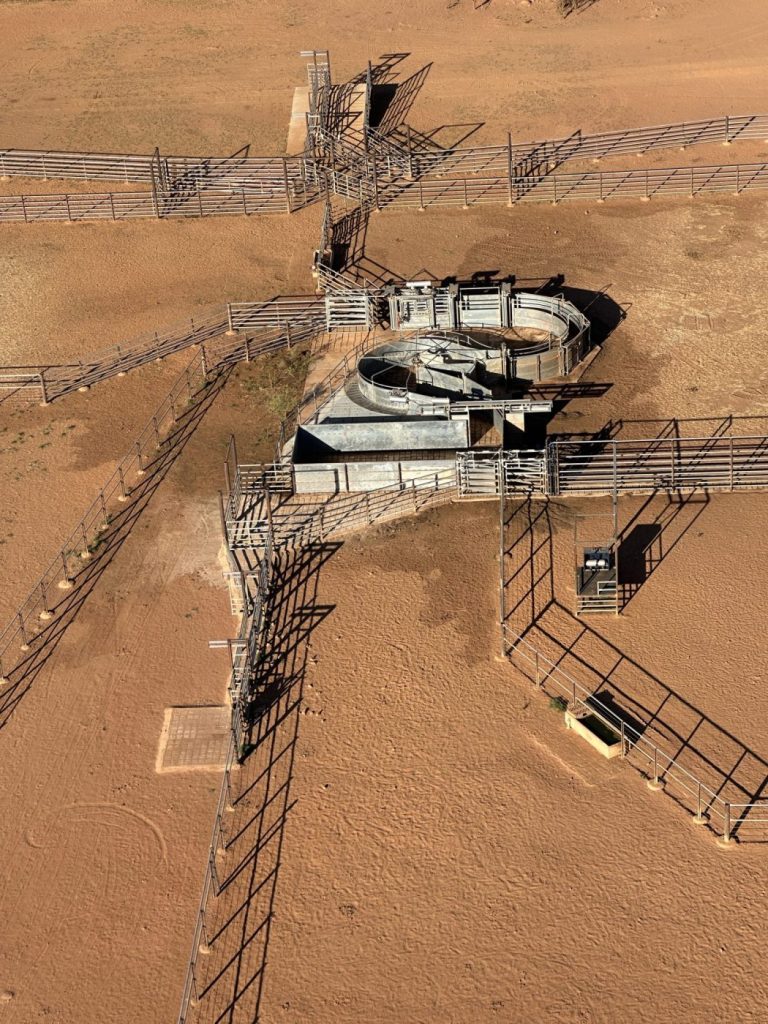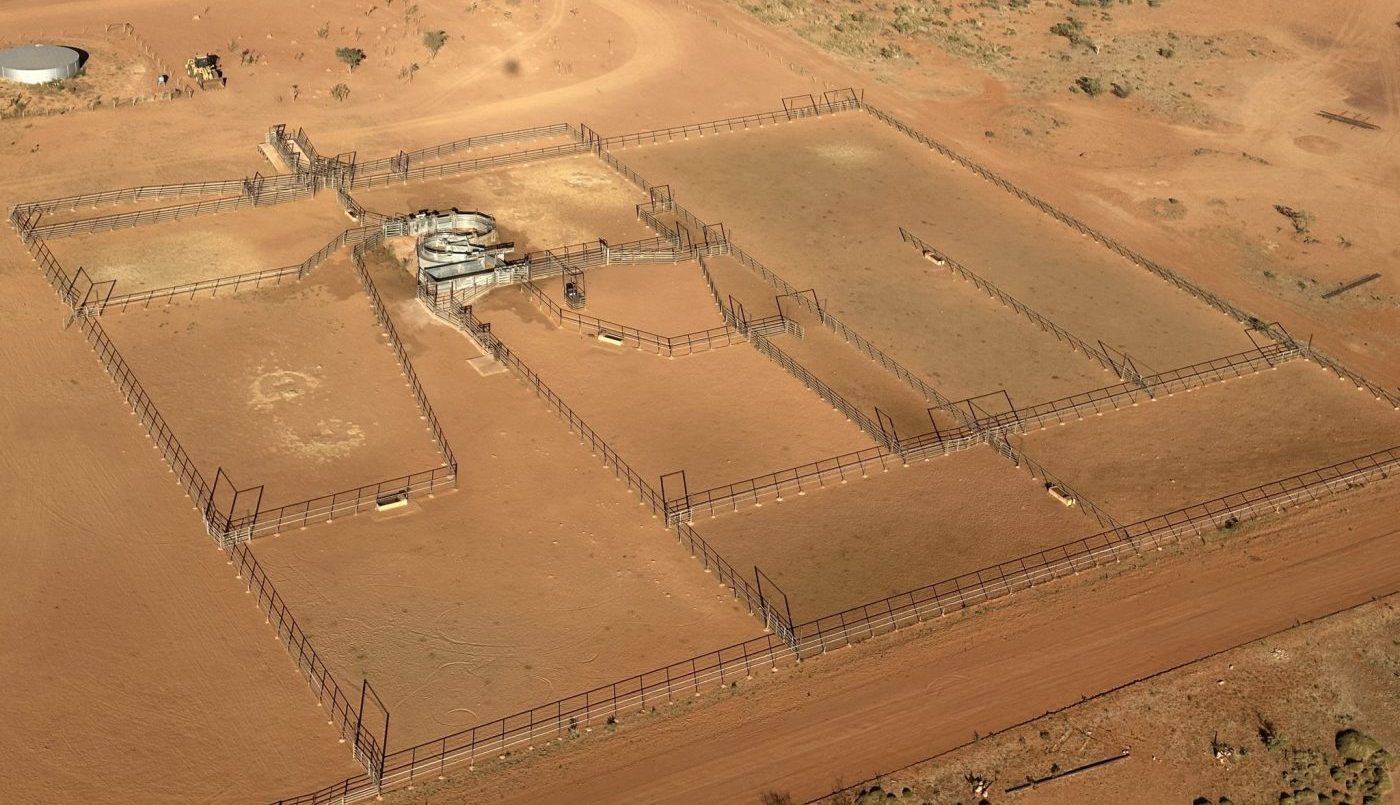
Kalyeeda yards taken from a chopper yesterday. Click on image for a larger view
A COMBINATION of safety, efficiency and longevity has driven a $900,000 investment into a new set of cattle yards on a well-known northern station.
The Camp family from Kalyeeda Station in Western Australia’s Kimberley region last year finished installing the yards on one of the property’s outer breeding paddocks – to handle breeding cattle and truck weaners back to processing yards at the homestead.
One of its main roles was to separate the loading of weaners onto a truck from the processing of cows and bulls in the crush. Peter Camp, who designed the yards, said the new set up allows them to process about 1000 breeders/day.
“We wanted to be able to truck weaners back to the homestead yards without interfering with the processing of the breeders,” Mr Camp said.
“In this day and age, a fair bit happens on the head bale with cattle needing to be scanned, body scored, lactation status and all that sort of stuff, which slows down the numbers you can put through in a day.”
Mr Camp said safety, efficiency and longevity were the priorities when designing the yards – with heavy duty steel across the whole set up, pneumatic gates through the crush area and all yards designed for minimal labour usage.
“This is something that is going to be there for 40 or 50 years with minimal maintenance. The idea is that you do them and do them properly,” he said.
“You can buy a lot of prefabricated yards and put them up, but rust can be an issue. So, when you use hefty steel like railway iron and bore casing it is going to be there for a long time.”
Mr Camp said he has had to re-train the staff for the new set-up.
“The biggest issue is getting people used to the pneumatic side, instead of physically opening and closing the gates,” Mr Camp said.
“Once they are used to it, they are pushing out 800-1000 breeders/day. The main limiting factor is how fast the head bale is.”
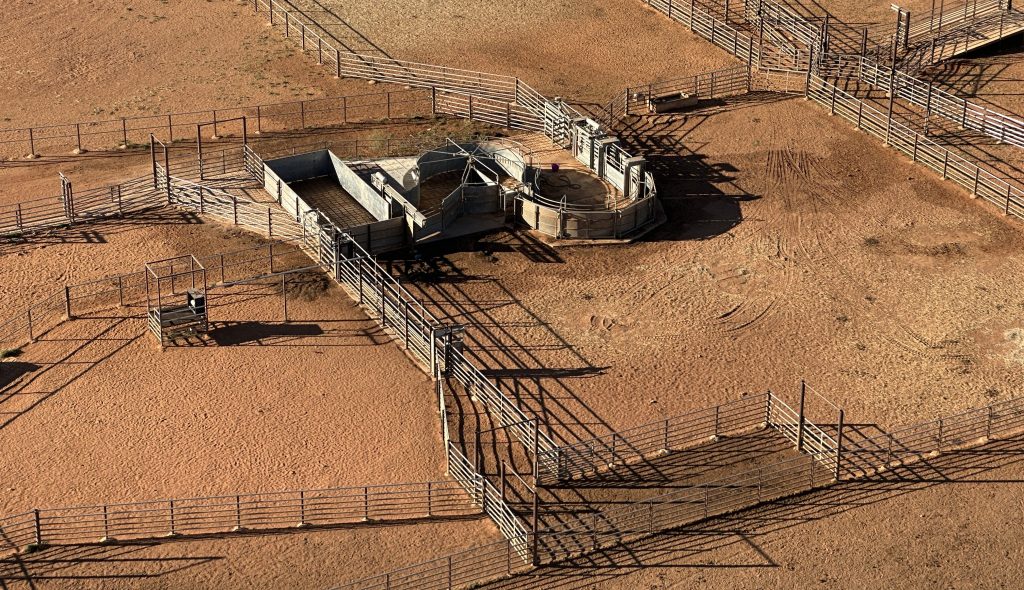
Bud Box design evident in this aerial photo taken yesterday for Beef Central
The cost breakdown
Mr Camp said labour made up about a third of the cost, the pneumatic gates and crush cost about $160,000 and the rest of the cost was steel.
“There is over $250,000 worth of labour in that yard,” he said.
“For the posts we used 45lb railway line and the corner posts and gate posts were all 7 inch bore casing. The rails themselves were specially made to length at 8.1m in Vietnam, so each piece of pipe was run to cater for three 2700mm panels.
“All our forces leading up to draft are all six rails and all the external yards are all top and belly rail with seven cables. I like cables because you can get plenty of air flow through the yard when it is warm in this climate and it is cost effective.
“We have a fair bit of steel leftover, but the majority of the cost was steel.”
Mr Camp said speaking to others in the area, the cost of building new yards had gone up since construction has finished at Kalyeeda.
“A couple of other properties in the West Kimberley area that are looking at building yards and they are doing their estimates above mine, they are looking at over $1m.”
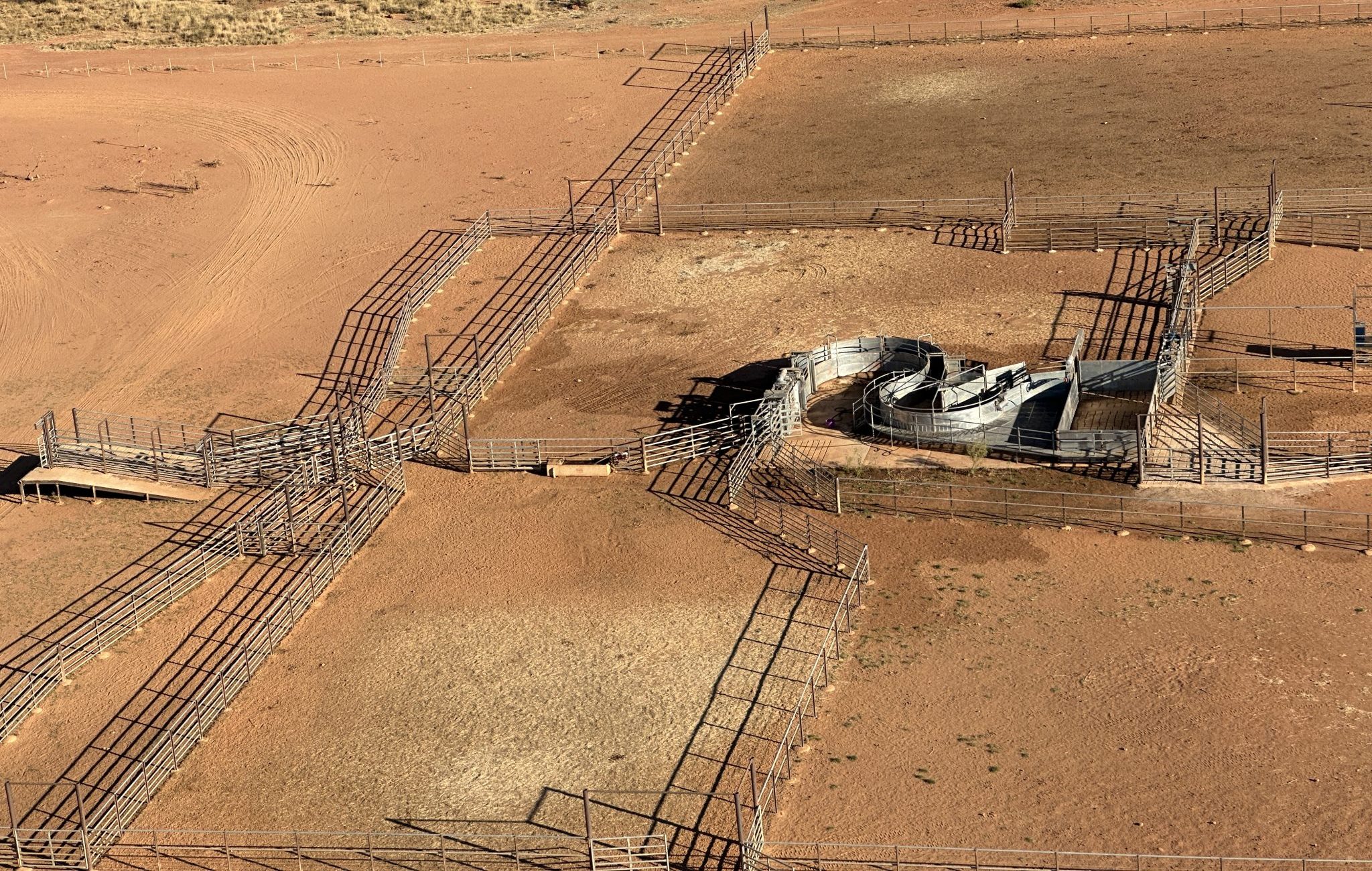
Reliance on the Bud Box principle
The yards are based on the Bud Box principle, which was developed by late American cattleman and low stress stock handling specialist Bud Williams. It runs on the theory that cattle will always want to return to where they came from when they are in confined spaces.
‘The box’ is a rectangular yard with specific dimensions (usually 6m x 3.5m or 20 feet x 12 feet), with a race coming off it at a right angle at the point of entry. When cattle are brought into the box, they seek to return to the point of entry as they reach the back of the box. The handler walks up one side of the box to encourage a single file movement into the race.
“I have been in the industry all my life, I have built a lot of yards, I have Googled a lot of yards, I was a contract yard builder at one stage, I have always taken an interest in that type of thing and we find the cattle run really well with this design,” Mr Camp said.
The boxes in the Kalyeeda yards are not built to the specific measurements prescribed for the Bud Box. However, it uses the Bud Box principles of cattle walking past the gate, then back through.
Outer yards contain big rectangular boxes to guide cattle as they move towards the five-way race draft and processing area.
After they move the race and draft, the cattle enter a big box with a sliding pneumatic gate at the entry before they go through a crowd tub, 180-degree race, onto the crush and into another draft which can be used for separating dry cows when preg-testing.
The loading ramp is a similar set up, with two yards running across the face of the loading ramp to a yard either side of the ramp, with weaners do a 90 degree turn and run up the truck.
“This ramp is pointing east, because in Northern Australia when they get loaded in the cooler months there is east or south-easterly breeze – so if the ramp is facing east they don’t have to run into too much dust,” he said.
“For cattle that have never been on a truck before, they just rattle straight up there and it works really well.”