
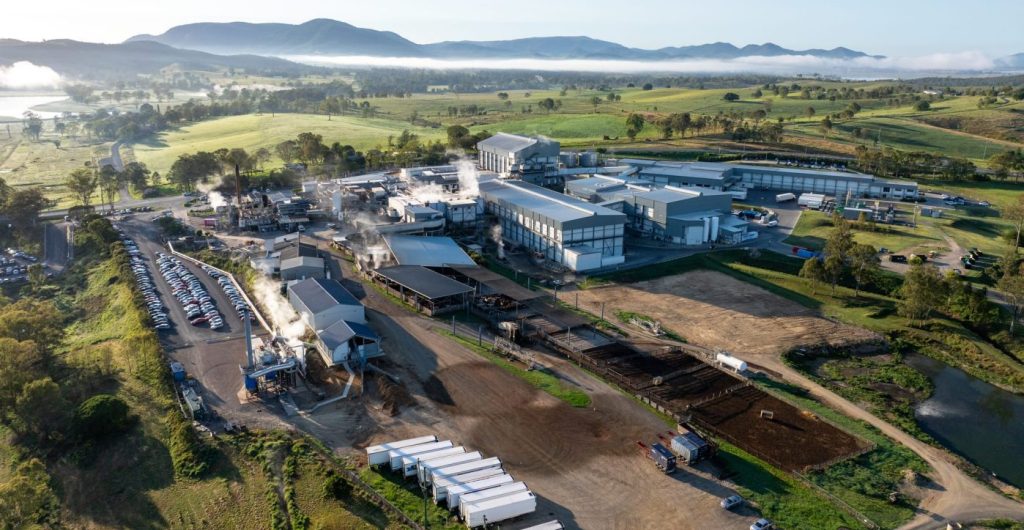
Kilcoy Global Foods processing facility north of Brisbane
A RESEARCH pilot project using digital twins and generative AI to identify, diagnose and resolve beef production issues in real time has delivered strong early results for Queensland beef processor Kilcoy Global Foods.
The collaborative project between KGF, RMIT University and Food Agility CRC, centres on enabling team members to make decisions by layering technology.
KGF’s Kilcoy facility in southern Queensland is a state-of-the-art grainfed beef processing site operating 24-7. The project pairs a series of digital twins with generative AI agents, that have access to additional data. These agents then make an informed decision and alert team members as required.
Wikipedia describes a ‘digital twin’ is a virtual, computer-based copy of a real-world object, system, or process. Unlike a standard model or static simulation, it connects to real sensors. It updates live using real data to show how the physical thing works right now
The layered technology provides early warning signs for anomalies, meaning potential issues can be addressed before they become critical.
The project is producing promising early results – particularly the judgement applied by the generative AI technology to determining which issues need immediate human oversight, and which can be watched and carried-over for the following day’s meeting.
Alert fatigue
However, detecting a problem is only half the challenge, and in a heavily instrumented processing plant, detecting everything can create a new problem entirely: alert fatigue.
The pilot project’s defining innovation is the judgement applied at this point. A generative AI agent captures and triages every detected issue, then decides what genuinely needs human oversight.
This allows messages to reach the floor team directly through the communication tools they use every day, and parks messages that can be raised with management the next day.
The result is that when the AI does interrupt someone, it matters, and the team’s trust in the system grows with every alert.
To make this possible, the research team developed a sophisticated approach to giving the AI genuine operational understanding. It can combine ontology, knowledge graph and retrieval-augmented generation techniques so that raw data signals arrive with the full context of the process, product and plant behind it.
Kilcoy Global Foods president Jiah Falcke said the human dimension was where the technology was proving itself.
“The digital twins are impressive – they can spot when something isn’t running the way it should, often before we can,” Mr Falcke said.
“But the real value is what happens next: the AI talks directly with our teams, in plain language they use every day and guides them straight to the fix. That’s what turns a clever detection system into faster resolutions and fewer repeat problems.”
Human centred design has been key to the project’s success, ensuring it’s a practical, effective and accurate system.
“Previously, anomalies and potential issues were either not picked up right away or noticed once it’s too late to make a material difference – this new technology reduces our blind spots and empowers our people,” Mr Falcke said.
RMIT University’s Professor Alireza Bab-Hadiashar highlighted the partnership model behind the result.
“This project has benefited enormously from having an industry partner that is actively engaged in the research process and deeply committed to the outcomes,” Prof Bab-Hadiashar said.
“Their willingness to contribute expertise, provide guidance, and work alongside the research team has enabled the development of solutions that are both scientifically rigorous and highly relevant to industry needs.”
Chief Scientist of Food Agility, Professor David Lamb, said the term, ‘Digital Twin’ was often misapplied in Agtech innovation.
“This pilot demonstrates in a practical way the power of Digital Twins when put in the hands of people in a real life and highly complex operational setting,” he said.
The pilot has been in research and learning phase for the past 18 months, with the team at
KGF is now seeing real benefits and considering how to move it into their enterprise-grade technology stack.
HAVE YOUR SAY