
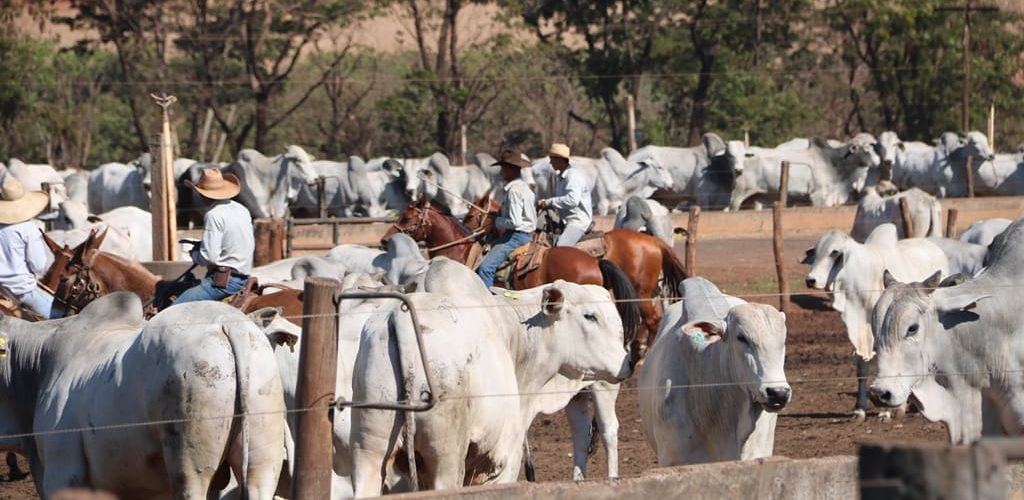
Nellore cattle on a ranch in Brazil
BRAZIL could lose at least US$1.3 billion worth of beef and livestock product sales to the United States in the second half of 2025, unless the nation can negotiate some relief from the additional 50 percent tariff threatened by Donald Trump.
That’s the estimate made by the Brazilian Meat Packers Association (ABRAFRIGO) this week.
However time is running out for Brazil to do a deal with Washington, with the new tariff due to start on 12 days time, from 1 August.
The impost of an additional 50pc tariff on imported Brazilian beef – on top of existing tariffs of 26.4pc under the MFN ‘Other Country’ quota within which Brazil operates – would take the tariff total for beef entering the US to a colossal 76.4pc.
Trade would be unviable under those terms, trade analysts inside and outside Brazil agree, meaning Brazil would have to divert to other export markets, principally China.
The US is now Brazil’s second largest beef export destination, after China. Calendar year to date, the US has imported 165,000 tonnes of Brazilian beef, up 85 percent on the same six-month period last year. In comparison, US imports from Australia so far this year are at 210,00t, up 32pc on last year.
An extra 50pc tariff on Brazilian beef would add another gaping hole in US beef supply during the back half of this year. The US tariff war with Brazil has big implications for Australian exports, with our beef shipment volume into the US this year already looking like topping 400,000t – among the highest volumes ever recorded.
While US domestic beef production is down dramatically this year due to drought impact on the national herd – now at its lowest level since the 1950s – it has become increasingly reliant on imported product out of Australia, Brazil, New Zealand and other suppliers.
Indignation
The Brazilian government on Tuesday sent a formal message to Washington expressing its “indignation” over the additional 50pc tariff imposed on Brazilian exports. At the same time, the letter signalled Brazil’s willingness to “engage in dialogue with US authorities and negotiate a mutually acceptable solution.”
Trump’s tariff hike could result in annual losses for the Brazilian beef industry of US$3 billion, the Brazilian Meatpacking Association said this week.
The association’s assessment was based on the performance of Brazilian beef and beef by-product exports to the US in the first half of this year, which totaled US$1.287 billion.
It estimated that the tariffs announced by Donald Trump could result in increases of 111pc to 384pc in the value of taxes paid per ton on imported Brazilian items, which would make sales to the US unviable and result in losses to Brazil’s trade balance.
ABRAFRIGO’s calculations suggested shipments of frozen boneless beef (149,400t worth US$737.8m), beef tallow (230,200t worth and US$248.7 million), value-added and corned beef or canned meat (23,400t worth US$239m), fresh or chilled boneless beef (7000t worth US$53m), salted, dried or smoked beef (1200t worth US$7.7 million), tripe, and tails.
Total revenue was almost double that of the same period in 2024, and shipped volume grew 85pc.
Association president Paulo Mustefaga said the threatened US tariff would affect a much broader basket of products, not just beef itself. There was a particular concern for beef tallow, where shipments to the US represented almost 100pc of Brazil’s exports of the commodity.
To calculate the total impact, ABRAFRIGO considered the average export price of these items, volumes, and revenues obtained in the last six months, and simulated the application of additional 50pc tariffs for the remainder of 2025 and subsequent years.
For fresh, chilled or frozen boneless meat, ABRAFRIGO reported that Brazil participates in a quota of 65,800 tons distributed among several countries. In the first half of 2025 alone, however, Brazilian meatpackers shipped a volume equivalent to 2.5 times the total quota, with almost 150,000 tons, which shows that most of them pay an extra-quota tariff.
For preserved meat and tallow, there is no tariff quota. Frozen boneless Brazilian meat exported to the US currently pays an extra-quota tariff of US$1780/t, representing 36pc of average FOB prices, the association said.
With the additional 50pc tariff, the amount would increase to US$3750/t of import tax, an increase of 111pc. The final tariff would be equivalent to 76pc of the cargo price, which would make trade unviable.
In the case of rendered beef tallow, the tariff would increase from US$151/t to US$583/t, an increase of 286pc. This amount would represent 54pc of average prices.
According to Mr Mustefaga, “The US importer is the one paying this tariff. They can’t afford to sell Brazilian frozen meat with 76pc of its value in taxes, which would have to be passed on to consumers.”
As a result, some American importers have already asked Brazilian meatpacking plants to suspend production, the association said. Almost 60 Brazilian establishments are currently authorised to export beef and beef products to the US.
So far this year, the US has accounted for 15pc of Brazil’s revenue from exports of frozen, chilled, or canned boneless meat. Regarding tallow, the US accounted for 99.6pc of export revenue.
In Mr Mustefaga’s view, the unviability of sales to the US could affect other markets where the US has influence, such as Mexico and Canada.
“The losses could be even greater,” he said.
He participated in a meeting with the Brazilian government and other export chains on Tuesday, saying he trusted vice president Geraldo Alckmin’s ability to lead the process and successfully reverse the tariff.