
A plant-based advocacy group’s survey claiming most Americans are buying less beef due to high prices is contradicted by retail data showing beef sales have actually risen sharply despite price increases. Image: Shutterstock
A SURVEY suggesting that a majority of American shoppers are cutting back on beef due to higher prices is at odds with actual retail data showing sustained – and in fact rising – beef sales across the US market.
The survey, conducted by online research firm Morning Consult in partnership with the Physicians Committee for Responsible Medicine (PCRM), a group which promotes plant-based diets according to its website, reported that 60 percent of American consumers say they are buying less beef or avoiding it altogether because of higher prices.
If prices rise further, 72 percent said they would consider reducing their purchases.
 However, US retail beef sales data provided to Beef Central this week from the National Cattlemen’s Beef Association (NCBA), a contractor to the Beef Checkoff, paints a very different picture.
For the year ending the first week of September 2025, beef sales were up by double digits compared with the same period a year earlier.
Sales of chicken and pork also rose, by 6.5 percent and 3.3 percent respectively.
In contrast, sales of meat alternatives continued to decline, down by double digits year-on-year.
 The double-digit growth rise in beef sales has occurred in a year in which retail beef prices have increased by six percent year-on-year.
The combination of higher prices and stronger sales highlights what economists describe as
“inelastic demand”, which occurs when consumer purchasing behaviour remains steady, or even strengthens, despite price increases.
“Facing economic headwinds, consumers recognize the power of animal proteins as good value for their money, more than 20 points higher than meat alternatives,” the NCBA analysis also revealed.
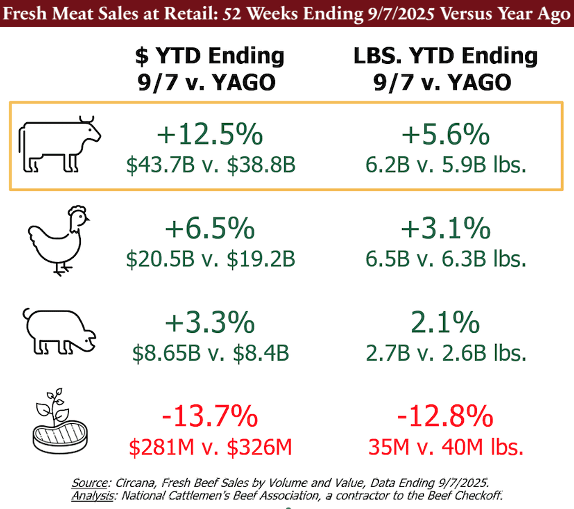
Beef sales are up across key metrics – value (prices x price/pound) as well as pounds sold. Data courtesy of NCBA.
A media release reporting the results of the PCRM survey said the highest percentage of meat avoidance was reported to be from respondents in the Gen Z demographic (born between 1997 to 2012), 52 percent of whom said they would consider plant-based proteins instead of beef.
There was lower interest in doing so among millennials (1981-1996) and baby boomers (1946 to 1964). (No reference was made in the online release about responses from Gen X (1965 to 1981).
However, Beef Checkoff data showed that 70 percent of Gen Z’s ae consuming beef once ore more per week – the highest level of consumption going back to 2018.