
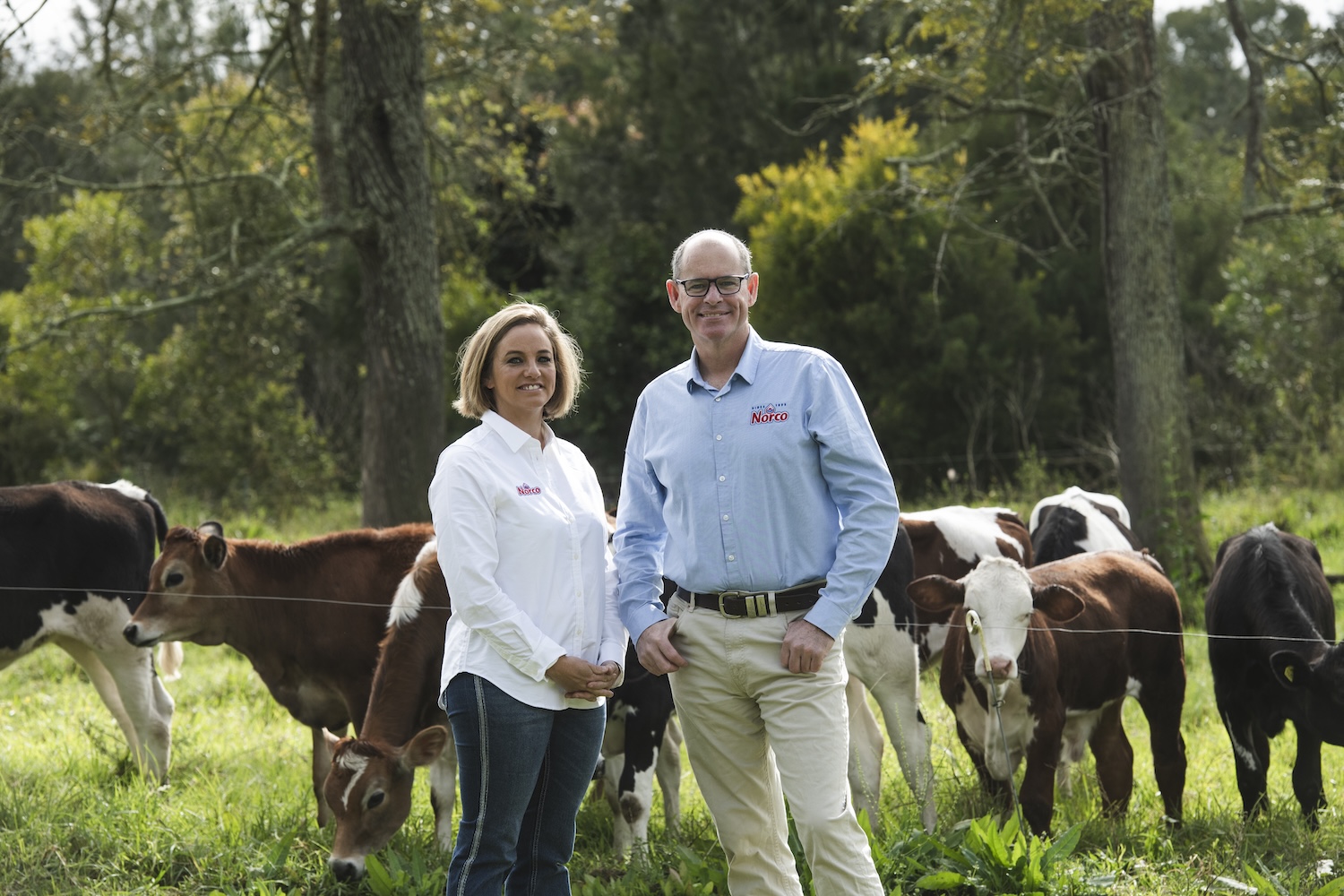
Norco Farmer Wellbeing report. Dairy farmer Jane Polson and Norco CEO Michael Hampson.
AS increased fuel, fertiliser and freight costs continue to place mounting pressure on Australian agriculture – alongside repeated natural disasters and growing global instability – a new report has revealed the escalating human toll facing the farmers behind Australia’s food supply.
New findings from the 2026 Norco National Farmer Wellbeing Report*, in partnership with the Black Dog Institute, show farmers are experiencing sustained levels of stress, anxiety and emotional exhaustion, with many now questioning their future in the industry.
The findings point to a worsening mental health landscape across Australian agriculture, with several major indicators increasing over the past three years.
More than half of farmers (54 percent) report feeling depressed or down in the past two years, almost a quarter (24pc) often or always feeling anxious, and one in three farmers (33pc) say their mental health has deteriorated over the past 12 months.
The report also suggests mental health is now emerging as one of the most significant health challenges facing the sector, with farmers almost twice as likely to report poor mental health as poor physical health (19pc vs 10pc).
One in seven farmers (15pc) reported thoughts of self-harm or suicide over the past two years – a rate substantially higher than that seen in the general Australian population.
Notably, the research was conducted before the recent surge in global uncertainty and renewed input cost pressures impacting Australian agriculture, suggesting many farmers are now operating in an even more challenging environment.
As conditions worsen, two in five farmers (41pc) say they have considered leaving the industry.
Norco Chief Executive Officer Michael Hampson said the findings highlight the sheer scale of the pressures facing Australian farmers today, and the broader implications for the future sustainability of the sector.
“Our 2023 Farmer Wellbeing Report shone a confronting light on the challenges facing Australian farmers, but these latest findings show those pressures have certainly not eased,” Hampson said.
“Over recent years we’ve seen repeated natural disasters, rising operating costs and global instability all converge at once, and this report shows that the human impact is becoming increasingly severe.
“Farmers produce around 90% of the food consumed in Australia, yet many are now reconsidering their future in the industry. That has significant implications not only for farming families and regional communities, but for Australia’s long-term food security.”
Black Dog Institute Executive Director and Chief Scientist Professor Samuel Harvey said the findings reveal the scale and complexity of the challenges facing Australia’s farming communities.
“The specific intersection of occupational, social, cultural and environmental stressors experienced by farmers has created a large and growing mental health crisis within Australia’s farming communities,” Professor Harvey said.
“Three years on from the first National Farmer Wellbeing Report, the continued scale of distress and unmet mental health care needs across the agricultural sector is deeply concerning. The results show we now have a situation that cannot be ignored.”
The reality behind the statistics: farmers pushed beyond the farm gate
Jane Polson, a Norco dairy farmer from Oxley Island, New South Wales, said the findings reflect the growing strain many farmers are experiencing behind the scenes.
 “People see natural disasters, fuel shortages or rising prices in the headlines, but what they don’t always see is the emotional and financial toll farmers are carrying every single day,” Ms Polson said.
“The ongoing uncertainty across so many areas is very real, and unfortunately those pressures don’t switch off when the workday ends.
“Farming is not just a job for most people, it’s a way of life for families, and one that’s often built over generations. But many farmers are exhausted and carrying the weight of navigating these increasingly difficult circumstances.”
Compounding these challenges, more than a quarter of farmers (27pc) say their farms have operated at a loss over the past three years, and of those, three in four (75pc) say this has negatively affected their mental health.
To remain financially viable, nearly six in ten farmers (59pc) are now relying on off-farm work or secondary occupations, with close to one in five (17pc) working an additional 30 hours or more each week – almost equivalent to a second full-time job.
The result is widespread fatigue and burnout, with almost one in four (23pc) saying they often struggle to cope with the demands of farming.
Farmer exodus puts industry at risk
The report suggests many Australian farmers feel increasingly invisible in the very system they help sustain.
More than nine in ten farmers (91pc) believe the role they play is undervalued by the Australian public, while more than one in four (27pc) are no longer optimistic about the future of farming in Australia.
Most farmers (79pc) come from multi-generational farming families, yet many have no clear succession plans in place, raising questions about who will produce Australia’s food in the generations ahead.
Mr Hampson said the findings should serve as a wake-up call for industry, government and the broader community, reinforcing that farmer wellbeing can no longer be viewed in isolation.
“In an increasingly uncertain global environment, maintaining strong local food production and sovereign capability has never been more important, and farmer wellbeing must now be recognised as a critical food security issue requiring coordinated action.
“The fact that 94pc of farmers believe Australia’s long-term food security depends on stronger support for farmers and regional communities sends a powerful message about the scale of concern across the sector.
“If we lose farmers, we lose far more than individual farms; we risk losing regional communities, local industries and ultimately Australia’s ability to sustain its own food production.
“Forty years ago, few could have imagined Australia would no longer have a car manufacturing sector, but history shows industries can disappear when long-term challenges are left unaddressed.
“That’s why it is critical we continue investing in the sustainability and resilience of Australian agriculture and the people behind it, because we simply cannot afford to take our farming sector for granted.”
Professor Harvey said that while the findings are confronting, the report also provides a clear path forward.
“We need to equip regional communities to better support each other and ensure farmers can access timely, high-quality professional mental health care when they need it, no matter where they live.
“But we also need to recognise the power policymakers have to improve farmer wellbeing through better responses to the economic and climate challenges they face. Mental health support is critical, but so too is addressing the underlying pressures that are driving distress in the first place.”
To download the full National Farmer Wellbeing Report click here.
If you or anyone you know needs help:
• Lifeline on 13 11 14
• Beyond Blue on 1300 224 636
• Suicide Call Back Service on 1300 659 467
• MensLine Australia on 1300 789 978
• Head Space on 1800 650 890
• Rural Aid Counselling on 1300 175 594
- Research was conducted by Pure Profile on behalf of Norco between October 2025 and March 2026. The research surveyed 1,017 Australian farmers aged 18+ with representation from all states and territories across Australia, as well as a cross section of farming sectors
HAVE YOUR SAY