TWO successful family-scale Wagyu beef supply chains are in the running for this year’s Premier of Queensland’s Export awards.
Finalists in the 2025 Agribusiness, Food & Beverage category this year include Elbow Valley Beef out of Warwick in the state’s southeast, and King River Wagyu out of Central Queensland.
King River is also a finalist in the Regional Exporter division.
The awards received a record 103 entries this year, with 46 announced as finalists in 14 business categories. Winners will be announced in Brisbane on 10 October, progressing to the National Exporter awards next year.
Here’s some background on this year’s finalists:
Elbow Valley Beef
Elbow Valley Beef is operated by founder Chris Shaw and family out of the Canning Downs South feedlot and grazing property in the Elbow Valley near Warwick on Queensland’s southern Darling Downs.
 The business produces and exports beef under the Sir Harry beef brand, named after the famous Sir Harry Chauvel who lived in the same homestead occupied by the Shaw family today.
Over time other properties in Queensland and New South Wales totalling 4000ha have been added to support the business through backgrounding, breeding and cropping operations.
Elbow Valley Beef’s integrated cattle production and feeding headquarters has been a pastoral property for more than 180 years.
The property was purchased by the Shaw family in 1998. In 2004, construction of the feedlot began, and a 999 head feedlot license was approved in 2005 used to feed for export and domestic markets. Ten years later, the feedlot was expanded to 2500 head, followed in 2019 with an increase to 9400 head capacity and a refocus on producing and feeding Wagyu and Wagyu x Angus cattle. Fullblood, Purebred and F4 Wagyu lines now dominate the feeding pens.
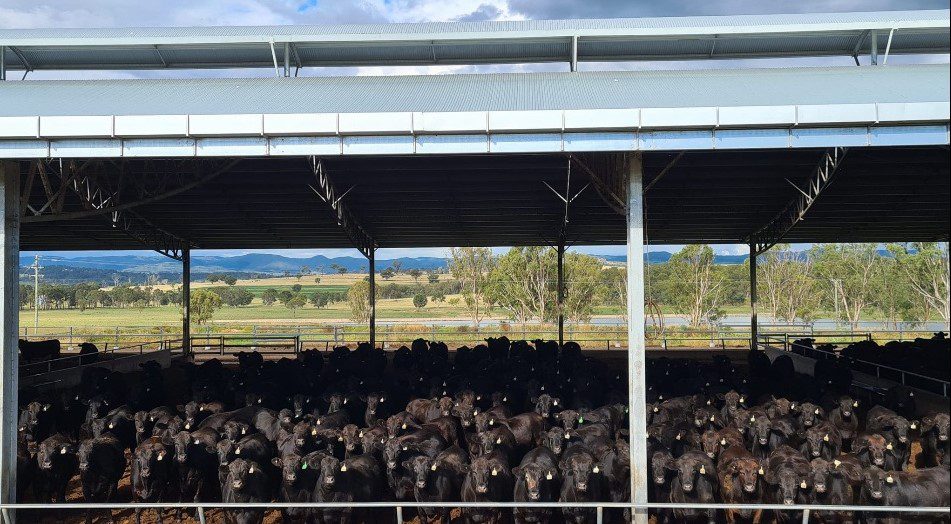
Wagyu cattle on feed under the Entegra shed system at the Canning Downs South feedlot
While rations fed are based on locally-grown wheat, barley and corn, citrus pulp sourced as a by product from local food manufacturing is included.
“The inclusion of citrus pulp changes the final product,” Chris Shaw said. “We notice improved palatability for the cattle and less feed required overall. Meanwhile our customers say they can taste a delicate orange tone in the meat,” he said.
Lab testing of citrus pulp rationing in cattle feedlots has shown a doubling or tripling of lipophilic antioxidants including α-tocopherol, an important E-vitamin and antioxidant in cattle and humans. Put simply, meat is protected from lipid (fat) oxidation – so it stays a brighter colour for longer, the Shaws suggest.
Focus on shedding
One of the defining features of the feedlot is the use of permanent shedding structures over all pens.
The first housing shed was completed in 2019, with another three sheds constructed including an industry-first 480me-long structure through to 2021. The fifth shed was completed in the first half of 2024 and the sixth and final shed was completed early this year.
 “Quality, coupled with best-in-class animal welfare and minimised environmental impacts means we are now committed to a 100pc shed system as we continue to grow,” Chris Shaw said. “We have been encouraged by positive customer feedback on the improvements in meat quality. “The sheds have proven to be an integral investment for us, positively shaping the quality of meat we are producing today.”
The concave curved roof lines of the sheds pull warm, moist air up and away from the cattle, with the ‘chimney effect’ increasing air exchanges by at least 20pc per hour compared to traditional barns, the Shaw family says. At the same time a flow of cool dry air is brought in at ground level.
Beneath the shedding deep-litter soft sawdust compost pads are used, which when well managed, means zero odour. The bedding is routinely top-dressed with fresh shavings and the roof stops rain from destroying the deep sawdust layer.
Inoculating sawdust with an organic probiotic helps keep the surface clean and odour-free. The end result is a stable and valuable compost.
Once spent, the compost goes back into the surrounding paddocks to grow feed for cattle again.
Captured rainfall from the feedlot’s roofing system reduces water taken from the environment.
“Since we built our sheds we use less of our water allocation per unit of production – leaving more in the Murray-Darling Basin for the environment,” Mr Shaw said. “So when it rains here it’s no big deal. Our cattle are left clean and dry and our fresh water dams fill up for drier days.”
King River Wagyu
This year’s second Exporter of the Year finalist from the beef industry is King River Wagyu, which won the regional exporter category last year.
One of the nation’s youngest vertically-integrated Wagyu beef supply chains, King River Wagyu was launched as an export entity less than four years ago.
 The business was established by the Rich and Kemp families, both with deep connections and history in the northern cattle industry. It is built around a network of five grazing properties across north, northwest and Central Queensland covering some 242,000ha, plus the Kemp family’s Lotus Park feedlot near Sarina, south of Mackay.
The breeding and backgrounding holdings include Carmelong station near Marlborough, Eight Mile Station in the Burdekin, Strath Park near Julia Creek, Mt Ravenswood Station in the Upper Burdekin and Lotus Park.
The 10,000 head capacity Lotus Park feedlot has been operated by the Kemp family for 40 years. It started feeding small numbers of Wagyu in 2017, but numbers have grown substantially since then.
The Rich family started dabbling in Wagyu breeding around 2015.
While still feeding some conventional 100-day cattle sold into established exporter grainfed programs, the Lotus Park feedlot’s inventory is gradually transitioning into more longfed Wagyu cattle under the King River program.
The establishment of the King River Wagyu export venture brought together both families’ skill-sets and resources. While both the Kemp family’s Lotus Park business and the Rich family’s cattle business had produced beef from conventional breeds for decades, neither had ventured into the export space prior to the establishment of the King River Wagyu venture.
In addition to cattle bred and grown by the Kemp and Rich families themselves, five other substantial central/North Queensland Wagyu breeders also supply feeder cattle into the King River program, building a strong provenance story.
Finished Wagyu cattle are processed at the John Dee export plant near Warwick, and Northern Cooperative Meat Co at Casino, recently re-approved for China. Prodruct is packed under two brands – King River and the premium marbling brand, Jewel.
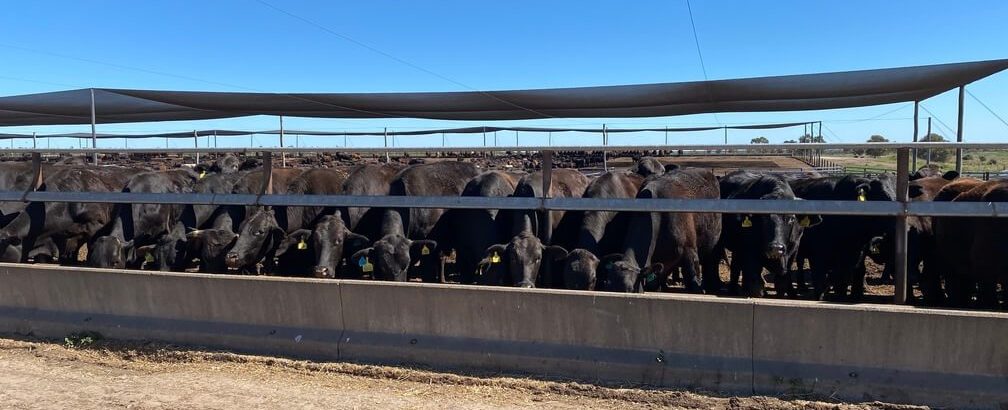
King River Wagyu cattle on feed in the Lotus Park feedlot
Exports to 40 countries
In what has been a dramatic rise in less than three years, King River now exports Wagyu beef into 40 countries around the world through a series of partners and distributor networks, with the European Union being the biggest destination by volume, followed by China and South Korea.
The United States is seen as a key target, given the current US cattle industry cycle.
In-country distribution networks delivering to restaurants, food services and stores play a key role.
The company did its first export consignment under its own license in January 2022, having worked through another export license-holder for 12 months prior to that.
From the outset of the brand program, King River had aimed to build long-term partner and customer relationships, now represented on three continents.
The business aims to customise orders for each international customers’ precise needs, maximising versatility of every beef carcase, adding profitability and sustainability.
The branded beef program operates just two streams – one for Purebred Wagyu 93.75pc content and higher, and an F2-F3 program for cattle carrying 75pc content or higher.
“We’re very big on not being a house of brands,” Josh Rich said. “We’d rather be a branded house.”